
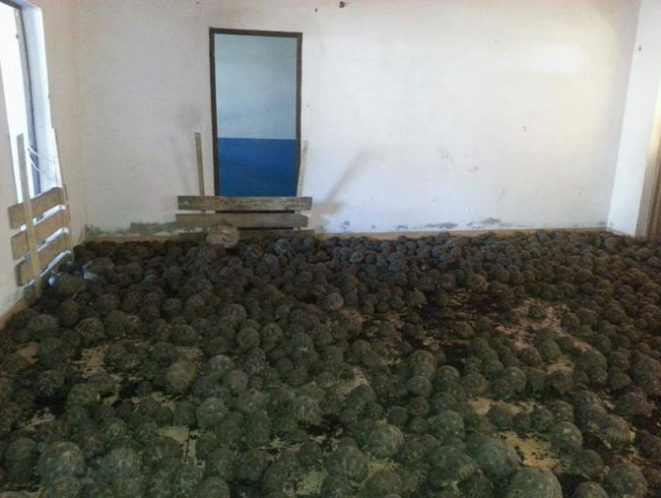
She arrived at a scene unlike any she’d seen before in her role as a regional head of Madagascar’s environmental agency: thousands of tortoises of varying sizes covering the floors, jammed up against one another with no room to move.
Randrianjafizanaka said the stench of feaces and urine was overwhelming.
You cannot imagine. It was so awful, she said. They had tortoises in the bathroom, in the kitchen, everywhere in the house.
In total the house contained 9,888 live radiated tortoises, a rare species found only in Madagascar—and 180 dead ones.
Randrianjafizanaka helped count them as rescuers loaded them onto six trucks that made several trips to Le Village Des Tortues (Turtle Village in French), a private wildlife rehabilitation facility in Ifaty, 18 miles north of Toliara.
It took until early the following morning to transfer all the tortoises to the rescue center.
The vast majority of the animals are alive and doing relatively well, according to Na Aina Tiana Rakotoarisoa, a veterinarian who’s taking care of them.
But a week after their discovery, 574 tortoises had died from either dehydration or infection.
Authorities have leads on those responsible. Three suspects—two men and a woman, the owner of the house—were arrested. According to Randrianjafizanaka, the men were in the process of burying dead tortoises on the property when her team arrived.
Rick Hudson, president of the U.S.-based Turtle Survival Alliance, which has been helping with the rescue efforts, believes that the small and mid-size tortoises—easier to conceal than the big ones, which can weigh 35 pounds with shells 16 inches across—would have been smuggled out of the country.
Randrianjafizanaka thinks the sheer number of tortoises indicates an organized effort. We don’t know exactly who the big person is, but we know there’s a big boss, she said.
Taking radiated tortoises from the forests is illegal in Madagascar, and a treaty signed by 182 countries and the European Union bans commercial trade of the species.
Nonetheless the animals are increasingly targeted by poachers, who either sell them locally as bush meat or smuggle them live to Southeast Asia or China, where they’re sold to reptile collectors.
Radiated tortoises are especially prized because of the intricate yellow star patterns on their upper shells.
Forest loss has also taken a toll on the population of radiated tortoises. A 2013 estimate put their numbers at six million, down from 12 million in the 1990s.
Today the population is likely closer to three million, Hudson said. In 2008 the International Union for the Conservation of Nature, which assesses the conservation status of animals in the wild, changed their designation from of least concern to critically endangered a rare, four-category jump that puts them one step away from extinct.
Hudson said he was shocked by the scale of the seizure. But he also found it totally believable that so many tortoises would be snatched from the wild. They’re being harvested at what I’d call an alarming, catastrophic rate, he said.
Wildlife poaching intensified in Madagascar after 2009, when a political coup sent the country into a downward economic spiral that weakened environmental protection efforts.
In recent years seizures of radiated tortoises—as well as of ploughshare tortoises, also native to Madagascar and even rarer—have become routine.
In 2015 authorities confiscated 453 live radiated tortoises from Madagascar’s Ivato International Airport, for example, and 316 were seized in southeast China in 2016 as part of a scheme involving an airport employee who snuck them to his apartment after they arrived from Madagascar.
It’s unlikely that the 10,000 tortoises will be released into the wild anytime soon, according to Jordan Gray, communications and outreach coordinator for the Turtle Survival Alliance.
Rampant poaching, he said, means that keeping them in captivity is their best chance for survival.
Tourism Observer


