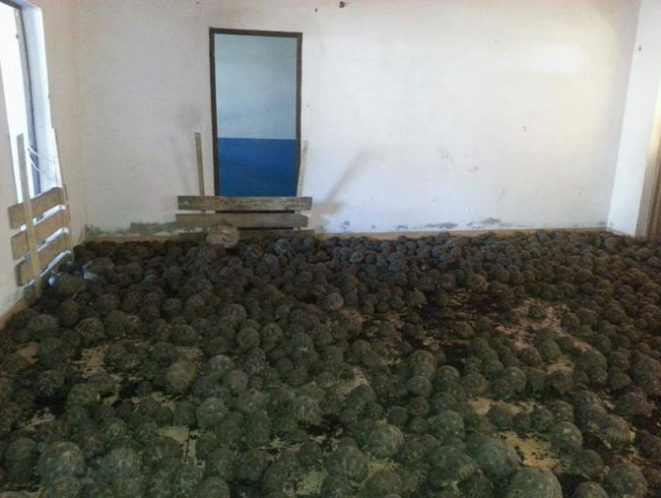
Soary Randrianjafizanaka set out with police, colleagues, and others earlier this month to investigate a rancid smell coming from a two-story house in Toliara, a town on the southwestern coast of Madagascar.
She arrived at a scene unlike any she’d seen before in her role as a regional head of Madagascar’s environmental agency: thousands of tortoises of varying sizes covering the floors, jammed up against one another with no room to move.
Randrianjafizanaka said the stench of feaces and urine was overwhelming.
You cannot imagine. It was so awful, she said. They had tortoises in the bathroom, in the kitchen, everywhere in the house.
In total the house contained 9,888 live radiated tortoises, a rare species found only in Madagascar—and 180 dead ones.
Randrianjafizanaka helped count them as rescuers loaded them onto six trucks that made several trips to Le Village Des Tortues (Turtle Village in French), a private wildlife rehabilitation facility in Ifaty, 18 miles north of Toliara.
It took until early the following morning to transfer all the tortoises to the rescue center.
The vast majority of the animals are alive and doing relatively well, according to Na Aina Tiana Rakotoarisoa, a veterinarian who’s taking care of them.
But a week after their discovery, 574 tortoises had died from either dehydration or infection.
Authorities have leads on those responsible. Three suspects—two men and a woman, the owner of the house—were arrested. According to Randrianjafizanaka, the men were in the process of burying dead tortoises on the property when her team arrived.
Rick Hudson, president of the U.S.-based Turtle Survival Alliance, which has been helping with the rescue efforts, believes that the small and mid-size tortoises—easier to conceal than the big ones, which can weigh 35 pounds with shells 16 inches across—would have been smuggled out of the country.
Randrianjafizanaka thinks the sheer number of tortoises indicates an organized effort. We don’t know exactly who the big person is, but we know there’s a big boss, she said.
Taking radiated tortoises from the forests is illegal in Madagascar, and a treaty signed by 182 countries and the European Union bans commercial trade of the species.
Nonetheless the animals are increasingly targeted by poachers, who either sell them locally as bush meat or smuggle them live to Southeast Asia or China, where they’re sold to reptile collectors.
Radiated tortoises are especially prized because of the intricate yellow star patterns on their upper shells.
Forest loss has also taken a toll on the population of radiated tortoises. A 2013 estimate put their numbers at six million, down from 12 million in the 1990s.
Today the population is likely closer to three million, Hudson said. In 2008 the International Union for the Conservation of Nature, which assesses the conservation status of animals in the wild, changed their designation from of least concern to critically endangered a rare, four-category jump that puts them one step away from extinct.
Hudson said he was shocked by the scale of the seizure. But he also found it totally believable that so many tortoises would be snatched from the wild. They’re being harvested at what I’d call an alarming, catastrophic rate, he said.
Wildlife poaching intensified in Madagascar after 2009, when a political coup sent the country into a downward economic spiral that weakened environmental protection efforts.
In recent years seizures of radiated tortoises—as well as of ploughshare tortoises, also native to Madagascar and even rarer—have become routine.
In 2015 authorities confiscated 453 live radiated tortoises from Madagascar’s Ivato International Airport, for example, and 316 were seized in southeast China in 2016 as part of a scheme involving an airport employee who snuck them to his apartment after they arrived from Madagascar.
It’s unlikely that the 10,000 tortoises will be released into the wild anytime soon, according to Jordan Gray, communications and outreach coordinator for the Turtle Survival Alliance.
Rampant poaching, he said, means that keeping them in captivity is their best chance for survival.
Tourism Observer
Showing posts with label Ivato International Airport. Show all posts
Thursday, 30 August 2018
Tuesday, 5 June 2018
MADAGASCAR: Air Austral And Air Madagascar In Codeshare Deal
The new Air Austral and Air Madagascar strategic partnership is being seen as a move for a new force in the Indian Ocean.
It was on the 30th November of last year that Air Austral entered into a partnership with Air Madagascar with 409% shares.
In the arena when competition has been intensifying on the run Paris - La Reunion, Air Austral has been developing a strategy of diversification to be better positioned as the leader on the Indian Ocean Route.
With this partnership Air Austral is planning to reinforce its regional network with added services to new Madagascar airports and will be able to offer a more comprehensive network in the Indian Ocean with flights programmed to Mauritius, Seychelles, Mayotte over and above Madagascar.
Congratulations to Air Austral and Air Madagascar in this consolidation of resources.
The Indian Ocean Vanilla Islands is in need of better air connectivity to be able to continue the development of two or three island holiday packages for key tourism source markets.
Air Austral is a French airline with its headquarters at Roland Garros Airport in Sainte-Marie, Reunion, France.
The airline's main base of flight operations is Roland Garros Airport.
It operates scheduled services from Reunion to metropolitan France, South Africa, Thailand, India and a number of destinations in the Indian Ocean. The company has 900 employees.
Air Austral was created in December 1974 by local businessman Gerard Etheve. It was Reunion's first commercial airline, known as Reunion Air Services (RAS).
By August 1977 RAS had started regional services from Sainte-Marie to Mayotte with a 32-seat Hawker Siddeley HS 748 turboprop.
RAS became Air Reunion in December, 1986.
In October 1990 Sematra, a company 46% owned by the local councils of Reunion with the remaining shares owned by banks and other private partners, purchased Air Reunion. A month later, Air Reunion became Air Austral.
Two months later, Air Austral bought its first Boeing 737-500. Another 737-300 was acquired in 1994, and in 1997 the airline purchased a 737-300QC, which enabled both passenger and cargo only traffic.
In 2000 the airline took delivery of an ATR 72-500, a short-haul turboprop.
By then, Air Austral operated from both Roland Garros Airport in Sainte-Marie and Pierrefonds Airport in Saint Pierre with scheduled services to Mayotte, Johannesburg, South Africa, Comoros, Mauritius, the Seychelles, and three destinations in Madagascar Antananarivo, Tamatave, Nosy Be, Majunga.
In 2003, Air Austral launched its first long-haul service between Reunion and Paris, with two Boeing 777-200ERs.
The two Boeing 777s were joined by a third Boeing 777-200ER in 2005. A second long-haul route from Reunion to Marseille and Lyon was established.
In 2007, a third long-haul service to Toulouse via Marseille started. In 2008, the airline introduced new uniforms for staff and crew members, designed by Balenciaga.
The second ATR 72-500 was added to the fleet, followed by a third a few months later. In April 2009, Air Austral started a new service to Sydney and New Caledonia, thus opening up a new route between Paris and Sydney via Reunion.
The airline also acquired two Boeing 777-300ERs. In November, it placed a firm order for two all-economy class 840-seat Airbus A380s, for delivery in 2014.
These are intended for Air Austral's Reunion-Paris flights. In June 2010, it was announced that Air Austral would start scheduled flights from Reunion to Bordeaux and Nantes from February 2011.
In August 2011, Air Austral received its first Boeing 777-200LR. In April 2012, founder and chief executive Gerard Etheve was replaced by Marie-Joseph Male following financial difficulties caused by risky business decisions made worse by high fuel prices.
Non-profitable lines to Noumea, Sydney, Marseille, Bordeaux, Nantes, Toulouse and Lyon were closed.
The company has since returned to profit. Also in April 2012, Air Austral was unable to pay for a new 777-200LR awaiting delivery.
The company was looking to sell on the plane instead of taking delivery. Following this development, Air Austral announced in May 2012 that it would defer or cancel its order for 2 Airbus A380s, with a decision to be made by the end of June 2012.
In June 2013, Air Austral introduced direct flights to Chennai, India with its new Boeing 737-800s.
In February 2015, the company announced an order for two Boeing 787-8s, to be delivered in May and October 2016 respectively.
In March 2015, it also announced the lease of 2 more B777-300ER from Air Lease Corporation (ALC). These aircraft, delivered in late 2016, replaced the oldest two models of the same type then operated by Air Austral.
In October 2015, the company announced the sale of its single Boeing 777-200LR to Florida-based broker Atlas Aviation in November 2015.
Air Austral simultaneously announced the lease, from November 2015 to May 2016 of a Boeing 737-300QC (QC for quick change) from ASL Airlines France formerly Europe Airpost.
The plane involved was F-ODZZ, a convertible version of the 737-300 the cabin configuration can be changed from passengers to freight, that had actually already been in Air Austral service between 1997 and 2005.
It was used until the first of the two Boeing 787-8s ordered by the company was delivered in May 2015.
Societe Nationale Malgache de Transports Aeriens, Societe Anonyme, operating as Air Madagascar, is an airline based in Antananarivo, Madagascar.
It is the national airline of Madagascar operating services to Europe, Asia and neighbouring African and Indian Ocean island destinations, from its main base, Ivato International Airport in Antananarivo.
It also operates an extensive domestic network.
The airline was formed in 1947 to feed into flights by Transports Aeriens Intercontinentaux and Air France, and upon the independence of Madagascar, it became the national airline.
Initially operating services on domestic routes, the airline saw expansion in the late 1960s and 1970s, when it began international flights to destinations such as France and South Africa.
In recent years the airline has been a subject of failed privatisation measures.
These are now on hold and the airline is majority owned by the Madagascar government.
Air Madagascar has codeshare agreements with the following airlines:
- Air Austral
- Air Mauritius
- Etihad Airways
- Thai Airways
During the mid-2000s, Air Madagascar was looking to renew their fleet. The two ageing Boeing 737-200 which had an average age of 36.7 years, were scrapped in 2006 and replaced by more modern Boeing 737-300.
The airline then replaced its four Boeing 767-300ER and one Boeing 767-200ER with a Boeing 777-200ER.
The middle-age 777, though, was replaced with two Airbus A340-300 wet-leased from Air France from March 2012 till 2018 when a replacement aircraft is required,the wet leases have since been converted to one damp lease and one sublease of an operating lease.
Tourism Observer
It was on the 30th November of last year that Air Austral entered into a partnership with Air Madagascar with 409% shares.
In the arena when competition has been intensifying on the run Paris - La Reunion, Air Austral has been developing a strategy of diversification to be better positioned as the leader on the Indian Ocean Route.
With this partnership Air Austral is planning to reinforce its regional network with added services to new Madagascar airports and will be able to offer a more comprehensive network in the Indian Ocean with flights programmed to Mauritius, Seychelles, Mayotte over and above Madagascar.
Congratulations to Air Austral and Air Madagascar in this consolidation of resources.
The Indian Ocean Vanilla Islands is in need of better air connectivity to be able to continue the development of two or three island holiday packages for key tourism source markets.
Air Austral is a French airline with its headquarters at Roland Garros Airport in Sainte-Marie, Reunion, France.
The airline's main base of flight operations is Roland Garros Airport.
It operates scheduled services from Reunion to metropolitan France, South Africa, Thailand, India and a number of destinations in the Indian Ocean. The company has 900 employees.
Air Austral was created in December 1974 by local businessman Gerard Etheve. It was Reunion's first commercial airline, known as Reunion Air Services (RAS).
By August 1977 RAS had started regional services from Sainte-Marie to Mayotte with a 32-seat Hawker Siddeley HS 748 turboprop.
RAS became Air Reunion in December, 1986.
In October 1990 Sematra, a company 46% owned by the local councils of Reunion with the remaining shares owned by banks and other private partners, purchased Air Reunion. A month later, Air Reunion became Air Austral.
Two months later, Air Austral bought its first Boeing 737-500. Another 737-300 was acquired in 1994, and in 1997 the airline purchased a 737-300QC, which enabled both passenger and cargo only traffic.
In 2000 the airline took delivery of an ATR 72-500, a short-haul turboprop.
By then, Air Austral operated from both Roland Garros Airport in Sainte-Marie and Pierrefonds Airport in Saint Pierre with scheduled services to Mayotte, Johannesburg, South Africa, Comoros, Mauritius, the Seychelles, and three destinations in Madagascar Antananarivo, Tamatave, Nosy Be, Majunga.
In 2003, Air Austral launched its first long-haul service between Reunion and Paris, with two Boeing 777-200ERs.
The two Boeing 777s were joined by a third Boeing 777-200ER in 2005. A second long-haul route from Reunion to Marseille and Lyon was established.
In 2007, a third long-haul service to Toulouse via Marseille started. In 2008, the airline introduced new uniforms for staff and crew members, designed by Balenciaga.
The second ATR 72-500 was added to the fleet, followed by a third a few months later. In April 2009, Air Austral started a new service to Sydney and New Caledonia, thus opening up a new route between Paris and Sydney via Reunion.
The airline also acquired two Boeing 777-300ERs. In November, it placed a firm order for two all-economy class 840-seat Airbus A380s, for delivery in 2014.
These are intended for Air Austral's Reunion-Paris flights. In June 2010, it was announced that Air Austral would start scheduled flights from Reunion to Bordeaux and Nantes from February 2011.
In August 2011, Air Austral received its first Boeing 777-200LR. In April 2012, founder and chief executive Gerard Etheve was replaced by Marie-Joseph Male following financial difficulties caused by risky business decisions made worse by high fuel prices.
Non-profitable lines to Noumea, Sydney, Marseille, Bordeaux, Nantes, Toulouse and Lyon were closed.
The company has since returned to profit. Also in April 2012, Air Austral was unable to pay for a new 777-200LR awaiting delivery.
The company was looking to sell on the plane instead of taking delivery. Following this development, Air Austral announced in May 2012 that it would defer or cancel its order for 2 Airbus A380s, with a decision to be made by the end of June 2012.
In June 2013, Air Austral introduced direct flights to Chennai, India with its new Boeing 737-800s.
In February 2015, the company announced an order for two Boeing 787-8s, to be delivered in May and October 2016 respectively.
In March 2015, it also announced the lease of 2 more B777-300ER from Air Lease Corporation (ALC). These aircraft, delivered in late 2016, replaced the oldest two models of the same type then operated by Air Austral.
In October 2015, the company announced the sale of its single Boeing 777-200LR to Florida-based broker Atlas Aviation in November 2015.
Air Austral simultaneously announced the lease, from November 2015 to May 2016 of a Boeing 737-300QC (QC for quick change) from ASL Airlines France formerly Europe Airpost.
The plane involved was F-ODZZ, a convertible version of the 737-300 the cabin configuration can be changed from passengers to freight, that had actually already been in Air Austral service between 1997 and 2005.
It was used until the first of the two Boeing 787-8s ordered by the company was delivered in May 2015.
Societe Nationale Malgache de Transports Aeriens, Societe Anonyme, operating as Air Madagascar, is an airline based in Antananarivo, Madagascar.
It is the national airline of Madagascar operating services to Europe, Asia and neighbouring African and Indian Ocean island destinations, from its main base, Ivato International Airport in Antananarivo.
It also operates an extensive domestic network.
The airline was formed in 1947 to feed into flights by Transports Aeriens Intercontinentaux and Air France, and upon the independence of Madagascar, it became the national airline.
Initially operating services on domestic routes, the airline saw expansion in the late 1960s and 1970s, when it began international flights to destinations such as France and South Africa.
In recent years the airline has been a subject of failed privatisation measures.
These are now on hold and the airline is majority owned by the Madagascar government.
Air Madagascar has codeshare agreements with the following airlines:
- Air Austral
- Air Mauritius
- Etihad Airways
- Thai Airways
During the mid-2000s, Air Madagascar was looking to renew their fleet. The two ageing Boeing 737-200 which had an average age of 36.7 years, were scrapped in 2006 and replaced by more modern Boeing 737-300.
The airline then replaced its four Boeing 767-300ER and one Boeing 767-200ER with a Boeing 777-200ER.
The middle-age 777, though, was replaced with two Airbus A340-300 wet-leased from Air France from March 2012 till 2018 when a replacement aircraft is required,the wet leases have since been converted to one damp lease and one sublease of an operating lease.
Tourism Observer
Subscribe to:
Posts (Atom)
