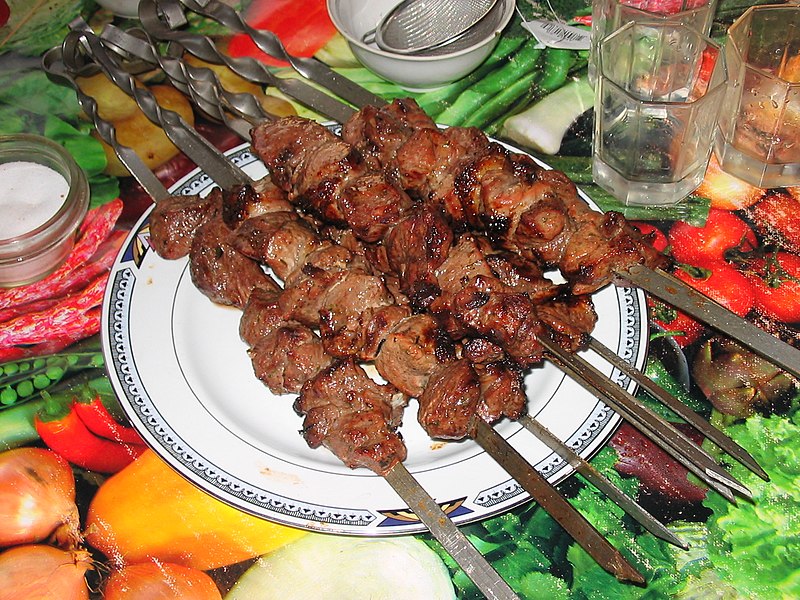
Russian Shashlik
When temperatures can drop to -30°C (-22°F) during Moscow's winter, it's no surprise that Russian food is typically hearty, with potatoes, bread, pastry and sour cream featuring as common ingredients.
Delicate smoked fishes, thin papery crepesand red and black caviar are equal contenders in Russian cuisine.
You may feel French influences show through in several dishes, although the Russian versions stand on their own merit and creation.
Restaurants are not cheap in Moscow, however, classic Russian dishes are just as good from streets stalls and fast-food eateries as they are from high-end restaurants, although the latter do provide exquisite variations.
Shashlik /Shashlyik
If semi-raw marinated fish doesn't suit your tastes, these roasted meats and fish on skewers are hard not to like.
As the name suggests, this dish is a form of shish kebab, although the Russian version is served with chunkier portions of lamb, beef, chicken or salmon, and served with an unleavened bread, Russian pickles and a sometimes spicy tomato sauce.
If your travels take you to Moscow's Izmailovsky flea market and it's certainly a top 10 thing to taste, you'll find a range of market stalls serving shashlik sticks right off the grill.
Russian dumplings
What's different about Russian dumplings or pelmeni are the tasty herbs added to the packed meat fillings of lamb, pork or beef and the thinness of the dough.
You can also find fish which is typically salmon or creamy mushrooms as common fillers. When ordering them, you'll be asked if you want to eat them solo (boiled) or served in a broth.
Borsch / Borscht
This beet and cabbage red soup is a delicious belly warmer on Moscow's colder days, served with or without meat, potato, herbs usually dill and a dollop of smetana, Russian sour cream.
Accompanied with a piece of rye bread or garlic bread topped with melted cheese, this dish is hearty enough to serve as a meal, although it is usually eaten as a starter.
A staple of Russia cuisine, it would be an offense to leave Moscow without trying this soup at least once although its surprisingly tasty flavour will certainly leave you wishing you had tried more local variations.
Other common Russian soups to try are ukha, a seasoned fish and vegetable broth, and schi, a cabbage-based broth.
Stroganoff
Another Russian dish that is served on dinner tables worldwide, eating stroganoff from its Russian source is everything you would expect– tastier, smoother and creamier than you've ever had at home.
The credit goes in part to Russian sour cream, but Russia is also home to some of the best and widest variation of mushrooms.
Coupled with interesting variations of hunting/game meats, you'll definitely want to try this dish again.
Russian pancakes
Blini are Russia's version of the thin French crepe and a staple on most Moscovian menus, typically made with buckwheat for savoury fillings or white flour for sweet toppings.
You'll see accompaniments of smoked salmon, creamy mushrooms, sour cream, jams and condensed milk– to name a few– but the high-end, revered combination is a spoonful of red salmon or black sturgeon caviar.
Another tasty Russian pancake is the cottage cheese version called syrniki, a denser form of ricotta-pancakes, which are eaten for breakfast or dessert.
They're best served with homemade jams made from Russia's large array of berries, although condensed milk, honey and sour cream are also served as condiments.
Mini-pies
Russia's mini pies or pirozhki use similar fillings and herbs to dumplings, except they are encased in pastry and either pan-fried or oven-baked.
Besides the typical meat or salmon fillings, however, you also get the additional choice of cabbage, potato, egg, cheese and even sweet fillings.
Pirozhki make a great appetizer at a restaurant, as well as a quick bite from a street stall or bakery.
Mushroom julienne
With a similar taste to stroganoff, but without meat, this creamy mushroom dish is found on almost every menu as a hot appetizer.
Combining some of Russia's ubiquitous ingredients and a hint of French obsession, it's made with thinly sliced mushrooms, cheese, sour cream and cream and broiled/grilled for a crusty top, served in a dainty metal dish or bread crust.
While this rich, small-serving dish may not impress foreigners with its basic ingredients, it's a special dish in Russian cuisine.
Indeed, mushrooms in any form are a must-try in Russia, where mushroom hunting could almost be considered a national pastime.
When you're fully creamed-out, try an assortment of pickled mushrooms instead.
Russian salad
This hardly needs mentioning seeing as Russian salad is one such dish that has spread internationally, and chances are you've tried a version in your home country.
However, the Russian version is fresher and crispier with a light smattering of mayonnaise, quite the opposite to the ratio of the soft-boiled, mayonnaise heavy international versions.
This could be due to the use of fresh cucumber or crunchy Russian pickles, although the base of diced potato, peas, egg and mayonnaise/sour cream remains ubiquitous.
In Moscow, however, it's known as Olivier salad, named after the chef Lucien Olivier who created the secret recipe there around the mid-1800s, although the original ingredients have been swapped for cheaper, more available foods.
You'll also find a variation of similar cold Russian salads that will equally vie for your attention.
Smoked salmon or salted herring
Smoked, salted and marinated river and saltwater fish feature widely in Russian cuisine, and are expertly prepared to have a delicate and fresh flavour.
On menus you'll typically find marinated or smoked salmon served alone as a dish or with pancakes, and salted herring served in salads.
A typical one colloquially named herring under a fur coat or shuba, which covers salted herring with layers of grated boiled vegetables, beets, onions and mayonnaise.
Tartareis is also commonly found on menus in Moscow. Other common fish served in Moscow include trout, carp, zander, sturgeon and sterlet, also know as the Tsar fish.
Honeycake
The intricate looking cake medovik involves alternating ultra-thin layers of honey spongecake with sweetened sour cream.
The thin layers are built-up to form the cake, from anywhere between 5 and 15 layers, topped off with a sprinkling of crushed sponge or nuts and left overnight to soften and absorb the cream.
Fluffy and light to eat, but full-on in flavour and sweetness.
Tourism Observer
Showing posts with label pirozhki. Show all posts
Sunday, 24 December 2017
Saturday, 3 October 2015
Russian Cuisine
Shashlik
Russian cuisine is a collection of the different cooking traditions of the Russian people. The cuisine is diverse, as Russia is by area the largest country in the world.
Russian cuisine derives its varied character from the vast and multi-cultural expanse of Russia. Moreover, it is necessary to divide Russian traditional cuisine and Soviet cuisine, which has its own peculiarity. Its foundations were laid by the peasant food of the rural population in an often harsh climate, with a combination of plentiful fish, pork, poultry, caviar, mushrooms, berries, and honey.
Crops of rye, wheat, barley and millet provided the ingredients for a plethora of breads, pancakes, pies, cereals, beer and vodka. Soups and stews full of flavor are centered on seasonal or storable produce, fish and meats. This wholly native food remained the staple for the vast majority of Russians.
Russia's great expansions of culture, influence, and interest during the 16th–18th centuries brought more refined foods and culinary techniques, as well as one of the most refined food countries in the world. It was during this period that smoked meats and fish, pastry cooking, salads and green vegetables, chocolate, ice cream, wines, and juice were imported from abroad.
At least for the urban aristocracy and provincial gentry, this opened the doors for the creative integration of these new foodstuffs with traditional Russian dishes. The result is extremely varied in technique, seasoning, and combination.
Soups
Soups have always played an important role in the Russian meal. The traditional staple of soups such as borscht,shchi, ukha ,rassolnik, solyanka, botvinya, okroshka, and tyurya was enlarged in the 18th to 20th centuries by both European and Central Asian staples like clear soups, pureed soups, stews, and many others.
Russian soups can be divided into at least seven large groups:
Chilled soups based on kvass, such as tyurya, okroshka, and botvinya.
Light soups and stews based on water and vegetables, such as swekolnik.
Noodle soups with meat, mushrooms, or milk.
Soups based on cabbage, most prominently shchi.
Thick soups based on meat broth, with a salty-sour base like rassolnik and solyanka.
Fish soups such as ukha.
Grain- and vegetable-based soups.
Cold soups
Okroshka
Okroshka is a cold soup based on kvass or sour milk. Okroshka is also a salad. The main ingredients are two types of vegetables that can be mixed with cold boiled meat or fish in a 1:1 proportion . Thus vegetable, meat, poultry, and fish varieties of okroshka are made.
There are typically two types of vegetables in okroshka. The first must have a neutral taste, such as boiled potatoes, turnips, rutabagas, carrots, or fresh cucumbers. The second must be spicy, consisting of mainly green onion as well as other herbs—greens of dill, parsley, chervil, celery, or tarragon. Different meat and poultry can be used in the same soup. The most common ingredient is beef alone or with poultry. If it is made with fish, the best choice would be tench, European perch, pike-perch, cod, or other neutral-tasting fish.
The kvass most commonly used in cooking is white okroshka kvass, which is much more sour than drinking kvass. Spices used include mustard, black pepper and pickled cucumber (specifically, the liquid from the pickles), solely or in combination. For the final touch, boiled eggs and smetana (similar to crème fraîche) are added.
For sour milk based okroshka, well shaken up natural sour milk often with the addition of seed oil is used with the addition of pure water and ground garlic. Sometimes manufactured kefir is used instead of natural sour milk for time saving reasons, though some say it detracts from the original taste of okroshka.
Tyurya is very similar to okroshka, the main difference being that instead of vegetables, bread is soaked in kvass. It was commonly consumed during rough times such as the Russian Revolution, World War I, World War II, and by poor peasants. Also, due to its simplicity, it was very common as a meal during religious fasting.
Botvinya is another type of cold soup. The name of the soup comes from the Russian word botva, which means "leafy tops of root vegetables", and, true to its name, it is made with the leafy tops of young beets, sorrel, scallions, dill, cucumbers, and two types of kvass. Mustard, garlic, and horseradish are then added for flavor. The vegetables are rubbed through a sieve and kvass is poured over.
Hot soups
Shchi
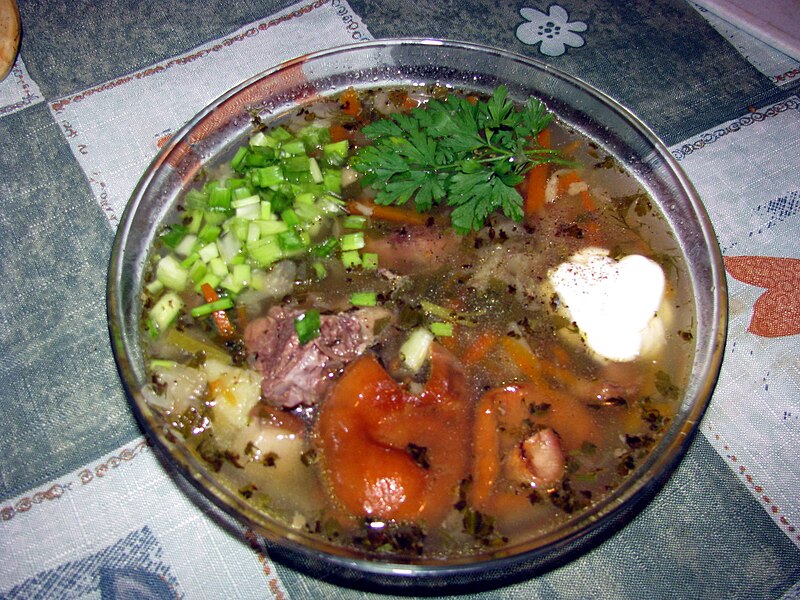
Shchi (cabbage soup) had been the predominant first course in Russian cuisine for over a thousand years. Although tastes have changed, it steadily made its way through several epochs. Shchi knew no social class boundaries, and even if the rich had richer ingredients and the poor made it solely of cabbage and onions, all these "poor" and "rich" variations were cooked in the same tradition.
The unique taste of this cabbage soup was from the fact that after cooking it was left to draw (stew) in a Russian stove. The "Spirit of shchi" was inseparable from a Russian izba (log hut). Many Russian proverbs are connected to this soup, such as Shchi da kasha pishcha nasha , "Shchi and porridge are our staples". It can be eaten regularly, and at any time of the year.
The richer variant of shchi includes several ingredients, but the first and last components are a must:
Cabbage.
Meat (very rarely fish or mushrooms).
Carrots, basil or parsley roots.
Spicy herbs (onions, celery, dill, garlic, pepper, bay leaf).
Sour components (smetana, apples, sauerkraut, pickle water).
When this soup is served, smetana is added. It is eaten with rye bread. During much of the year when the Orthodox Christian Church prescribes abstinence from meat and dairy, a vegan version of shchi is made. "Kislye" (sour) schi are made from pickled cabbage (sauerkraut), "serye" (grey) schi from the green outer leaves of the cabbage head. "Zelyonye" (green) schi are made from sorrel leaves, not cabbage, and used to be a popular summer soup.
Opekannaya ukha made from pike perch
Ukha is a warm watery fish dish, however calling it a fish soup would not be absolutely correct. "Ukha" as a name for fish broth was established only in the late 17th to early 18th centuries. In earlier times this name was first given to thick meat broths, and then later chicken. Beginning from the 15th century, fish was more and more often used to prepare ukha, thus creating a dish that had a distinctive taste among soups.
A minimum of vegetables is added in preparation, and in classical cooking ukha was simply a rich fish broth served to accompany fish pies (rasstegai, kuliebiaka, etc.). These days it is more often a fish soup, cooked with potatoes and other vegetables. A wide variety of freshwater fish is traditionally used.
Rassolnik is a hot soup in a salty-sour cucumber base. This dish formed in Russian cuisine quite late—only in the 19th century. About this time the name rassolnik was attached to it, originating from the Russian word rassol which means "brine" (pickle water). Pickle water was known to be used as base for soups from the 15th century at the latest. Its concentration and ratio with other liquids and soup components gave birth to different soups: solyanka, shchi, and of course rassolnik. The latest are moderately sour-salty soups on pickled cucumber base. Some are vegetarian, but more often with products like veal or beef kidneys or all poultry giblets (stomach, liver, heart, neck, feet). For best taste there has to be a balance between the sour part and neutral absorbers (cereals, potatoes, root vegetables). Typical rassolnik is based on kidneys, brine (and pickles), vegetables and barley.
Kal'ya was a very common dish first served in the 16th–17th centuries. Subsequently it almost completely disappeared from Russian cuisine. Often it was incorrectly called "fish rassolnik". The cooking technique is mostly the same as of ukha, but to the broth were added pickled cucumbers, pickle water, lemons and lemon juice, either separately or all together. The main characteristic of kal'ya is that only fat, rich fish was used; sometimes caviar was added along with the fish. More spices are added, and the soup turns out more piquant and thicker than ukha. Formerly kal'ya was considered a festivity dish.
Solyanka
Solyanka is a thick, piquant soup that combines components from shchi (cabbage, smetana) and rassolnik (pickle water and cucumbers), spices such as olives, capers, tomatoes, lemons, lemon juice, kvass, salted and pickled mushrooms make up a considerably strong sour-salty base of the soup. Solyanka is much thicker than other soups, about 1/3 less liquid ratio. Three types are distinguished: meat, fish, and simple solyanka. The first two are cooked on strong meat or fish broths, and the last on mushroom or vegetable broth. All the broths are mixed with cucumber pickle water.
Lapsha (noodle soup) was adopted by Russians from Tatars, and after some transformation became widespread in Russia. It comes in three variations: chicken, mushroom, and milk. Cooking all three is simple, including preparation of noodles, cooking of corresponding broth, and boiling of noodles in broth. Noodles are based on the same wheat flour or buckwheat/wheat flour mix. Mixed flour noodles go better with mushroom or milk broth.
Porridge
Kasha with milk
Porridge is one of the most important dishes in the traditional Russian cuisine. Variety of cereals is based on variety of local crops. In Russian, the word kasha refers to any kind of porridge. Russian people have learned to do several varieties of cereals from whole grains to a variety of ways. The most popular cereals are buckwheat, millet, semolina, oats, barley, and rice. These cereals are traditionally cooked in milk, especially for breakfast. People add butter, salt, and sugar to taste.
Main dishes
List of Russian dishes
Meat
Pelmeni
Kholodets
Kotlety
In traditional Russian cuisine three basic variations of meat dishes can be highlighted:
a large boiled piece of meat cooked in a soup or porridge, and then used as second course or served cold (particularly in jellied stock—see Kholodets' below)
offal dishes (liver, tripe, etc.), baked in pots together with cereals;
whole fowl dishes or parts of fowl (legs or breasts), or a large piece of meat (rump) baked on a baking tray in an oven, so-called "zharkoye" (from the word "zhar" meaning "heat")
The 16th century "Domostroi" aimed at affluent households also mentions sausage-making, spit-roasted meats, stews and many other meat dishes.
As a garnish to meat dishes in the past the most common were porridges and cereals, in which the meat was boiled, later on boiled or rather steamed and baked root vegetables (turnips, carrots) as well as mushrooms; additionally the meat, without taking account its type, was garnished with pickled products—pickled cabbage, sour and "soaked" (marinated) apples (mochoniye yabloki), soaked cranberries, "vzvar"s. Pan juices, alone or mixed with sour cream or melted butter, were used as gravy to pour on garnishing vegetables and porridges. Meat sauces, i.e. gravies based on flour, butter, eggs and milk, are not common for traditional Russian cuisine.
Pelmeni are a traditional Eastern European (mainly Russian) dish usually made with minced meat filling, wrapped in thin dough (made out of flour and eggs, sometimes with milk or water added). For filling, pork, lamb, beef, or any other kind of meat can be used; mixing several kinds is popular. The traditional Ural recipe requires the filling be made with 45% of beef, 35% of lamb, and 20% of pork. Traditionally, various spices, such as pepper, onions, and garlic, are mixed into the filling.
Russians seem to have learned to make pelmeni from Finnic and Tatar peoples of the Taiga, the Urals and Siberia. The word means "ear-shaped bread" in Finnic languages such as Udmurt and Komi. In Siberia they were made in large quantities and stored safely frozen outside for several winter months. In mainland Russia, the term "Siberian Pel'meni" refers to pel'meni made with a mix of meats (whether the 45/35/20 mix mentioned above, or another ratio), rather than a single meat.
By the late 19th century, they became a staple throughout urban European Russia. They are prepared immediately before eating by boiling in water until they float, and then 2–5 minutes more. The resulting dish is served with butter or sour cream (mustard, horseradish, and vinegar are popular as well). Some recipes suggest frying pelmeni after boiling until they turn golden brown.
Pelmeni belong to the family of dumplings. Akin to vareniki: Ukrainian variety of dumplings with filling made of mashed potatoes, farmer's cheese, or cherries, to mention the most popular three. They are not dissimilar to Chinese potstickers, Tibetan mo-mo and Italian ravioli, as well as the Manti of the Kazakh and Kyrgyz cultures. The main difference between pelmeni and other kinds of dumplings is in their shape and size — the typical pelmen' is roughly spherical and is about 2 to 3 cm in diameter, whereas most other types of dumplings are usually elongated and much larger.
The process of making pelmeni is somewhat labor-intensive, but a device known as "pelmennitsa" greatly speeds up the task. It consists of a typically round aluminum plate with a matrix of holes surrounded by ridges. A sheet of dough is placed over the matrix, filling is scooped into each "cell", and the dough sags under the weight of the filling, forming the body of the dumpling. Another sheet of dough is placed on top, and a wooden roller is rolled over the top, pressing the dough layers together, cutting the dumplings apart by the ridges, and forcing the dumplings to fall through the holes. Using a pelmennitsa, the chef can quickly manufacture batches of dumplings at a time.
Various minced meat dishes were adopted from other cuisines and became popular only in the nineteenth and twentieth centuries; for traditional Russian cuisine they are not typical.
Kholodets (or Studen'): Jellied chopped pieces of pork or veal meat with some spices added (pepper, parsley, garlic, bay leaf) and minor amounts of vegetables (carrots, onions). The meat is boiled in large pieces for long periods of time, then chopped, boiled a few times again and finally chilled for 3–4 hours (hence the name) forming a jelly mass, though gelatine is not used because calves' feet, pigs' heads and other such offal is gelatinous enough on its own. It is served with horseradish, mustard, or ground garlic with smetana.
Kotlety (minced cutlets, meatballs), a Western European dish popular in modern Russian households, are small pan-fried meat balls, not dissimilar from Salisbury steak and other such dishes. Made primarily from pork and beef (sometimes also from chicken or fish), they are easily made and require little time. Ground beef, pork, onions and bread are put in a bowl and mixed thoroughly until it becomes relatively consistent. Once this effect is achieved, balls are formed and then put into a hot frying pan to cook.
Shashlyk
Shashlyk is a form of Shish kebab (marinated meat grilled on a skewer) popular in former Soviet Union countries, notably in Georgia, Russia, Armenia, Azerbaijan, and Uzbekistan. It often features alternating slices of meat and onions. Even though the word "shashlyk" was apparently borrowed from the Crimean Tatars by the Cossacks as early as the 16th century, kebabs did not reach Moscow until the late 19th century, according to Vladimir Gilyarovsky's "Moscow and Moscovites". From then on, their popularity spread rapidly; by the 1910s they were a staple in St Petersburg restaurants and by the 1920s they were already a pervasive street food all over urban Russia. Shashlik is also used in Russia as a food to be cooked in outdoor environment, similarly to barbecue in English-speaking countries.
Fish
Fish was important in pre-revolutionary cuisine, especially on Russian Orthodox fast days when meat was forbidden, similar to the Catholic custom of eating fish instead of meat on Fridays. Strictly freshwater fish such as carp and sudak (Sander lucioperca, Zander) were commonly eaten in inland areas, as well as anadromous sturgeon and in northern areas salmon, pike and trout. A greater variety of fish—including saltwater species—were preserved by salting, pickling or smoking and consumed as "zakuski" (hors d'oeuvres).
Pies and pancakes
Pirozhki made with onion, mushroom, meat and rice stuffing
Pirozhki (singular: pirozhok; diminutive of pirog pie]) are small stuffed buns (pies) made of either yeast dough or short pastry. They are filled with one of many different fillings and are either baked (the ancient Slavic method) or shallow-fried known as "priazhenie", this method was borrowed from the Tatars in the 16th century. One feature of pirozhki that sets them apart from, for example, English pies is that the fillings used are almost invariably fully cooked. The use of chopped hard-boiled eggs in fillings is another interesting feature. Six typical fillings for traditional pirozhki are:
Chopped boiled meat mixed with sautéed onions
Rice and boiled eggs with dill
Fish sautéed with onions and mixed with hard-boiled chopped eggs and rice
Mashed potatoes mixed with dill and green onion
Sautéed cabbage
Sautéed mushrooms with onions and sometimes carrots
Syrniki with raisins
Blini are thin pancakes made with yeasted batter which are often served in connection with a religious rite or festival. The word "blin" (singular of blini) comes from Old Slavic "mlin", which means "to mill". Blins had a somewhat ritual significance for early Slavic peoples in pre-Christian times since they were a symbol of the sun, due to their round form.
They were traditionally prepared at the end of the winter to honor the rebirth of the new sun during Maslenitsa , Butter Week; also known as Pancake Week. This tradition was adopted by the Orthodox Church and is carried on to the present day, as the last week of dairy and egg products before Lent.
Bliny are still often served at wakes, to commemorate the recently deceased. Blini can be made from wheat, buckwheat, or other grains, although wheat blini are most popular in Russia. They may be topped with butter, smetana (sour cream), fruit preserves or caviar. The word "blin" is also often used as a soft curse word, expressing frustration.
Syrniki are fried curd fritters, garnished with sour cream, jam, honey or apple sauce.
Vatrushka is a kind of cake with a ring of dough and tvorog (cottage cheese) in the middle, often with raisins or bits of fruit, from about five inches to two and a half feet in diameter.
Vegetables
Cabbage, potatoes, and cold tolerant greens are common in Russian and other Eastern European cuisines. Pickling cabbage (sauerkraut), cucumbers, tomatoes and other vegetables in brine is used to preserve vegetables for winter use. Pickled apples and some other fruit also used to be widely popular. These are sources of vitamins during periods when fresh fruit and vegetables are traditionally not available.
Salads
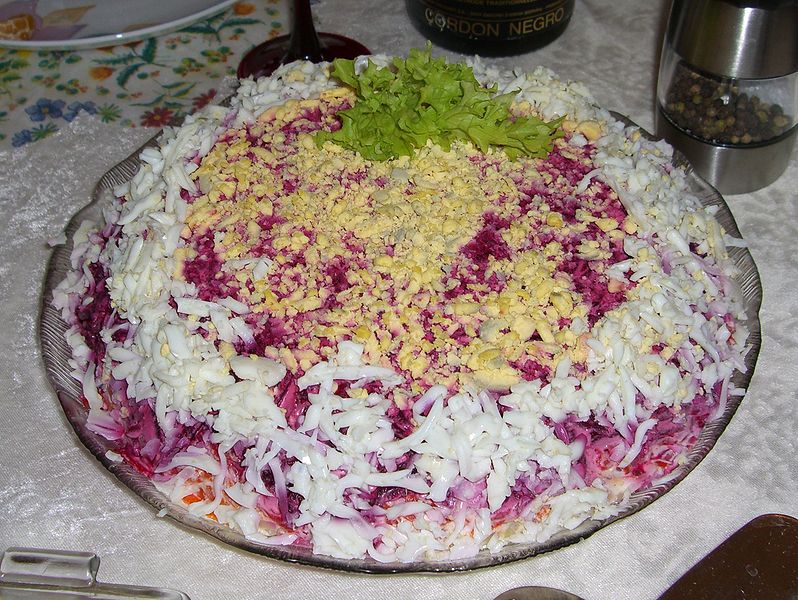
Dressed Herring
Khrenovina Sauce, a traditional Siberian sauce, made of tomatoes, garlic and horseradish, Novokuznetsk, Russia
Olivier salad (also known as Russian salad), a mayonnaise-based potato salad distinguished by its diced texture and the contrasting flavors of pickles, hard-boiled eggs, boiled carrots, boiled potatoes, meat, and peas. This dish is one of the main New Year buffet.
Sel'd' pod shuboy (or Shuba, from Russian шуoа (fur coat)), also known as "dressed herring", is chopped salted herring under a "coat" of shredded cooked beet, sometimes with a layer of egg or other vegetables.
Very popular New Year dish.
Vinegret (from French vinaigrette), a salad made of boiled beets, potatoes, carrots, pickles, onions, sauerkraut, and sometimes peas or white beans. Dressed with sunflower or olive oil.
Desserts
Varenye, a dessert and condiment made from cooking berries. It is similar to jam except the fruit is not macerated and the consistency is more akin to fruit within syrup. It is used as a topping for crepes and syrniki and as a sweetener for tea. It is also eaten on its own as a sweet.
Russian cuisine is a collection of the different cooking traditions of the Russian people. The cuisine is diverse, as Russia is by area the largest country in the world.
Russian cuisine derives its varied character from the vast and multi-cultural expanse of Russia. Moreover, it is necessary to divide Russian traditional cuisine and Soviet cuisine, which has its own peculiarity. Its foundations were laid by the peasant food of the rural population in an often harsh climate, with a combination of plentiful fish, pork, poultry, caviar, mushrooms, berries, and honey.
Crops of rye, wheat, barley and millet provided the ingredients for a plethora of breads, pancakes, pies, cereals, beer and vodka. Soups and stews full of flavor are centered on seasonal or storable produce, fish and meats. This wholly native food remained the staple for the vast majority of Russians.
Russia's great expansions of culture, influence, and interest during the 16th–18th centuries brought more refined foods and culinary techniques, as well as one of the most refined food countries in the world. It was during this period that smoked meats and fish, pastry cooking, salads and green vegetables, chocolate, ice cream, wines, and juice were imported from abroad.
At least for the urban aristocracy and provincial gentry, this opened the doors for the creative integration of these new foodstuffs with traditional Russian dishes. The result is extremely varied in technique, seasoning, and combination.
Soups
Soups have always played an important role in the Russian meal. The traditional staple of soups such as borscht,shchi, ukha ,rassolnik, solyanka, botvinya, okroshka, and tyurya was enlarged in the 18th to 20th centuries by both European and Central Asian staples like clear soups, pureed soups, stews, and many others.
Russian soups can be divided into at least seven large groups:
Chilled soups based on kvass, such as tyurya, okroshka, and botvinya.
Light soups and stews based on water and vegetables, such as swekolnik.
Noodle soups with meat, mushrooms, or milk.
Soups based on cabbage, most prominently shchi.
Thick soups based on meat broth, with a salty-sour base like rassolnik and solyanka.
Fish soups such as ukha.
Grain- and vegetable-based soups.
Cold soups
Okroshka
Okroshka is a cold soup based on kvass or sour milk. Okroshka is also a salad. The main ingredients are two types of vegetables that can be mixed with cold boiled meat or fish in a 1:1 proportion . Thus vegetable, meat, poultry, and fish varieties of okroshka are made.
There are typically two types of vegetables in okroshka. The first must have a neutral taste, such as boiled potatoes, turnips, rutabagas, carrots, or fresh cucumbers. The second must be spicy, consisting of mainly green onion as well as other herbs—greens of dill, parsley, chervil, celery, or tarragon. Different meat and poultry can be used in the same soup. The most common ingredient is beef alone or with poultry. If it is made with fish, the best choice would be tench, European perch, pike-perch, cod, or other neutral-tasting fish.
The kvass most commonly used in cooking is white okroshka kvass, which is much more sour than drinking kvass. Spices used include mustard, black pepper and pickled cucumber (specifically, the liquid from the pickles), solely or in combination. For the final touch, boiled eggs and smetana (similar to crème fraîche) are added.
For sour milk based okroshka, well shaken up natural sour milk often with the addition of seed oil is used with the addition of pure water and ground garlic. Sometimes manufactured kefir is used instead of natural sour milk for time saving reasons, though some say it detracts from the original taste of okroshka.
Tyurya is very similar to okroshka, the main difference being that instead of vegetables, bread is soaked in kvass. It was commonly consumed during rough times such as the Russian Revolution, World War I, World War II, and by poor peasants. Also, due to its simplicity, it was very common as a meal during religious fasting.
Botvinya is another type of cold soup. The name of the soup comes from the Russian word botva, which means "leafy tops of root vegetables", and, true to its name, it is made with the leafy tops of young beets, sorrel, scallions, dill, cucumbers, and two types of kvass. Mustard, garlic, and horseradish are then added for flavor. The vegetables are rubbed through a sieve and kvass is poured over.
Hot soups
Shchi
Shchi (cabbage soup) had been the predominant first course in Russian cuisine for over a thousand years. Although tastes have changed, it steadily made its way through several epochs. Shchi knew no social class boundaries, and even if the rich had richer ingredients and the poor made it solely of cabbage and onions, all these "poor" and "rich" variations were cooked in the same tradition.
The unique taste of this cabbage soup was from the fact that after cooking it was left to draw (stew) in a Russian stove. The "Spirit of shchi" was inseparable from a Russian izba (log hut). Many Russian proverbs are connected to this soup, such as Shchi da kasha pishcha nasha , "Shchi and porridge are our staples". It can be eaten regularly, and at any time of the year.
The richer variant of shchi includes several ingredients, but the first and last components are a must:
Cabbage.
Meat (very rarely fish or mushrooms).
Carrots, basil or parsley roots.
Spicy herbs (onions, celery, dill, garlic, pepper, bay leaf).
Sour components (smetana, apples, sauerkraut, pickle water).
When this soup is served, smetana is added. It is eaten with rye bread. During much of the year when the Orthodox Christian Church prescribes abstinence from meat and dairy, a vegan version of shchi is made. "Kislye" (sour) schi are made from pickled cabbage (sauerkraut), "serye" (grey) schi from the green outer leaves of the cabbage head. "Zelyonye" (green) schi are made from sorrel leaves, not cabbage, and used to be a popular summer soup.
Opekannaya ukha made from pike perch
Ukha is a warm watery fish dish, however calling it a fish soup would not be absolutely correct. "Ukha" as a name for fish broth was established only in the late 17th to early 18th centuries. In earlier times this name was first given to thick meat broths, and then later chicken. Beginning from the 15th century, fish was more and more often used to prepare ukha, thus creating a dish that had a distinctive taste among soups.
A minimum of vegetables is added in preparation, and in classical cooking ukha was simply a rich fish broth served to accompany fish pies (rasstegai, kuliebiaka, etc.). These days it is more often a fish soup, cooked with potatoes and other vegetables. A wide variety of freshwater fish is traditionally used.
Rassolnik is a hot soup in a salty-sour cucumber base. This dish formed in Russian cuisine quite late—only in the 19th century. About this time the name rassolnik was attached to it, originating from the Russian word rassol which means "brine" (pickle water). Pickle water was known to be used as base for soups from the 15th century at the latest. Its concentration and ratio with other liquids and soup components gave birth to different soups: solyanka, shchi, and of course rassolnik. The latest are moderately sour-salty soups on pickled cucumber base. Some are vegetarian, but more often with products like veal or beef kidneys or all poultry giblets (stomach, liver, heart, neck, feet). For best taste there has to be a balance between the sour part and neutral absorbers (cereals, potatoes, root vegetables). Typical rassolnik is based on kidneys, brine (and pickles), vegetables and barley.
Kal'ya was a very common dish first served in the 16th–17th centuries. Subsequently it almost completely disappeared from Russian cuisine. Often it was incorrectly called "fish rassolnik". The cooking technique is mostly the same as of ukha, but to the broth were added pickled cucumbers, pickle water, lemons and lemon juice, either separately or all together. The main characteristic of kal'ya is that only fat, rich fish was used; sometimes caviar was added along with the fish. More spices are added, and the soup turns out more piquant and thicker than ukha. Formerly kal'ya was considered a festivity dish.
Solyanka
Solyanka is a thick, piquant soup that combines components from shchi (cabbage, smetana) and rassolnik (pickle water and cucumbers), spices such as olives, capers, tomatoes, lemons, lemon juice, kvass, salted and pickled mushrooms make up a considerably strong sour-salty base of the soup. Solyanka is much thicker than other soups, about 1/3 less liquid ratio. Three types are distinguished: meat, fish, and simple solyanka. The first two are cooked on strong meat or fish broths, and the last on mushroom or vegetable broth. All the broths are mixed with cucumber pickle water.
Lapsha (noodle soup) was adopted by Russians from Tatars, and after some transformation became widespread in Russia. It comes in three variations: chicken, mushroom, and milk. Cooking all three is simple, including preparation of noodles, cooking of corresponding broth, and boiling of noodles in broth. Noodles are based on the same wheat flour or buckwheat/wheat flour mix. Mixed flour noodles go better with mushroom or milk broth.
Porridge
Kasha with milk
Porridge is one of the most important dishes in the traditional Russian cuisine. Variety of cereals is based on variety of local crops. In Russian, the word kasha refers to any kind of porridge. Russian people have learned to do several varieties of cereals from whole grains to a variety of ways. The most popular cereals are buckwheat, millet, semolina, oats, barley, and rice. These cereals are traditionally cooked in milk, especially for breakfast. People add butter, salt, and sugar to taste.
Main dishes
List of Russian dishes
Meat
Pelmeni
Kholodets
Kotlety
In traditional Russian cuisine three basic variations of meat dishes can be highlighted:
a large boiled piece of meat cooked in a soup or porridge, and then used as second course or served cold (particularly in jellied stock—see Kholodets' below)
offal dishes (liver, tripe, etc.), baked in pots together with cereals;
whole fowl dishes or parts of fowl (legs or breasts), or a large piece of meat (rump) baked on a baking tray in an oven, so-called "zharkoye" (from the word "zhar" meaning "heat")
The 16th century "Domostroi" aimed at affluent households also mentions sausage-making, spit-roasted meats, stews and many other meat dishes.
As a garnish to meat dishes in the past the most common were porridges and cereals, in which the meat was boiled, later on boiled or rather steamed and baked root vegetables (turnips, carrots) as well as mushrooms; additionally the meat, without taking account its type, was garnished with pickled products—pickled cabbage, sour and "soaked" (marinated) apples (mochoniye yabloki), soaked cranberries, "vzvar"s. Pan juices, alone or mixed with sour cream or melted butter, were used as gravy to pour on garnishing vegetables and porridges. Meat sauces, i.e. gravies based on flour, butter, eggs and milk, are not common for traditional Russian cuisine.
Pelmeni are a traditional Eastern European (mainly Russian) dish usually made with minced meat filling, wrapped in thin dough (made out of flour and eggs, sometimes with milk or water added). For filling, pork, lamb, beef, or any other kind of meat can be used; mixing several kinds is popular. The traditional Ural recipe requires the filling be made with 45% of beef, 35% of lamb, and 20% of pork. Traditionally, various spices, such as pepper, onions, and garlic, are mixed into the filling.
Russians seem to have learned to make pelmeni from Finnic and Tatar peoples of the Taiga, the Urals and Siberia. The word means "ear-shaped bread" in Finnic languages such as Udmurt and Komi. In Siberia they were made in large quantities and stored safely frozen outside for several winter months. In mainland Russia, the term "Siberian Pel'meni" refers to pel'meni made with a mix of meats (whether the 45/35/20 mix mentioned above, or another ratio), rather than a single meat.
By the late 19th century, they became a staple throughout urban European Russia. They are prepared immediately before eating by boiling in water until they float, and then 2–5 minutes more. The resulting dish is served with butter or sour cream (mustard, horseradish, and vinegar are popular as well). Some recipes suggest frying pelmeni after boiling until they turn golden brown.
Pelmeni belong to the family of dumplings. Akin to vareniki: Ukrainian variety of dumplings with filling made of mashed potatoes, farmer's cheese, or cherries, to mention the most popular three. They are not dissimilar to Chinese potstickers, Tibetan mo-mo and Italian ravioli, as well as the Manti of the Kazakh and Kyrgyz cultures. The main difference between pelmeni and other kinds of dumplings is in their shape and size — the typical pelmen' is roughly spherical and is about 2 to 3 cm in diameter, whereas most other types of dumplings are usually elongated and much larger.
The process of making pelmeni is somewhat labor-intensive, but a device known as "pelmennitsa" greatly speeds up the task. It consists of a typically round aluminum plate with a matrix of holes surrounded by ridges. A sheet of dough is placed over the matrix, filling is scooped into each "cell", and the dough sags under the weight of the filling, forming the body of the dumpling. Another sheet of dough is placed on top, and a wooden roller is rolled over the top, pressing the dough layers together, cutting the dumplings apart by the ridges, and forcing the dumplings to fall through the holes. Using a pelmennitsa, the chef can quickly manufacture batches of dumplings at a time.
Various minced meat dishes were adopted from other cuisines and became popular only in the nineteenth and twentieth centuries; for traditional Russian cuisine they are not typical.
Kholodets (or Studen'): Jellied chopped pieces of pork or veal meat with some spices added (pepper, parsley, garlic, bay leaf) and minor amounts of vegetables (carrots, onions). The meat is boiled in large pieces for long periods of time, then chopped, boiled a few times again and finally chilled for 3–4 hours (hence the name) forming a jelly mass, though gelatine is not used because calves' feet, pigs' heads and other such offal is gelatinous enough on its own. It is served with horseradish, mustard, or ground garlic with smetana.
Kotlety (minced cutlets, meatballs), a Western European dish popular in modern Russian households, are small pan-fried meat balls, not dissimilar from Salisbury steak and other such dishes. Made primarily from pork and beef (sometimes also from chicken or fish), they are easily made and require little time. Ground beef, pork, onions and bread are put in a bowl and mixed thoroughly until it becomes relatively consistent. Once this effect is achieved, balls are formed and then put into a hot frying pan to cook.
Shashlyk
Shashlyk is a form of Shish kebab (marinated meat grilled on a skewer) popular in former Soviet Union countries, notably in Georgia, Russia, Armenia, Azerbaijan, and Uzbekistan. It often features alternating slices of meat and onions. Even though the word "shashlyk" was apparently borrowed from the Crimean Tatars by the Cossacks as early as the 16th century, kebabs did not reach Moscow until the late 19th century, according to Vladimir Gilyarovsky's "Moscow and Moscovites". From then on, their popularity spread rapidly; by the 1910s they were a staple in St Petersburg restaurants and by the 1920s they were already a pervasive street food all over urban Russia. Shashlik is also used in Russia as a food to be cooked in outdoor environment, similarly to barbecue in English-speaking countries.
Fish
Fish was important in pre-revolutionary cuisine, especially on Russian Orthodox fast days when meat was forbidden, similar to the Catholic custom of eating fish instead of meat on Fridays. Strictly freshwater fish such as carp and sudak (Sander lucioperca, Zander) were commonly eaten in inland areas, as well as anadromous sturgeon and in northern areas salmon, pike and trout. A greater variety of fish—including saltwater species—were preserved by salting, pickling or smoking and consumed as "zakuski" (hors d'oeuvres).
Pies and pancakes
Pirozhki made with onion, mushroom, meat and rice stuffing
Pirozhki (singular: pirozhok; diminutive of pirog pie]) are small stuffed buns (pies) made of either yeast dough or short pastry. They are filled with one of many different fillings and are either baked (the ancient Slavic method) or shallow-fried known as "priazhenie", this method was borrowed from the Tatars in the 16th century. One feature of pirozhki that sets them apart from, for example, English pies is that the fillings used are almost invariably fully cooked. The use of chopped hard-boiled eggs in fillings is another interesting feature. Six typical fillings for traditional pirozhki are:
Chopped boiled meat mixed with sautéed onions
Rice and boiled eggs with dill
Fish sautéed with onions and mixed with hard-boiled chopped eggs and rice
Mashed potatoes mixed with dill and green onion
Sautéed cabbage
Sautéed mushrooms with onions and sometimes carrots
Syrniki with raisins
Blini are thin pancakes made with yeasted batter which are often served in connection with a religious rite or festival. The word "blin" (singular of blini) comes from Old Slavic "mlin", which means "to mill". Blins had a somewhat ritual significance for early Slavic peoples in pre-Christian times since they were a symbol of the sun, due to their round form.
They were traditionally prepared at the end of the winter to honor the rebirth of the new sun during Maslenitsa , Butter Week; also known as Pancake Week. This tradition was adopted by the Orthodox Church and is carried on to the present day, as the last week of dairy and egg products before Lent.
Bliny are still often served at wakes, to commemorate the recently deceased. Blini can be made from wheat, buckwheat, or other grains, although wheat blini are most popular in Russia. They may be topped with butter, smetana (sour cream), fruit preserves or caviar. The word "blin" is also often used as a soft curse word, expressing frustration.
Syrniki are fried curd fritters, garnished with sour cream, jam, honey or apple sauce.
Vatrushka is a kind of cake with a ring of dough and tvorog (cottage cheese) in the middle, often with raisins or bits of fruit, from about five inches to two and a half feet in diameter.
Vegetables
Cabbage, potatoes, and cold tolerant greens are common in Russian and other Eastern European cuisines. Pickling cabbage (sauerkraut), cucumbers, tomatoes and other vegetables in brine is used to preserve vegetables for winter use. Pickled apples and some other fruit also used to be widely popular. These are sources of vitamins during periods when fresh fruit and vegetables are traditionally not available.
Salads
Dressed Herring
Khrenovina Sauce, a traditional Siberian sauce, made of tomatoes, garlic and horseradish, Novokuznetsk, Russia
Olivier salad (also known as Russian salad), a mayonnaise-based potato salad distinguished by its diced texture and the contrasting flavors of pickles, hard-boiled eggs, boiled carrots, boiled potatoes, meat, and peas. This dish is one of the main New Year buffet.
Sel'd' pod shuboy (or Shuba, from Russian шуoа (fur coat)), also known as "dressed herring", is chopped salted herring under a "coat" of shredded cooked beet, sometimes with a layer of egg or other vegetables.
Very popular New Year dish.
Vinegret (from French vinaigrette), a salad made of boiled beets, potatoes, carrots, pickles, onions, sauerkraut, and sometimes peas or white beans. Dressed with sunflower or olive oil.
Desserts
Varenye, a dessert and condiment made from cooking berries. It is similar to jam except the fruit is not macerated and the consistency is more akin to fruit within syrup. It is used as a topping for crepes and syrniki and as a sweetener for tea. It is also eaten on its own as a sweet.
Saturday, 19 September 2015
Russian Potato Salad Recipe
Russia is one of the northernmost countries with a harsh climate for most part of the year. Russian cuisine has its origin in the peasant population that used various meats, rye, barley, millet for making breads, beer, vodka, etc. Over the years, several ingredients made inroads into Russian cuisine and more varieties were included in its dishes.
Russian meals generally consist of soups along with main dishes and salads. The soups are served both cold and hot. Okroshka, Tyurya, Ukha, and Noodle soups like Lapsha, Shchi (cabbage based soup), and Solyanka are some common soups. The main course includes dishes such as Pelmeni, Kholodets, Kotlety, and Shashlyk. Breads are also common in Russia along with porridge. Some of the common breads include Pirozhki, Syrinki, and Blini. Salads such as Olivier Salad and Dressed Herring are also common.
For today’s recipe, I chose one of the most common salads called Russian Potato Salad or just Russian Salad. In Russia, this traditional salad dish is more popularly known as Olivier Salad. This salad is an absolute must for the New Year buffet in Russia and is prepared with mayonnaise mixed with potatoes, carrots, peas, pickle, eggs, and sometimes with added meat. It is quite a simple recipe and can be made in no time. Make sure to use this Russian Potato Salad Recipe in your next international buffet spread or just enjoy it any day for a perfect Russian taste.
Ingredients (Serves 4)
Potato – 2 medium-sized
Eggs – 4
Carrot – 1 cup (diced)
Peas – 1 cup
Green onion – 1/2 cup (cut in small pieces)
Picked radish – 1/2 cup (you can use any other picked vegetable )
Mayonnaise – 4 tbsp
Salt to taste
Black pepper powder – 1/2 tsp
Russian Salad Recipe
Boil the potatoes and cut them into small squares. Keep aside.
Boil and peel the eggs and cut in small pieces. Keep aside.
Parboil the carrots and peas separately. Keep aside.
Mix all vegetables and eggs and toss.
Add mayonnaise, salt, and black pepper powder and mix well.
Serve fresh.
Russian meals generally consist of soups along with main dishes and salads. The soups are served both cold and hot. Okroshka, Tyurya, Ukha, and Noodle soups like Lapsha, Shchi (cabbage based soup), and Solyanka are some common soups. The main course includes dishes such as Pelmeni, Kholodets, Kotlety, and Shashlyk. Breads are also common in Russia along with porridge. Some of the common breads include Pirozhki, Syrinki, and Blini. Salads such as Olivier Salad and Dressed Herring are also common.
For today’s recipe, I chose one of the most common salads called Russian Potato Salad or just Russian Salad. In Russia, this traditional salad dish is more popularly known as Olivier Salad. This salad is an absolute must for the New Year buffet in Russia and is prepared with mayonnaise mixed with potatoes, carrots, peas, pickle, eggs, and sometimes with added meat. It is quite a simple recipe and can be made in no time. Make sure to use this Russian Potato Salad Recipe in your next international buffet spread or just enjoy it any day for a perfect Russian taste.
Ingredients (Serves 4)
Potato – 2 medium-sized
Eggs – 4
Carrot – 1 cup (diced)
Peas – 1 cup
Green onion – 1/2 cup (cut in small pieces)
Picked radish – 1/2 cup (you can use any other picked vegetable )
Mayonnaise – 4 tbsp
Salt to taste
Black pepper powder – 1/2 tsp
Russian Salad Recipe
Boil the potatoes and cut them into small squares. Keep aside.
Boil and peel the eggs and cut in small pieces. Keep aside.
Parboil the carrots and peas separately. Keep aside.
Mix all vegetables and eggs and toss.
Add mayonnaise, salt, and black pepper powder and mix well.
Serve fresh.
Subscribe to:
Posts (Atom)
