Kenyans are free to travel to Indonesia without tourist visas, according to the latest directive issued by the Indonesian Ministry of Foreign Affairs.
The Indonesian government has offered visa-free travel for a group of countries including Kenya, hoping to pull in more numbers and boost its faltering tourism sector.
So far, tourists from 174 countries no longer need visas to enter the Asian nation. The latest group of countries offered the facility include Australia, Brazil, Ukraine, Kenya, Uzbekistan, Bangladesh, Cameroon, Palestine, Honduras, and Pakistan.
Others are Mongolia, Sierra Leone, Uruguay, Bosnia-Herzegovina, Costa Rica, Albania, Mozambique, Macedonia, El Salvador, Zambia, Moldova, Madagascar, Georgia, Namibia, Kiribati, Armenia, Bolivia, Bhutan, Guatemala, Mauritania, and Paraguay.
“Offering visa-free travel is one of the easiest ways to boost tourist numbers,” Indonesian Tourism minister Arief Yahya was quoted as saying by the country’s local media.
Indonesia is known for its volcanic islands and scenic beaches. The country hopes to chalk up 20 million foreign tourists in 2019, doubling the 2015 record.
Visa-free travel will only be available through five international airports in Jakarta, Medan, Batam, Bali and Surabaya, and would come with tighter monitoring to minimise misuse of the facility, an Indonesian government official has said, adding foreign tourists found smuggling illegal goods, such as drugs, would face serious penalties.
The country’s President Joko Widodo (Jokowi) has repeatedly said the visa-free travel is offered to boost the country’s tourism industry.
Kenya and Indonesia enjoy cordial relations and have had diplomatic ties since 1982. Diplomatic ties between the two countries began in July 1979, and in April 1982 Indonesia opened an Embassy in Nairobi.
The Kenyan High Commission in Kuala Lumpur, Malaysia is accredited to Indonesia and In April, 2015 the Government of Kenya appointed Mr Bilal Asif as the Honorary Consul of the Republic of Kenya to Indonesia.
Foreign Affairs secretary Amina Mohamed said recently Kenya is seeking to forge a strong partnership with the two countries.
“Kenya considers Indonesia an important partner and has identified and expressed interest in opening a mission in your country. In the meantime, Mr Bilal Asif was appointed as the Honorary Consul of Kenya early last year and we hope that the Government of Indonesia is granting him the necessary support to carry out his mandate,” said Ms Mohamed.
She spoke in Nairobi during the farewell lunch in honour of Mr Sunu Soemarno, who was the outgoing Indonesian ambassador in early 2016. She said: “Kenya, like Indonesia, is outward looking to have a diversified and growing economy that creates a lot of opportunities. We look forward to the review of the JCC that was signed on 3rd December, 2008. I believe this will bring on board new areas for co-operation between Kenya and your great country.”
The countries have signed bilateral agreements for co-operation in various fields, notable among them the agreement on economic, scientific, technical and cultural co-operation signed in Nairobi on September 2, 1992, an MOU on establishment of Joint Commission signed on June 19, 2008.
The two nations also signed Agreed Minutes for Joint Commission for Co-operation signed on 3rd December, 2008 besides Bilateral Air Services Agreement signed in 2007 and an MoU on Fisheries Co-operation signed in 2009.
According to the Export Promotion Council, the bi-lateral trade between Kenya and Indonesia is heavily in favour of Indonesia, with the trade balance rising from $272.6 million in 2007 to $327.3 million in 2009 and $491.4 million in 2011.
Kenya’s exports to Indonesia amounted to $24.9 million and accounted for only 0.4 per cent of Kenya’s total exports in 2011.
The exports to Indonesia fluctuated over the period between 2007 and 2011 and the export products included soda ash, black tea, tobacco and products, sheep skin leather and dried leguminous vegetables. Imports from Indonesia amounted to $516.3 million in 2011 and accounted for 3.4 per cent of Kenya’s total imports.
The main import products include crude palm oil, industrial chemicals, refrigerator, yarns, natural rubber and paper and paperboard.

Tourism, Travel, Hospitality, Conservation: News,Stories And Experiences From Allover The World
Showing posts with label albania. Show all posts
Showing posts with label albania. Show all posts
Monday, 16 January 2017


Friday, 9 December 2016
CROATIA: Dubrovnik Tourism Growing Rapidly

According to the latest statistics it could well be. November saw a record number of tourists visit the famous stone-walled city in southern Dalmatia.
According to E-visitor 21,632 tourists visited Dubrovnik in November 2016, which is 32% more tourists than in the same month in 2015. Overnight stays, a key measure in tourism, were also up 27% with 50,842 recorded.
In November it was tourists from Croatia, Albania, USA, Bosnia and Herzegovina, Korea, Japan Taiwan, United Kingdom, Germany and Slovenia who made up the majority of 21,632 arrivals.
Dubrovnik is becoming an attractive destination outside the summer months, confirmed by the fact that all year direct flight connections from Frankfurt, Istanbul and London have been established and strengthened.
From 1 January to 30 November 2016 Dubrovnik recorded 1,017,756 arrivals (including nautical tourism numbers), which was 12% more than in the same period last year. Overnight stays (3.6 million) were up 13% from 2015.
The most tourists in 2016 in Dubrovnik came from the UK, followed by Germany, USA, France, Croatia, Spain, Sweden, Finland, Australia and Italy.
Thursday, 14 April 2016
CANADA: Suicide Tourism, Assisted Death Bill Coming
Canada's new assisted suicide law to be announced on Thursday will exclude non-Canadians, which means Americans won't be able to travel to Canada to die.
A senior government official said late Wednesday the new law will exclude non-Canadians, precluding the prospect of suicide tourism from the U.S. and elsewhere. The official spoke on condition of anonymity because they were not authorized to discuss details ahead of the Thursday morning announcement.
The law will also will exclude those who experience mental illness or psychiatric conditions. It will also ban advance consent. That is, it won't allow requests to end one's life in the future.
The Supreme Court last year struck down laws that bar doctors from helping someone die, but put the ruling on hold while the government came up with a new law. New Prime Minister Justin Trudeau's Liberal government asked for a four-month extension to come up with the new law. Canada's justice minister Jody Wilson-Raybould is due to announce details on Thursday.
Wilson-Raybould said earlier this week the bill would seek to protect "the conscience rights of medical practitioners," as well as vulnerable members of society.
Assisted suicide is legal in Switzerland, Germany, Albania, Colombia, Japan and in the U.S. states of Washington, Oregon, Vermont, New Mexico and Montana. The Netherlands, Belgium and Luxembourg allow doctors, under strict conditions, to euthanize patients whose medical conditions have been judged hopeless and who are in great pain.
Canada's Supreme Court declared last year that outlawing that option deprives dying people of their dignity and autonomy. It had been illegal in Canada to counsel, aid or abet a suicide, an offence carrying a maximum prison sentence of 14 years.
Last year's ruling immediately triggered emotional responses from both sides of the debate.
The decision was spurred by cases brought by the families of two British Columbia women, who have since died. The decision reversed a Canadian Supreme Court ruling in 1993. At the time, the justices were primarily concerned that vulnerable people could not be properly protected under physician-assisted suicide. But the top court said last year that doctors are capable of assessing the competence of patients to consent, and found there is no evidence that the elderly or people with disabilities are vulnerable to being talked into ending their lives.
It has been more than 20 years since the case of another patient with Lou Gehrig's disease, Sue Rodriguez, gripped Canada as she fought for the right to assisted suicide. She lost her appeal but took her own life with the help of an anonymous doctor in 1994, at the age of 44.
A senior government official said late Wednesday the new law will exclude non-Canadians, precluding the prospect of suicide tourism from the U.S. and elsewhere. The official spoke on condition of anonymity because they were not authorized to discuss details ahead of the Thursday morning announcement.
The law will also will exclude those who experience mental illness or psychiatric conditions. It will also ban advance consent. That is, it won't allow requests to end one's life in the future.
The Supreme Court last year struck down laws that bar doctors from helping someone die, but put the ruling on hold while the government came up with a new law. New Prime Minister Justin Trudeau's Liberal government asked for a four-month extension to come up with the new law. Canada's justice minister Jody Wilson-Raybould is due to announce details on Thursday.
Wilson-Raybould said earlier this week the bill would seek to protect "the conscience rights of medical practitioners," as well as vulnerable members of society.
Assisted suicide is legal in Switzerland, Germany, Albania, Colombia, Japan and in the U.S. states of Washington, Oregon, Vermont, New Mexico and Montana. The Netherlands, Belgium and Luxembourg allow doctors, under strict conditions, to euthanize patients whose medical conditions have been judged hopeless and who are in great pain.
Canada's Supreme Court declared last year that outlawing that option deprives dying people of their dignity and autonomy. It had been illegal in Canada to counsel, aid or abet a suicide, an offence carrying a maximum prison sentence of 14 years.
Last year's ruling immediately triggered emotional responses from both sides of the debate.
The decision was spurred by cases brought by the families of two British Columbia women, who have since died. The decision reversed a Canadian Supreme Court ruling in 1993. At the time, the justices were primarily concerned that vulnerable people could not be properly protected under physician-assisted suicide. But the top court said last year that doctors are capable of assessing the competence of patients to consent, and found there is no evidence that the elderly or people with disabilities are vulnerable to being talked into ending their lives.
It has been more than 20 years since the case of another patient with Lou Gehrig's disease, Sue Rodriguez, gripped Canada as she fought for the right to assisted suicide. She lost her appeal but took her own life with the help of an anonymous doctor in 1994, at the age of 44.
Friday, 28 August 2015
Pope Francis: The Patron Saint of Tourism
Pope Francis blesses a woman during his weekly general audience in the Pope Paul VI hall at the Vatican, Aug. 19, 2015.
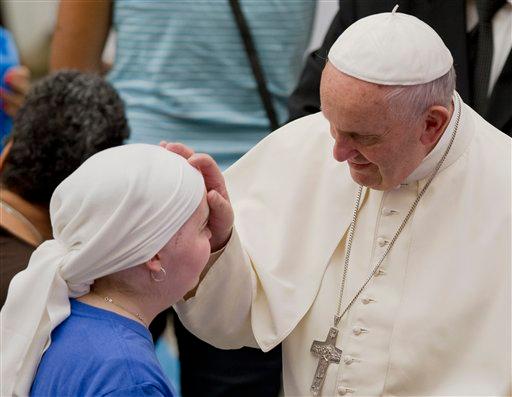
Folks in Philadelphia still speak with pride about the time Pope John Paul II visited the city in 1979. Next month, a new pope, with an even higher profile (and certainly a much larger social media following), will once again bless the City of Brotherly Love with his presence, along with a formidable boost in tourism.
“We know Pope Francis attracts attention wherever he is, and this visit will touch the perception people have of Philadelphia,” said Meryl Levitz, the CEO of Visit Philadelphia. “In addition to being a religious figure, he is a world figure, so we expect tourism in the short term and long term to be affected by his visit.”
Call it a papal bump, if you will. Pope Francis has been a boon for tourism all over the world. In 2013, in the first nine months following his election, 6.6 million tourists visited the Vatican — almost three times as many as the 2.35 million who came the year before.
Hotels and services in the Philippines received a similar bump in January of this year when the Pope made his visit there.
Philippine Chamber of Commerce and Industry President Alfredo Yao called the papal visit “advertising for the Philippines.”
And when the Pope visited Albania in 2014, it was described as nothing short of a game changer.
“The visit of … figure like the Pope is positive PR, and the attention it will draw in the media will counterbalance the unfair image of Albania as Muslim and backward,” Kliton Gerxhani, an Albanian tourism consultant, said at the time.
Next month will be the first trip to the United States for the head of the 1.2 billion-member Catholic Church. While Francis will also be visiting New York and Washington, D.C., during his trip to the States, Philadelphia is the one stop where visitors are expected to be able to see and spend time with the pope in the flesh.
Pope Francis will be attending the World Meeting of Families in Philadelphia. He will arrive on Saturday, Sept. 26, and speak at Independence Hall before celebrating at the Festival of Families, a free party held on Benjamin Franklin Parkway. On the afternoon of Sept. 27, the pope will lead Mass for hundreds of thousands of people, also on the parkway.
The Go Philadelphia! app will work offline in case service is disrupted by the influx of visitors to the city.
Anticipating a demand for information, the World Meeting of Families created the Go Philadelphia! mobile app, which provides a guide to all things papal, including places to visit, emergency information, and public transportation information. The app will also provide real-time translation and captioning in eight languages during portions of the Papal Mass and maps of papal visit locations.
Hotels in the city are being snatched up quickly, and this coming Thursday, the home rental site Airbnb is holding an event in Philadelphia for those thinking about hosting, so they can meet the Airbnb team, other hosts in the area, and local city officials to get advice on how to best prepare their homes for those traveling to the city for the visit.
“We’ve seen a 270 percent increase in listings on Airbnb.com since April, which means more people are starting to list their private rooms or entire homes up on Airbnb.com for events like the Made in America Festival and the papal visit,” said Alex Ward, the general manager of new markets in the United States for Airbnb. “The papal visit has definitely had an effect on demand and as a result, more people are becoming hosts in the city to welcome them.”
The home rental site HomeAway also says it has seen a 795 percent increase in demand in Philadelphia short-term rentals, which is based on a combination of bookings and inquiries compared to the same time last year.
HomeAway has also seen an uptick of 45 percent in demand in D.C. and a 40 percent increase in the surrounding D.C. area across Virginia and Maryland suburbs during the pope’s visit.
The papal bump also seems to have a spillover effect. Lancaster, Pa., about two hours outside of both Philadelphia and Washington D.C., is also preparing for a boost.
“We’re aware of up to two dozen bus groups that are actually staying here in Lancaster and then going on down into Philly,” Joel Cliff, of Discover Lancaster, told local news station Fox 43. “So they’re using hotel rooms here simply because it works better for their itinerary, their costs.”
Cliff is also hoping that groups take a day trip to see the local attractions in the region, which includes Amish Country.
Beyond a spike in September, Philadelphia is hoping to see more long-term effects from the visit.
“There will be a carryover. People will see things that intrigue them and they will come back,” Levitz said.
Other locations around the globe are hoping to see a similar interest from papal tourism. In November, Pope Francis will travel to Africa, where he is scheduled to visit Uganda, Kenya, and the Central African Republic. Francis’s visit to Uganda will be the third by a sitting pope, and the Uganda Tourism Board estimates that around 10 million tourists — both local and international — will turn out for the visit.
Related: Take a Gay and Lesbian Pilgrimage With a Catholic Nun
“Tour operators are expecting to gain from this visit. Many people from different continents will be persuaded to explore more about this East African country as a result of pope’s visit. Being the fact that he will visit some cultural and religious sites like Namugongo shrine, it will help in boosting the country’s tourism,” the tour company Maranatha posted on its website.
“Hopefully this upcoming event will help in boosting the country’s tourism, which has of lately been affected by various happenings in the world.”
Let Yahoo Travel inspire you every day. Hang out with us on Facebook, Twitter, Instagram, and Pinterest. Check out our original adventure travel series, “A Broad Abroad.”
Folks in Philadelphia still speak with pride about the time Pope John Paul II visited the city in 1979. Next month, a new pope, with an even higher profile (and certainly a much larger social media following), will once again bless the City of Brotherly Love with his presence, along with a formidable boost in tourism.
“We know Pope Francis attracts attention wherever he is, and this visit will touch the perception people have of Philadelphia,” said Meryl Levitz, the CEO of Visit Philadelphia. “In addition to being a religious figure, he is a world figure, so we expect tourism in the short term and long term to be affected by his visit.”
Call it a papal bump, if you will. Pope Francis has been a boon for tourism all over the world. In 2013, in the first nine months following his election, 6.6 million tourists visited the Vatican — almost three times as many as the 2.35 million who came the year before.
Hotels and services in the Philippines received a similar bump in January of this year when the Pope made his visit there.
Philippine Chamber of Commerce and Industry President Alfredo Yao called the papal visit “advertising for the Philippines.”
And when the Pope visited Albania in 2014, it was described as nothing short of a game changer.
“The visit of … figure like the Pope is positive PR, and the attention it will draw in the media will counterbalance the unfair image of Albania as Muslim and backward,” Kliton Gerxhani, an Albanian tourism consultant, said at the time.
Next month will be the first trip to the United States for the head of the 1.2 billion-member Catholic Church. While Francis will also be visiting New York and Washington, D.C., during his trip to the States, Philadelphia is the one stop where visitors are expected to be able to see and spend time with the pope in the flesh.
Pope Francis will be attending the World Meeting of Families in Philadelphia. He will arrive on Saturday, Sept. 26, and speak at Independence Hall before celebrating at the Festival of Families, a free party held on Benjamin Franklin Parkway. On the afternoon of Sept. 27, the pope will lead Mass for hundreds of thousands of people, also on the parkway.
The Go Philadelphia! app will work offline in case service is disrupted by the influx of visitors to the city.
Anticipating a demand for information, the World Meeting of Families created the Go Philadelphia! mobile app, which provides a guide to all things papal, including places to visit, emergency information, and public transportation information. The app will also provide real-time translation and captioning in eight languages during portions of the Papal Mass and maps of papal visit locations.
Hotels in the city are being snatched up quickly, and this coming Thursday, the home rental site Airbnb is holding an event in Philadelphia for those thinking about hosting, so they can meet the Airbnb team, other hosts in the area, and local city officials to get advice on how to best prepare their homes for those traveling to the city for the visit.
“We’ve seen a 270 percent increase in listings on Airbnb.com since April, which means more people are starting to list their private rooms or entire homes up on Airbnb.com for events like the Made in America Festival and the papal visit,” said Alex Ward, the general manager of new markets in the United States for Airbnb. “The papal visit has definitely had an effect on demand and as a result, more people are becoming hosts in the city to welcome them.”
The home rental site HomeAway also says it has seen a 795 percent increase in demand in Philadelphia short-term rentals, which is based on a combination of bookings and inquiries compared to the same time last year.
HomeAway has also seen an uptick of 45 percent in demand in D.C. and a 40 percent increase in the surrounding D.C. area across Virginia and Maryland suburbs during the pope’s visit.
The papal bump also seems to have a spillover effect. Lancaster, Pa., about two hours outside of both Philadelphia and Washington D.C., is also preparing for a boost.
“We’re aware of up to two dozen bus groups that are actually staying here in Lancaster and then going on down into Philly,” Joel Cliff, of Discover Lancaster, told local news station Fox 43. “So they’re using hotel rooms here simply because it works better for their itinerary, their costs.”
Cliff is also hoping that groups take a day trip to see the local attractions in the region, which includes Amish Country.
Beyond a spike in September, Philadelphia is hoping to see more long-term effects from the visit.
“There will be a carryover. People will see things that intrigue them and they will come back,” Levitz said.
Other locations around the globe are hoping to see a similar interest from papal tourism. In November, Pope Francis will travel to Africa, where he is scheduled to visit Uganda, Kenya, and the Central African Republic. Francis’s visit to Uganda will be the third by a sitting pope, and the Uganda Tourism Board estimates that around 10 million tourists — both local and international — will turn out for the visit.
Related: Take a Gay and Lesbian Pilgrimage With a Catholic Nun
“Tour operators are expecting to gain from this visit. Many people from different continents will be persuaded to explore more about this East African country as a result of pope’s visit. Being the fact that he will visit some cultural and religious sites like Namugongo shrine, it will help in boosting the country’s tourism,” the tour company Maranatha posted on its website.
“Hopefully this upcoming event will help in boosting the country’s tourism, which has of lately been affected by various happenings in the world.”
Let Yahoo Travel inspire you every day. Hang out with us on Facebook, Twitter, Instagram, and Pinterest. Check out our original adventure travel series, “A Broad Abroad.”
Subscribe to:
Posts (Atom)