US President Donald Trump landed in Saudi Arabia Saturday for the start of an eight-day foreign tour, taking his first steps on the world stage as scandals mount at home.
Trump can expect a warm welcome in Saudi Arabia where he is to meet King Salman and other senior royals -- in sharp contrast to Washington where pressure is building over his team's alleged links to Moscow.
Air Force One had barely taken off when it was announced that James Comey, the former FBI chief fired by Trump, had agreed to testify publicly about Russian interference in the US elections.
Reports also emerged that Trump had called Comey "a nut job" and that the FBI had identified a senior White House official as a "significant person of interest" in its probe of Russian meddling.
A red carpet was rolled out and staircase rolled up to Air Force One after it landed at King Khalid International Airport in Riyadh shortly before 9:50 am (0650 GMT).
Trump and his wife Melania, who dressed conservatively in black but did not cover her hair, walked side-by-side to the tarmac where they both shook hands with Saudi King Salman.
Trump is to hold talks with King Salman and the kingdom's two powerful crown princes later on Saturday, before giving a speech on Islam to leaders of Muslim countries on Sunday.
For Riyadh the visit is an opportunity to rebuild ties with a key ally, which were strained under Trump's predecessor Barack Obama who Sunni Arab Gulf states suspected of a tilt towards their Shiite regional rival Iran.
That, together with a more muted focus on human rights and the likely announcement of new arms deals, should please Washington's traditional Sunni Gulf allies.
He's going to be tougher on Iran, said Philip Gordon, senior fellow at the Council on Foreign Relations. "He's not going to lecture them on democracy and human rights."
Sunday's speech to dozens of Muslim leaders has been touted as a major event -- along the lines of a landmark address to the Islamic world given by Obama in Cairo in 2009.
The speech will be especially sensitive given tensions sparked by the Trump administration's attempted travel ban targeting several Muslim majority nations and accusations of anti-Islamic rhetoric on the campaign trail.
I'll speak with Muslim leaders and challenge them to fight hatred and extremism, and embrace a peaceful future for their faith, Trump said ahead of his visit.
Trump wants Gulf states in particular to do more to tackle extremists such as the Islamic State jihadist group.
He will encourage our Arab and Muslim partners to take bold, new steps to promote peace and to confront those, from ISIS to Al-Qaeda... who perpetuate chaos and violence that has inflicted so much suffering throughout the Muslim world and beyond,said Trump's National Security Adviser H.R. McMaster.
Before departing, the president tweeted he would be "strongly protecting American interests" on his marathon eight-day trip to the Middle East and Europe.
After Saudi Arabia, Trump will head to Israel and the Palestinian Territories where he hopes to revive the moribund peace process.
He then travels to Europe where he will hold face-to-face meetings including with Pope Francis and France's new leader, Emmanuel Macron.
It is a trip fraught with peril for the real estate magnate, who is known to dislike lengthy travel.
The avalanche of revelations in the run-up to his departure have eroded Trump's standing at home where the parallels with Richard Nixon's ill-fated presidency are now being openly drawn.
On Friday, the probe into his campaign's Russia ties had identified a "significant person of interest" in the White House undercut Trump's insistence his election bid had nothing to do with the Kremlin.
The White House was rocked by another bombshell when reports emerged that Trump said his firing of "nut job" Comey had relieved "great pressure" on him due to the investigation.
The scandals have revived questions about his ability to strike a presidential tone with his foreign counterparts, with Trump declaring himself the victim of the "greatest witch hunt" in American political history.
Arms contracts
His visit to the Gulf is expected to bring lucrative arms contracts for US firms.
"The big question mark that you should bear in mind is if Saudi Arabia signs up for a $100 billion arms deal with oil prices where they are today, how are they actually going to pay that in the future?" said Bruce Riedel, former CIA analyst and counterterrorism expert now with the Brookings Institution.
In Israel, Trump will meet his "friend" Israeli Prime Minister Benjamin Netanyahu in Jerusalem and Palestinian president Mahmud Abbas in Bethlehem.
The Israeli leg of his trip is already awash in controversy -- from a row over Trump's visit to Jerusalem's Western Wall, the holiest prayer site for Jews, to his alleged disclosure of Israeli intelligence to Russian officials.
Trump's meeting with Pope Francis -- two men at odds on everything from climate change to refugee policy remains highly unpredictable, although the pontiff says he will give America's bullish leader an open-minded hearing.
The president will also meet members of NATO in Brussels and attend a G7 summit in the picturesque Sicilian town of Taormina overlooking the Mediterranean.

Tourism, Travel, Hospitality, Conservation: News,Stories And Experiences From Allover The World
Showing posts with label pope francis. Show all posts
Showing posts with label pope francis. Show all posts
Saturday, 20 May 2017


Sunday, 9 April 2017
EGYPT: Church Bombings On Palm Sunday Kill 36
Bombings at two Egyptian churches killed more than 35 people as they gathered to mark Palm Sunday, officials said, in one of the deadliest recent attacks on the country's Coptic Christians.
The attacks on the Mar Girgis church in the city of Tanta north of Cairo and Saint Mark's Church in the coastal city of Alexandria came just weeks ahead of a visit by Pope Francis to show support for Egypt's large Christian minority.
Egyptian officials denounced the attack as an attempt to sow divisions in the country, while Francis sent his "deep condolences" to Coptic Christian Pope Tawadros II.
There was no immediate claim of responsibility for the attacks but Egyptian Christians have repeatedly been targeted by jihadists including the Islamic State group.
The first blast killed at least 25 people and wounded more than 70 when it hit the church in Nile Delta City of Tanta, about 120 kilometres (75 miles) north of Cairo, according to a health ministry toll.
Images broadcast by private television stations showed bloodstains smearing the whitewashed walls of the church next to shredded wooden benches.
"The explosion took place in the front rows, near the altar, during the mass," General Tarek Atiya, the deputy to Egypt's interior minister in charge of relations with the media, said.
The worshippers had been celebrating Palm Sunday, one of the holiest days of the Christian calendar, marking the triumphant entrance of Jesus to Jerusalem.
The second blast killed at least 11 people and wounded 35 at the church in Alexandria, Egypt's second largest city, according to the health ministry.
Tawadros had been attending a mass at the church but a Coptic Church official said he had left before the blast.
Francis, who is due to visit Cairo on April 28-29, offered prayers for the victims.
"Let us pray for the victims of the attack unfortunately carried out today," he said in an Angelus prayer. "May the Lord convert the heart of those who sow terror, violence and death and also the heart of those who make weapons and trade in them."
Copts, who make up about one tenth of Egypt's population of more than 92 million and who celebrate Easter next weekend, have been targeted by several attacks in recent months.
Jihadists and Islamists accuse Copts of supporting the military overthrow of Islamist president Mohamed Morsi in 2013, which ushered in a deadly crackdown on his supporters.
In December, a suicide bombing claimed by IS killed 29 worshippers during Sunday mass in Cairo. The bombing of the church within a compound that also holds the seat of the Coptic papacy was the deadliest attack against the minority in recent memory.
A spate of jihadist-linked attacks in Egypt's restive Sinai Peninsula, including the murder of a Copt in the city of El Arish whose house was also burned, have led some Coptic families to flee their homes.
About 250 Christians took refuge in the Suez Canal city of Ismailiya after IS released a video in February calling for attacks on the religious minority.
Reacting before the second bombing in Alexandria, Egyptian Foreign Ministry spokesman Ahmed Abu Zeid called the attack in Tanta "a failed attempt against our unity".
"Terrorism hits Egypt again, this time on Palm Sunday," he tweeted.
Prime Minister Sherif Ismail also condemned the attack, stressing Egypt's determination to "eliminate terrorism". The Cairo-based Al-Azhar, an influential Sunni Muslim authority, said it aimed to "destabilise security and the unity of Egyptians".
Egypt's Copts have endured successive attacks since Morsi's ouster in July 2013. More than 40 churches were attacked nationwide in the two weeks after the deadly dispersal by security forces of two pro-Morsi protest camps in Cairo on August 14, 2013, Human Rights Watch said.
Amnesty International later said more than 200 Christian-owned properties were attacked and 43 churches seriously damaged, adding that at least four people were killed.
President Abdel Fattah al-Sisi, who as then army chief helped remove Morsi, has defended his security forces and accused jihadists of attacking Copts in order to divide the country.
In October 2011, almost 30 people mostly Coptic Christians were killed after the army charged at a protest outside the state television building in Cairo to denounce the torching of a church in southern Egypt.
In May that year, clashes between Muslims and Copts left 15 dead in the working-class Cairo neighbourhood of Imbaba where two churches were attacked.
A few months earlier, the unclaimed bombing of a Coptic church killed more than 20 people in Egypt's second city of Alexandria on New Year's Day.
The attacks on the Mar Girgis church in the city of Tanta north of Cairo and Saint Mark's Church in the coastal city of Alexandria came just weeks ahead of a visit by Pope Francis to show support for Egypt's large Christian minority.
Egyptian officials denounced the attack as an attempt to sow divisions in the country, while Francis sent his "deep condolences" to Coptic Christian Pope Tawadros II.
There was no immediate claim of responsibility for the attacks but Egyptian Christians have repeatedly been targeted by jihadists including the Islamic State group.
The first blast killed at least 25 people and wounded more than 70 when it hit the church in Nile Delta City of Tanta, about 120 kilometres (75 miles) north of Cairo, according to a health ministry toll.
Images broadcast by private television stations showed bloodstains smearing the whitewashed walls of the church next to shredded wooden benches.
"The explosion took place in the front rows, near the altar, during the mass," General Tarek Atiya, the deputy to Egypt's interior minister in charge of relations with the media, said.
The worshippers had been celebrating Palm Sunday, one of the holiest days of the Christian calendar, marking the triumphant entrance of Jesus to Jerusalem.
The second blast killed at least 11 people and wounded 35 at the church in Alexandria, Egypt's second largest city, according to the health ministry.
Tawadros had been attending a mass at the church but a Coptic Church official said he had left before the blast.
Francis, who is due to visit Cairo on April 28-29, offered prayers for the victims.
"Let us pray for the victims of the attack unfortunately carried out today," he said in an Angelus prayer. "May the Lord convert the heart of those who sow terror, violence and death and also the heart of those who make weapons and trade in them."
Copts, who make up about one tenth of Egypt's population of more than 92 million and who celebrate Easter next weekend, have been targeted by several attacks in recent months.
Jihadists and Islamists accuse Copts of supporting the military overthrow of Islamist president Mohamed Morsi in 2013, which ushered in a deadly crackdown on his supporters.
In December, a suicide bombing claimed by IS killed 29 worshippers during Sunday mass in Cairo. The bombing of the church within a compound that also holds the seat of the Coptic papacy was the deadliest attack against the minority in recent memory.
A spate of jihadist-linked attacks in Egypt's restive Sinai Peninsula, including the murder of a Copt in the city of El Arish whose house was also burned, have led some Coptic families to flee their homes.
About 250 Christians took refuge in the Suez Canal city of Ismailiya after IS released a video in February calling for attacks on the religious minority.
Reacting before the second bombing in Alexandria, Egyptian Foreign Ministry spokesman Ahmed Abu Zeid called the attack in Tanta "a failed attempt against our unity".
"Terrorism hits Egypt again, this time on Palm Sunday," he tweeted.
Prime Minister Sherif Ismail also condemned the attack, stressing Egypt's determination to "eliminate terrorism". The Cairo-based Al-Azhar, an influential Sunni Muslim authority, said it aimed to "destabilise security and the unity of Egyptians".
Egypt's Copts have endured successive attacks since Morsi's ouster in July 2013. More than 40 churches were attacked nationwide in the two weeks after the deadly dispersal by security forces of two pro-Morsi protest camps in Cairo on August 14, 2013, Human Rights Watch said.
Amnesty International later said more than 200 Christian-owned properties were attacked and 43 churches seriously damaged, adding that at least four people were killed.
President Abdel Fattah al-Sisi, who as then army chief helped remove Morsi, has defended his security forces and accused jihadists of attacking Copts in order to divide the country.
In October 2011, almost 30 people mostly Coptic Christians were killed after the army charged at a protest outside the state television building in Cairo to denounce the torching of a church in southern Egypt.
In May that year, clashes between Muslims and Copts left 15 dead in the working-class Cairo neighbourhood of Imbaba where two churches were attacked.
A few months earlier, the unclaimed bombing of a Coptic church killed more than 20 people in Egypt's second city of Alexandria on New Year's Day.
Wednesday, 17 February 2016
MEXICO: Pope Francis Celebrates Mass In Michoacan, Mexico

The pope urged Mexico’s priests not to resign themselves to a country dominated by drug-fueled violence and corruption, but rather to be inspired to get out of their comfortable lives and fight injustice.
In his homily, Francis told priests and nuns not to be paralyzed by resignation, which he calls the devil’s “favourite weapon.”
“What temptation can come to us from places often dominated by violence, corruption, drug trafficking? What temptations can we have in face all of that that?What temptations might we face with this reality, which seems to have become a permanent system? I think we can sum it up in a word: resignation.”
Far from the haves and closer to the have-nots through words and gestures. That appears to be the message Pope Francis has transmitted throughout his visit to Mexico, home to the world’s second largest Catholic congregation.
His visit to Chiapas, the southern and poorest Mexican state was also meant to revive the religion as the number of followers has fallen significantly. Mired in poverty and plagued by rising insecurity, the region has fallen far behind other parts of the country economically.
Preaching to a packed sports stadium, the pope drew comparisons between Catholic and indigenous values.
“The most abandoned and abused poor can be found in our oppressed land. We cannot ignore this any more in front of one of the greatest environmental crises in history. In this, you have a lot to teach us,” the pope said.
The pope also denounced the “systemic” exclusion of Mexico’s indigenous people and encouraged the used of native languages in Catholic worship in a bid to stem a wave of Protestant conversions.
“Your people have been misunderstood and excluded from society. Some have even considered you inferior, (as well) your values, cultures, your tradition,” he added.
In the colonial mountain city of San Cristobal de las Casas, the pope prayed in front of the tomb of Bishop Samuel Ruiz, a champion for indigenous rights who served as mediator between the government and Zapatista rebels.
But Francis didn’t only address the poor. He also took a message to the country’s rich and corrupt elite to lament the fact that some 26,000 people are missing and more than 100,000 others have been killed over the last decade in drug related violence.
“Each time we seek the path of privileges or benefits for a few to the detriment of the good of all, sooner or later the life of society becomes a fertile soil for corruption, drug trade, exclusion of different cultures,” he said.
He also had some no-nonsense choice words for Mexican priests who he said should stop acting like princes and move closer to the people.
Saturday, 28 November 2015
UGANDA: Viva Papa, Viva Papa, Viva Papa - Pope Jets Into Uganda

17:07pm: Pope Francis' shepherd one lands at Entebbe International Airport.
17:12pm: Bishops make their way to receive the pope, the team to receive the pope on behalf of the government also moves forward. President Museveni leads government, Diplomats and religious leaders in welcoming the Pope to Uganda.
Bishops head out to meet Pope Francis at Entebbe Airport.

17:28: Pope Francis alights the Shepherd One, exchanges pleasantries with President Museveni. Now the Vatican anthem playing. Meanwhile a gun salute for the pope.
17:40pm: Pope Francis greets bishops and other dignitaries.
17:41pm: Archbishop of Gulu diocese Odama has had his day in the sun, and enjoyed it, introducing all Bishops to the Pope. Now president takes over.
After the pope made his way to the VVIP lounge towards his waiting official car. Meanwhile, people could be heard chanting: "no change, our man." The Pope then got into his car (KIA) and set off for statehouse.
The Holy Father rides in a small KIA Soul from Entebbe Airport, supplied by The Motorcenter EA, the KIA distributors in Uganda.

18:22pm: Pope Francis arrives at State House Entebbe, he and Museveni have a one on one. Vatican Spokesman Federico Lombardi in the room too.
18:35pm: Vatican secretary of state, Archbishop Parolini and Cardinal Turkson for peace and Justice of the Holy Sea enter State House room. House rises and claps.
18:36pm: Pope enters room at State House to address diplomats and senior government officials.
18:41pm: President Museveni invites Pope Francis to address diplomats at State House.
18:51pm: Pope says he is happy to be in Uganda, calls for unity, justice and reconciliation
Pope Francis last night declared Africa a “land of hope”, urging Uganda to invest in its young population and use the country’s “abundant” natural resources to benefit both current and future generations.
In a brief speech at State House Entebbe, which assembled diplomats, senior government and cultural leaders repeatedly interrupted with cheers and hand-clapping, the pontiff described Uganda as a “great nation”.
He praised the country for opening its doors with compassion to receive refugees and allowing them rebuild their lives in “security and dignity”.
The Pope said Uganda’s national motto, For God and My Country, reminds of the role moral rectitude and a commitment to common good have played and continue to play in the social, economic and political life of the country.
“This reminds us to seek truth, work for justice, reconciliation and respect and protect one another as members of one human family,” he said.
He told the officials, including Opposition leaders, to ensure just distribution of the dividends of Uganda’s God-granted resources.
The Pope said his six-day, three-nation maiden Africa tour was to draw global attention to the continent; its hope, promise, travails and achievements. “
The world looks to Africa as the continent of hope,” he said, and cautioned government officials of the “challenges” of managing the blessings of abundant natural resources to benefit all citizens.
Speaking with excitement about his scheduled meeting with 10,000 youth at Kololo Ceremonial Grounds, the Holy Father extolled the role of young people as the future and hope of the country, and the world, if well-educated and assured of gainful employment. It was a striking message for Uganda grappling with 80 per cent youth unemployment. The elderly, he said, need better care as reservoirs of wisdom and their knowledge and experience, like a compass, should help illuminate decisions-making when confronted with evolving problems.
“It is these small signs that we see the true soul of people,” he said in reference to his call for care and help to the sick, the poor and underprivileged.
The Pope’s meeting followed his one-on-one meeting with co-host President Museveni.
Mr Museveni said former Tanzanian President Julius Nyerere, whose widow was in attendance, was the “greatest African who lived”, citing his lead role in liberation of almost half of African countries from colonialism.
Pope Francis landed in Uganda Friday on the second leg of a landmark trip to Africa, with huge crowds, choirs and dancers celebrating as he touched down.
Francis arrived in Uganda after three days in neighbouring Kenya, where vast crowds turned out to an open air mass, and where the pontiff lashed out at corruption and wealthy minorities who hoard resources at the expense of the poor.
Large crowds gathered in Entebbe some 30 kilometres (20 miles) south of the capital Kampala where Francis will meet Museveni at the presidential palace later on Friday.
Crowds gathered along the roads, four deep in some places, while street lights were draped with black, yellow and red banners, the colours of the national flag.
"I'd like him to talk about corruption, which is too much in Uganda. And we hope he can bring political change. He must talk to Museveni: if a pope can stand down why not a president?" a lady said.
Police and soldiers, all armed with assault rifles or batons, lined the road and military pickups raced up and down the street.
"This latest pope, Francis, he cares for all the people, the whole universe, regardless of political or religious affiliation."
Security has been ratcheted up for the visit over fears Islamist rebels from Al-Qaeda's East Africa branch, the Shebab, could use the opportunity to stage attacks.
But chief of the defence forces Katumba Wamala has said measures are in place and expressed confidence "all will go as planned."
Francis has shrugged off safety fears, joking that he was "more worried about the mosquitoes".
Pope itinerary 28th Nov 2015
•Arrives at the Anglican Shrine in Namugongo at 8.30am.
•Arrives at the Uganda Catholic Martyrs Shrine at 9am, says a short private meditative prayer not exceeding 15 minutes and begin Mass.
•The Mass starts at 9.30am.Those intending to attend should have assembled by 6.30am.
•Addresses the youth at Kololo Inndence/Ceremonial Grounds at 3:15pm
•At 4.30pm, Pope will arrive at the Bakateyamba Home, Nalukolongo.
• Arrives at Rubaga Cathedral at 5pm for meeting with bishops and priests.
Pope Francis arrived minutes ago at the Namugongo protestant shrine-Nakiyanja where he is inspecting the martyrs museum led by ArchBishop of the Anglican Church of Uganda Stanley Ntagali.
The pope is blessing the Anglicans amidst cheers
8:58 a.m The pope waves to the cheering believers as he drives off to the Catholic shrine where he will celebrate a mass to mark the 50th anniversary of the canonisation of the Uganda martyrs
9:03 am The pope's convoy approaches the Catholic shrine, believers cheer him in excitement
The President of Uganda H E Yoweri Kaguta Museveni and the first lady arrived almost an hour ago to Namugongo Shrine. Presidential aspirants Amama Mbabazi, Dr Kizza Besigye are also at the Shrine. South Sudan's Salva Kiir and Mama Nyerere are also present.
9:10 a.m Pope's team arrives in four vans to loud and frenzied cheers
The choir ushers in the pope as they sing "Matching together" a famous catholic hymn
9:23 a.m Bishops stand in a long procession waiting for the pope to join them so that the open air mass celebration at the Catholic martyrs shrine begins
The crowds are so big i have never seen in my life.
If Jesus or Holy Mary came to Uganda, a predominantly catholic country, i wonder if any one would remain in the villages
Viva Papa, Viva Papa, Viva Papa.
Friday, 27 November 2015
KENYA: Pope Francis Condemns Land Grabbing In Kenya On His Last Day

He added: “I am aware that faceless developers have attempted to give themselves the playgrounds of your childrens’ schools”. The Pope further said the suffering of the poor is occasioned by the greedy minority in power. He urged Christians and pastors to renew their calls and take up their neighbors problems.
Pope Francis is in Kenya on a three-day tour. This is his maiden trip to Africa and he will also visit Uganda and Central African Republic.
"These are wounds inflicted by minorities who cling to power and wealth, who selfishly squander while a growing majority is forced to flee to abandoned, filthy and run-down peripheries," the 78-year-old pontiff told crowds in the Nairobi shanty town of Kangemi. Francis, whose visit to the slum is a highlight of his three-nation Africa tour, condemned the "dreadful injustice of urban exclusion."
Wild singing and ululating broke out as he arrived early on Friday, his popemobile weaving through streets in a sea of tin-roofed homes. "I am here because I want you to know that I am not indifferent to your joys and hopes, your troubles and your sorrows," Francis told the packed congregation in the church of St Joseph the Worker in Kangemi. "I realise the difficulties which you experience daily. How can I not denounce the injustices which you suffer?"
People arrived long hours before dawn in the hope of catching a glimpse of the pope, who has made efforts for social justice a hallmark of his tenure. Francis criticised the lack of "infrastructures and basic services", including sewerage, electricity, good roads, school and hospitals. "They are a consequence of new forms of colonialism countries are frequently pressured to adopt policies typical of the culture of waste," he added.
"This situation of indifference and hostility experienced by poor neighbourhoods is aggravated when violence spreads and criminal organisations, serving economic or political interests, use children and young people as 'cannon fodder' for their ruthless business affairs," he added, singling out the role women play in binding such societies together. "I also appreciate the struggles of those women who fight heroically to protect their sons and daughters from these dangers."
Pope Francis visited Nairobi's Kangemi area on Friday, calling such informal settlements "wounds inflicted" by a wealthy and powerful elite and urging Africa's governments to do more to lift their people up from poverty.
The pope, making his first visit to the continent, has championed the plight of the poor both in public declarations and his own way of life, shunning the institutional perks of the Vatican. Even before he became Latin America's first pope in 2013, he was known as the "the slum bishop" because of his frequent visits to the shantytowns of Buenos Aires.
Kenya is the first stop on his Africa tour, which also takes him to Uganda and the Central African Republic, a grindingly poor nation riven by Muslim-Christian sectarian conflict. While calling for religious dialogue and appealing for steps to address climate change when he visited the U.N. offices in Nairobi, Francis has regularly returned to his concern about inequality and poverty in his homilies and speeches.
On his last day in Kenya, the pope visited Nairobi's Kangemi district, a neighbourhood of potholed roads, open sewers and jerry-built shacks for homes, lying a few hundred metres from smart apartment blocks and gated residential compounds.
Addressing slum dwellers, charity workers and clergy in St. Joseph the Worker Church, the pope spoke of the "dreadful injustice of urban exclusion" represented in such poor areas.
"These are wounds inflicted by minorities who cling to power and wealth, who selfishly squander while a growing majority is forced to flee to abandoned, filthy and run-down peripheries," he said. Debt to the poor He criticised "faceless private developers who hoard areas of land and even attempt to appropriate the playgrounds of your schools" but he said communal values in poor districts showed there was an alternative culture to the "god of money."
Children from a school run by the Catholic nuns and priests sang for the pope in the simple church of cinder blocks and wood, built across the road from a row of homes made of corrugated metal. Francis said one of biggest challenges was a lack of basic amenities. "Our world has a grave social debt towards the poor who lack access to drinking water," he said, adding no "bureaucratic pretext" should deny a family clean water.
Welcoming the pope Musonde Kivuva, archbishop of Mombasa and president of Kenya's branch of the Catholic charity Caritas, thanked the pope for setting an example of humility with his simple life and for his calls for change. "More can be done and should be done in all our slums. We do not need to wait for the Holy Father to come," he said.
Later on Friday, he travels to Uganda, which like Kenya been struck by Islamist militant attacks. On Sunday, he flies to the Central African Republic, where dozens of people have been killed in violence since September.
KENYA: Pope Francis Speaks Out Against Ivory Poaching
Pope Francis has urged global action against the illegal trafficking of blood diamonds, ivory and other natural resources, in the second day of his landmark three-nation Africa trip.
In a speech in the Kenyan capital Nairobi on Thursday, the pope said the illegal trade in precious stones and ivory fulled political instability and organised crime.
"We cannot be silent about forms of illegal trafficking which arise in situations of poverty," he said, just two weeks before Nairobi hosts a key ministerial meeting of the World Trade Organisation.
Figures published earlier this year by Amnesty International showed conflict diamonds, which account for four percent of total global production, have helped finance civil wars and prop up military regimes.
The pontiff's remarks on wildlife trafficking were likely to hit home in Kenya, a country trying to stamp out rampant poaching to protect its remaining elephant population.
Hundreds of elephants are lost to poaching every year, with conservationists warning the African elephant could be extinct in the wild within a generation.
The Argentine pope also warned against "the globalisation of indifference" and the danger of becoming resigned to "new forms of slavery, human trafficking, forced labour, prostitution and trafficking in organs".
Tens of thousands of Kenyans travelled to the centre of Nairobi on Thursday for a chance to attend a Mass with Pope Francis on his first official visit to the continent.
Rain poured down on the crowds which was considered a blessing from Pope Francis, some of whom had spent the night outside the custom-built chapel in central Nairobi.
He next visits Uganda and the Central African Republic to address a number of pressing concerns, including climate change, conflict resolution, corruption and interfaith tolerance.
In a speech in the Kenyan capital Nairobi on Thursday, the pope said the illegal trade in precious stones and ivory fulled political instability and organised crime.
"We cannot be silent about forms of illegal trafficking which arise in situations of poverty," he said, just two weeks before Nairobi hosts a key ministerial meeting of the World Trade Organisation.
Figures published earlier this year by Amnesty International showed conflict diamonds, which account for four percent of total global production, have helped finance civil wars and prop up military regimes.
The pontiff's remarks on wildlife trafficking were likely to hit home in Kenya, a country trying to stamp out rampant poaching to protect its remaining elephant population.
Hundreds of elephants are lost to poaching every year, with conservationists warning the African elephant could be extinct in the wild within a generation.
The Argentine pope also warned against "the globalisation of indifference" and the danger of becoming resigned to "new forms of slavery, human trafficking, forced labour, prostitution and trafficking in organs".
Tens of thousands of Kenyans travelled to the centre of Nairobi on Thursday for a chance to attend a Mass with Pope Francis on his first official visit to the continent.
Rain poured down on the crowds which was considered a blessing from Pope Francis, some of whom had spent the night outside the custom-built chapel in central Nairobi.
He next visits Uganda and the Central African Republic to address a number of pressing concerns, including climate change, conflict resolution, corruption and interfaith tolerance.
Thursday, 26 November 2015
Healing Pope, Some Miracles Perfomed By Pope Francis
Pope Francis may yet earn the accolade "The Healing Pope" for the miracles he has been performing when touching people with serious health problems.
When the Pope flew to New York as part of his six-day apostolic visit to the United States, he once again showed his healing power when he blessed a 12-year-old girl who was one of those who greeted him at JFK Airport.
Julia Bruzzese of Brooklyn, New York was in a wheelchair when the smiling Pope stopped by, touched her face and blessed her. She had been using the wheelchair ever since she suffered a sudden paralysis whose cause puzzled her doctors no end.
Her doctors said she seemed to exhibit symptoms of Lyme disease. But the problem was that her blood tests showed she was negative for that disease. Early symptoms of the inflammatory Lyme disease include a rash, headache, fever, and chills, according to WebMD. The sufferer then develops arthritis and neurological and cardiac disorders. The disease is caused by bacteria transmitted by ticks, according to the medical website.
While her doctors were still trying to figure out what exactly caused her paralysis, Julia, together with her mother Josephine, decided to meet Pope Francis, hoping and praying for a miracle to enable her to walk again.
"Meeting the pope was the most precious moment of my life," the young girl said. Josephine recalled the moment when the Pope saw and approached them. "He looked me right in the eyes; I kissed his hand and thanked him, and I walked away saying 'she's gonna be okay,'" Josephine said.
Five days later, the doctors decided to subject Julia to another blood test. To their utter surprise, they finally found the cause of her ailment. Their initial suspicion turned out to be right—she had Lyme disease, an ailment that can easily be treated with medication.
"The miracle has begun," Julia said. "Yesterday, I went to the doctor and for the first time they saw Lyme disease activity in my blood, and that just shows a miracle can happen if you believe, just like I did. If you believe and pray everything can happen." In another interview with NBC New York, Julia said she is now brimming with optimism that she will be able to walk again soon. "I know I will walk again because of him [Pope Francis]," she said.
Julia is already starting to plan her activities once she gets to walk again. She said she wants to play softball and soccer again and sing in the choir as well.
"It's unfortunate that this has happened. This experience has made me wiser, made me look at life in a different perspective. Life is precious," she said. Performing miracles is nothing new to Pope Francis. Last March, authorities attested that he turned the dried blood of St. Gennaro into liquid in Naples, Italy.
Just before he began his visits to Cuba and the US, Pope Francis abruptly stopped his motorcade in the rain and asked his aide to bring to him the baby he saw being lifted at the barricade by her parents at St. Peter's Square. The Pope briefly placed his palm on the chest of the three-month-old girl who was suffering from Down's syndrome and had two holes in her heart. Later when the doctors checked on the baby, they found one of the two holes had completely closed while the other one was reduced to half its former size.
Lynn Cassidy, the mother of the baby, said that what happened to her child made her believe that "God can act through the pope's blessings in miraculous ways."
When the Pope flew to New York as part of his six-day apostolic visit to the United States, he once again showed his healing power when he blessed a 12-year-old girl who was one of those who greeted him at JFK Airport.
Julia Bruzzese of Brooklyn, New York was in a wheelchair when the smiling Pope stopped by, touched her face and blessed her. She had been using the wheelchair ever since she suffered a sudden paralysis whose cause puzzled her doctors no end.
Her doctors said she seemed to exhibit symptoms of Lyme disease. But the problem was that her blood tests showed she was negative for that disease. Early symptoms of the inflammatory Lyme disease include a rash, headache, fever, and chills, according to WebMD. The sufferer then develops arthritis and neurological and cardiac disorders. The disease is caused by bacteria transmitted by ticks, according to the medical website.
While her doctors were still trying to figure out what exactly caused her paralysis, Julia, together with her mother Josephine, decided to meet Pope Francis, hoping and praying for a miracle to enable her to walk again.
"Meeting the pope was the most precious moment of my life," the young girl said. Josephine recalled the moment when the Pope saw and approached them. "He looked me right in the eyes; I kissed his hand and thanked him, and I walked away saying 'she's gonna be okay,'" Josephine said.
Five days later, the doctors decided to subject Julia to another blood test. To their utter surprise, they finally found the cause of her ailment. Their initial suspicion turned out to be right—she had Lyme disease, an ailment that can easily be treated with medication.
"The miracle has begun," Julia said. "Yesterday, I went to the doctor and for the first time they saw Lyme disease activity in my blood, and that just shows a miracle can happen if you believe, just like I did. If you believe and pray everything can happen." In another interview with NBC New York, Julia said she is now brimming with optimism that she will be able to walk again soon. "I know I will walk again because of him [Pope Francis]," she said.
Julia is already starting to plan her activities once she gets to walk again. She said she wants to play softball and soccer again and sing in the choir as well.
"It's unfortunate that this has happened. This experience has made me wiser, made me look at life in a different perspective. Life is precious," she said. Performing miracles is nothing new to Pope Francis. Last March, authorities attested that he turned the dried blood of St. Gennaro into liquid in Naples, Italy.
Just before he began his visits to Cuba and the US, Pope Francis abruptly stopped his motorcade in the rain and asked his aide to bring to him the baby he saw being lifted at the barricade by her parents at St. Peter's Square. The Pope briefly placed his palm on the chest of the three-month-old girl who was suffering from Down's syndrome and had two holes in her heart. Later when the doctors checked on the baby, they found one of the two holes had completely closed while the other one was reduced to half its former size.
Lynn Cassidy, the mother of the baby, said that what happened to her child made her believe that "God can act through the pope's blessings in miraculous ways."
KENYA: Thousands Brave Rains To Attend Pope’s Public Mass
Thousands of Kenyans braved the Thursday morning rains and cold as they gathered at University of Nairobi grounds, ready for Pope Francis’ 10a.m. public mass.
Others were forced to camp at the Central Park, almost 500 m away from the main mass place watching huge screens that had been mounted.
This is because the main venue had been filled by 9 a.m. Security was tight as contingents of police backed by National Youth Service screened those getting into the venues. The queues snaked close to a kilometer as the faithful braved the rains that were being experienced. A police helicopter hovered the venue with security officials declaring the city had an incident free night.
Nairobi police boss Japheth Koome was leading the more than 15,000 security personnel in controlling the crowds that started streaming in by 4 a.m.
“So far we have had good times as there is no incident worth attention,” said Koome. Buses that had ferried the faithful were allowed into the city centre as other personal vehicles were locked out.
Police were rained on and did not have umbrellas as other pedestrians who were headed for the venue. The Pope mobile, which he was scheduled to use to the venue, was stationed at the Kenyatta Avenue/Uhuru Highway roundabout with an escort car and a motorbike to lead it and ready for action.
Those at venue played Catholic hymns as the crowds milled in. There had been heavy rains from Wednesday morning but they did not deter the enthusiasts who wanted to get to the venue.
Police had announced they would block the roads into the CBD. The Pope was in a meeting with inter religious leaders in Lavington by 8 am ahead of the 10 am mass at University of Nairobi.
Others were forced to camp at the Central Park, almost 500 m away from the main mass place watching huge screens that had been mounted.
This is because the main venue had been filled by 9 a.m. Security was tight as contingents of police backed by National Youth Service screened those getting into the venues. The queues snaked close to a kilometer as the faithful braved the rains that were being experienced. A police helicopter hovered the venue with security officials declaring the city had an incident free night.
Nairobi police boss Japheth Koome was leading the more than 15,000 security personnel in controlling the crowds that started streaming in by 4 a.m.
“So far we have had good times as there is no incident worth attention,” said Koome. Buses that had ferried the faithful were allowed into the city centre as other personal vehicles were locked out.
Police were rained on and did not have umbrellas as other pedestrians who were headed for the venue. The Pope mobile, which he was scheduled to use to the venue, was stationed at the Kenyatta Avenue/Uhuru Highway roundabout with an escort car and a motorbike to lead it and ready for action.
Those at venue played Catholic hymns as the crowds milled in. There had been heavy rains from Wednesday morning but they did not deter the enthusiasts who wanted to get to the venue.
Police had announced they would block the roads into the CBD. The Pope was in a meeting with inter religious leaders in Lavington by 8 am ahead of the 10 am mass at University of Nairobi.
KENYA: Pope Francis Lectures Humility To African Leaders
In a region where presidents speed past slums in cavalcades of luxury vehicles and the public complain about corruption in high office, the pope was cheered as he drove in a small Honda and told national leaders to act with integrity.
Kenya's prolific Twitter users were quick to notice the contrast. "Thieving politicians arrive in their SUVs and Mercs to listen to @Pontifex who will arrive in a Honda. Shameless 'leaders'," wrote @Kunj_Shah. Francis, who has spurned many of the institutional perks of the Vatican, shunned the armoured cars with tinted glass driven by President Uhuru Kenyatta and his entourage.
Nor did he follow the example of visitors like U.S. President Barack Obama, who turned up in Nairobi in July for an official visit with an army of security personnel and a bullet-proof limousine, dubbed "the Beast". Instead, the pope waved to rapturous crowds from his white popemobile with open sides despite pouring rain and was ferried around Nairobi in the Honda that local media said cost a modest 1.5 million shillings ($14,700).
"The pope is down to earth," said a by stander, who braved a downpour to attend open-air Mass in a sodden Nairobi University sports field. "It is good for our leaders to notice."
"They like the wealth of the world but they can't understand the people of our country," she said. "It is vanity."
The pope lives in a small apartment in a guesthouse in the Vatican rather than the spacious papal apartments in the regal and frescoed Apostolic Palace used by his predecessors.
The day after his election in 2013, he returned to a Rome hotel to personally pay his bill and recently went to a Rome optician to pick up his own eyeglasses.
In September, he rode around Washington DC in a small Fiat on his state visit there.
His Africa trip will take the Pope to Uganda and the Central African Republic, a nation mired in sectarian conflict. He dismissed security concerns, joking with reporters that the "only thing I'm concerned about is the mosquitoes".
Barely two hours after arriving in Nairobi on Wednesday, Francis told the president and dignitaries they had a duty to care for the poor and support the aspirations of the young.
"I encourage you to work with integrity and transparency for the common good, and to foster a spirit of solidarity at every level of society," he said, speaking in the elegant surroundings of State House, the Kenyan president's official residence.
A day earlier, Kenyatta reshuffled his cabinet after several ministers were embroiled in corruption allegations. Kenyatta, a Catholic like 30 percent of Kenya's 45 million people, also spoke of the challenge of graft in his welcome to the pope.
"Your Holiness, like you, as a nation we want to combat the vices of corruption which sacrifice people and the environment in the pursuit of illegal profit," Kenyatta told Francis. "Holy Father, I ask for your prayer as we fight this war."
Scandals in past months have ranged from a ministry buying ballpoint pens for $85 each and probes into multi-million dollar government contract awards. It has angered Kenyans, even though they are long used to corruption sagas where top officials never seem to be convicted.
When he was finance minister Kenyatta tried to address ostentation among officials, demanding they use smaller cars but there has been little lasting impact.
"The sheer humility of the Pope, the simplicity of his message, I fear may be lost on the most rapacious elite on this side of Africa," John Githongo, Kenya's former anti-graft tsar and now an outspoken anti-corruption activist, said.
Kenya's prolific Twitter users were quick to notice the contrast. "Thieving politicians arrive in their SUVs and Mercs to listen to @Pontifex who will arrive in a Honda. Shameless 'leaders'," wrote @Kunj_Shah. Francis, who has spurned many of the institutional perks of the Vatican, shunned the armoured cars with tinted glass driven by President Uhuru Kenyatta and his entourage.
Nor did he follow the example of visitors like U.S. President Barack Obama, who turned up in Nairobi in July for an official visit with an army of security personnel and a bullet-proof limousine, dubbed "the Beast". Instead, the pope waved to rapturous crowds from his white popemobile with open sides despite pouring rain and was ferried around Nairobi in the Honda that local media said cost a modest 1.5 million shillings ($14,700).
"The pope is down to earth," said a by stander, who braved a downpour to attend open-air Mass in a sodden Nairobi University sports field. "It is good for our leaders to notice."
"They like the wealth of the world but they can't understand the people of our country," she said. "It is vanity."
The pope lives in a small apartment in a guesthouse in the Vatican rather than the spacious papal apartments in the regal and frescoed Apostolic Palace used by his predecessors.
The day after his election in 2013, he returned to a Rome hotel to personally pay his bill and recently went to a Rome optician to pick up his own eyeglasses.
In September, he rode around Washington DC in a small Fiat on his state visit there.
His Africa trip will take the Pope to Uganda and the Central African Republic, a nation mired in sectarian conflict. He dismissed security concerns, joking with reporters that the "only thing I'm concerned about is the mosquitoes".
Barely two hours after arriving in Nairobi on Wednesday, Francis told the president and dignitaries they had a duty to care for the poor and support the aspirations of the young.
"I encourage you to work with integrity and transparency for the common good, and to foster a spirit of solidarity at every level of society," he said, speaking in the elegant surroundings of State House, the Kenyan president's official residence.
A day earlier, Kenyatta reshuffled his cabinet after several ministers were embroiled in corruption allegations. Kenyatta, a Catholic like 30 percent of Kenya's 45 million people, also spoke of the challenge of graft in his welcome to the pope.
"Your Holiness, like you, as a nation we want to combat the vices of corruption which sacrifice people and the environment in the pursuit of illegal profit," Kenyatta told Francis. "Holy Father, I ask for your prayer as we fight this war."
Scandals in past months have ranged from a ministry buying ballpoint pens for $85 each and probes into multi-million dollar government contract awards. It has angered Kenyans, even though they are long used to corruption sagas where top officials never seem to be convicted.
When he was finance minister Kenyatta tried to address ostentation among officials, demanding they use smaller cars but there has been little lasting impact.
"The sheer humility of the Pope, the simplicity of his message, I fear may be lost on the most rapacious elite on this side of Africa," John Githongo, Kenya's former anti-graft tsar and now an outspoken anti-corruption activist, said.
KENYA: Newborns To Be Named After Pope Francis
Kakamega County Referral Hospital maternity ward recorded 13 new births since Wednesday 4.30pm when Shepherd One touched down at the Jomo Kenyatta International Airport.
Excited mothers at the hospital said they will name their children after the Pope saying they wish their children to have characters similar to those of the catholic president, who is visiting Africa for the first time.
A woman who delivered her baby boy at 1.00am and named the child Pope Devin but she also wanted to name him Francis to take all the names used by Pope Francis. "Francis is a beautiful name with deep history and very significant as the Pope has visited Kenya.
It is worthy being considered in naming children, who will be a blessing to the society, "she said. Even though some of the mothers did not have a clue on who the Pope is, they vowed to name their children after him saying they want the children to be famous and successful like the Pope.
"I want my son to be blessed and famous like the Pope himself. I want him also to touch the lives of many people across the world," said one of the mothers.
She said she will use the name because of its uniqueness and attributes which the Pope Francis have like conserving the environment, promoting peace, love and unity in the world.
Excited mothers at the hospital said they will name their children after the Pope saying they wish their children to have characters similar to those of the catholic president, who is visiting Africa for the first time.
A woman who delivered her baby boy at 1.00am and named the child Pope Devin but she also wanted to name him Francis to take all the names used by Pope Francis. "Francis is a beautiful name with deep history and very significant as the Pope has visited Kenya.
It is worthy being considered in naming children, who will be a blessing to the society, "she said. Even though some of the mothers did not have a clue on who the Pope is, they vowed to name their children after him saying they want the children to be famous and successful like the Pope.
"I want my son to be blessed and famous like the Pope himself. I want him also to touch the lives of many people across the world," said one of the mothers.
She said she will use the name because of its uniqueness and attributes which the Pope Francis have like conserving the environment, promoting peace, love and unity in the world.
Tuesday, 24 November 2015
UGANDA: Welcome To Uganda Pope Francis, Everybody Is Waiting

As the count down to Pope Francis’ visit draws closer, Police have lined up 12,000 police officers to ensure security during Pope Francis’ visit. An additional 800 traffic police officers will ensure a smooth flow of traffic during the Pontiff’s visit this week.
This is unlike to 5,000 police officers during the Martyrs’ Day celebrations in June. Ten police lead vehicles will also be deployed to clear the road between Entebbe Airport and clock tower in the city of Kampala after the arrival of the Pope.
Police spokesperson Fred Enanga said yesterday the police officers will be deployed at key areas that the Pontiff’s delegation will use.
“We have lined up 12, 000 police officers with additional resources from marines, air force, and military police. As police, we can assure you that we are ready,” said Mr Enanga.
According to the police, the Air Force will provide flight patrols, especially hovering over Entebbe International Airport.
Pope Francis is expected to visit Uganda between 27, and 29, November.
Namugongo Martyrs shrines, Kololo Independence Grounds, are some of the areas Pope Francis is expected to visit and more than a million people are expected to attend.
Thousands of police trainees have been ferried from their training school in Masindi District to beef up security during the Pontiff’s visit.

Kampala Metropolitan Police spokesman, Mr Patrick Onyango, neither confirmed nor denied deployment of the trainees, saying it would compromise safety of the Pope if he gave particular of teams tasked to provide security.
The Vatican advance security team yesterday arrived in the country and made various spot checks at places Pope Francis is expected to visit during his three-day visit that starts this Friday.
A team of five security personnel accompanied by officers from the Uganda Special Forces Group and Uganda Police Force, visited the Namugongo Protestant Shrine where they were hosted by Archbishop Livingstone Mpalanyi Nkoyoyo and Mr Lugya Lwazi, one of the Anglican church leaders.
At the time of the advance team’s visit, Archbishop Nkoyoyo had just finished addressing journalists, where he announced an overnight prayer ahead of the Pope’s visit to the venue this Saturday.
“We are very ready to receive Pope Francis even if he said he is coming tomorrow. What is remaining is to mop and clean. As you have seen, we have received the Pope’s advance team. From here, they have headed to the Namugongo Catholic Shrine,” he said after showing the team the newly constructed museum.
Pope Francis is expected to officially open the museum that has molded impressions of how the martyrs were executed by Mukajanga, King David Mwanga’s chief executor, among others. The team travelling on black land cruisers, with a police lead car, arrived at the Namugongo Catholic Shrines around midday and was received by parish priest Fr Vincent Lubega and Mr Francis Mwonge.
Fr Lubega told journalists that the team also checked the level of preparedness at the shrines.
“Everything is on course. I would like to assure the public that we are ready to receive the Pope. The Basilica is done and the remaining unfinished work is to be completed before the Pope arrives,” he said.
Fr Lubega took journalists around the shrine of which most of the work was done. The newly reconstructed water pond was being filled with water and pavers were being fixed around it.
Pope Francis’s imminent visit to Uganda is shaking off benefits for citizens in more ways than one. And so are the downsides.
Although the trip officially is to commemorate the 51st anniversary of the Uganda Catholic Martyrs, Christian converts executed in 1884 on a traditional king’s orders, dividends abound.
Roads in previously ignored poor neighbourhoods have been upgraded to bitumen, side-drain channels constructed and blighted buildings gleam with a fresh coat of pain.

The pyramidal heavy steel roofing has been capped with glass, and translucent sheets affixed to usher sunlight into what traditionally was a dimly-lit, dull interior.

Roko, a private construction firm, snapped up billions of shillings to revamp the shrine as did firms surfacing the roads.
City and suburban authorities have fatefully superintended the removal or destruction of shacks along the Pope’s mapped routes to seclude fabricators, carpenters and the poor, for whom he advocates mercy, from sight.
“All our kiosks have been demolished. They have even chased us from where we had temporarily staged our kiosks as if the Pope is coming for the rich,” said Mr Moses Isabirye, a mechanic in Namugongo, Wakiso District.
In place of the makeshift, from which struggling vendors eked a living by selling groceries, officials concerned about security and aesthetics are planting grass and flower beds on the widened road reserves.
Like in the capital, managers of the neighbouring Kiira Town Council in Wakiso District have ordered property owners to surface the drive-ways into their premises as well as frontage kerbs, according to Martin Ariho, a resident.
Namugongo Local Council I chairman Nassir Nsubuga, citing the upgraded roads, paved sidewalks and well-built drainage channels, says the ongoing preparations have given his constituency “a deserved facelift” and readiness to welcome the Pope.
And leaders of Wakiso, the host district of the main November 28 papal Mass, want all businesses in and around Namugongo shrine shut during the papal visit.
This would be a drawback for residents who every Uganda Martyrs Day, observed on June 3rd, profiteered by selling food and renting out their houses to tourists and pilgrims.
Bar owners would rake in substantial cash from trooping patrons, bringing an ecstatic, if not chaotic, feel to the neighbourhood that otherwise closes early each night.
Not all is gloom, however. Several commercial structures have sprouted and are nearing completion, beautifying the skyline. Their owners hope to cash in on the visit of Pope Francis either by offering rooms out as improvised accommodation or shops, if not meeting venues.
The bitumen surfaced roads mean less dust, enabling shop owners to keep their merchandise spotless, while new roadside-channels drain off torrents from falling El Nino rains and prevent characteristic flooding in the inner city.
Back at the shrine, masons, landscapists and electricians are putting final touches to massive structures and installations already behind their completion timeline.
The site remains boarded-off, with the public getting a first glimpse of the new facilities during a walk that the New Vision Group, a media company in which the government owns majority shares, organised to raise funds to top up the money for the shrines’ renovations.
The company has also cashed in on sale of rosaries procured from Rome, and with the endorsement of the Uganda Episcopal Conference, an apex assembly of catholic leaders in the country.
In downtown Kampala, particularly along the capital’s commercial printing hub along Nasser Road, entrepreneurial citizens are ordering for calendars and other souvenirs with the Pope’s portraits. These mementoes, sold at inflated prices, have enabled individuals enrich themselves out of the papal trip; the third to Uganda fondly called the ‘Pearl of Africa’.
Former British Prime Minister Sir Winston Churchill coined the pleasant label in reference to the East African country’s priceless natural treasure of flora and fauna.
The tourism ministry sought Shs9 billion in supplementary budget to popularise the endowments, hoping hordes of visiting foreigners will call for days at any of the game parks before or after the Pope’s trip.
The ministry’s website, http://tourism.go.ug, has antiquated information including the line minister’s message, factsheet about Uganda and tourism sites but nothing on the home page about the Pope’s impending coming to the land of martyrs.
Uganda has previously spent billions of shillings to advertise its natural endowments, for instance, on Cable News Network (CNN).
The visit by Pope Francis, leader of the world’s 1.2 billion Catholics, offers the country of 35 million a gain of an unsolicited positive international publicity.
There are some 15 million Catholics in Uganda or 42 per cent of the country’s population, in tandem with the trend of growing numbers of the faithful in Africa and the developing world.
This trip is also an assurance to skeptics, particularly the prospective Western tourists, that Uganda which lies on the Great Lakes security fault line is safe if the Pope can visit it.
The country has half of the world’s mountain gorilla population, and a snow-capped Mt. Rwenzori that straddles its border with the expansive Democratic Republic of Congo is tempting adventure gem.
Mr Gideon Badagawa, the executive director of the Private Sector Foundation Uganda (PSFU), says “I don’t think” the government has pulled all the strings to make the Holy Father’s visit yield probable foreign exchange windfall.
“Our country will be the focus and centre of attraction once the Pope is here. Therefore, we should present ourselves as the best tourist destination because we have some of the best tourism products. Uganda Tourism Board (UTB) should lead in this,” he said.
Official action has staggered partly because lapses in getting the required infrastructure ready presented a crisis situation that sapped energy and redirected resources to most critical projects.
Mr Badagawa said not so much has been done to develop the countryside infrastructure, market and promote local cultures and wildlife ahead of the Papal visit. This, he said, will make it difficult to consolidate gains that could have been harnessed both during and after the trip.
“We expect UTB to do more promotion, image building and branding. And agriculture should also be part of the package,” Mr Badagawa said, referring to a sector that employs about 80 per cent of Ugandans.
Uganda has not effectively grabbed the huge opportunity to headline internationally, said Mr Badagawa.
There are at least 70 people expected in the Pope’s official entourage coupled with thousands of foreign priests, bishops and pilgrims each of whom will spend on accommodation, feeding, inland travel and other services. Their spending footprint is already manifesting.
For example, rooms in three of the guest houses nearest to Namugongo shrine have all been snapped up. 200 pilgrims from South Sudan also booked all the rooms and conference halls at Asisi Guest House, said Mr Ben Tenywa, a tour guide at the shrine.
A few kilometres away in Kyaliwajjala and Kiira Town Council, owners and managers of apartments and hotels, among them Esella country home, however reported having rooms on offer at between Shs81, 000 ($25)-Shs330, 000 ($100) per night.
Media companies, deeply involved in supporting the papal visit in different ways, are tapping cash from companies advertising their products in welcome messages to the Holy Father.
Pope Francis will fly in on November 27 from Kenya, and stay in Uganda for three days, including the Sunday he departs on a scheduled trip to the restive Central African Republic.
Monday, 21 September 2015
CUBA: Pope Meets Fidel Castro In Cuba

The Vatican described the 40-minute meeting at Castro's residence as informal and familial, with an exchange of books and discussion about big issues facing humanity, including Francis' recent encyclical on the environment and the global economic system.
Video of the encounter broadcast on Cuban state media showed the 89-year-old former president chatting animatedly with Francis and shaking the pope's hand, the pope standing in his white vestments and Castro sitting in a white button-down shirt and Adidas sweat top.
The meeting brought together the leader who shaped Cuba for the last half of the 20th century and Latin America's first pope, who many Cubans credit with opening a path to the future by mediating the warming diplomatic relations between their country and the United States. After his Cuba visit, the pope flies to Washington for his first ever trip to the U.S.
Since their historic deal, Presidents Barack Obama and Raul Castro have reopened embassies in each other's countries, held a personal meeting, had at least two phone calls and launched a process aimed at normalizing ties in fields ranging from trade to tourism to telecommunications.
Francis called on both Fidel and Raul Castro after celebrating Mass in Havana's main plaza on his first full day in Cuba. Believers and non-believers alike streamed into the square before dawn, and they erupted in cheers when the pope spun through the crowd in his open-sided popemobile. Francis wound his way slowly through the masses and stopping to kiss children held up to him.
At one point, Francis was approached by a man who grabbed onto the popemobile and appeared to be speaking emotionally to the pontiff, who touched him on his hand and head before he was pulled away by security agents. Video showed what appeared to be the same man throwing leaflets in the air, and backers of a Cuban dissident group said on Twitter he was a member of the opposition.
The head of the opposition group Ladies in White said 22 of 24 members of her group who wanted to attend Mass were prevented from going by Cuban security agents. And two other well-known Cuban dissidents said agents detained them after the Vatican invited them to the pope's vespers service at the Cathedral of Havana.
Marta Beatriz Roque and Miriam Leiva received invitations from the office of the papal ambassador in Havana but said they were arrested as they tried to travel to the cathedral.
"They told me that I didn't have a credential and that I couldn't go to the pope's event that was taking place there in the Plaza of the Cathedral," Roque said.
Vatican spokesman Federico Lombardi said some dissidents were invited to events to receive a greeting from the pope, although not in a formal meeting. He said the dissidents never showed up but he could not confirm that it was because they were arrested.
While most Cubans are nominally Catholic, less than 10 percent practice their faith and Cuba is the least Catholic country in Latin America. The Vatican said 200,000 people attended Sunday's Mass, more than at similar celebrations in the same plaza by Pope Benedict XVI in 2012 and St. John Paul II in 1998.
"This is very important for us," said Mauren Gomez, who traveled some 155 miles from Villa Clara to Havana by bus, spending her time reciting the Rosary.
In his homily delivered under the gaze of a metal portrait of revolutionary fighter Che Guevara, Francis urged Cubans to care for one another out of a sense of service, not ideology. He encouraged them to refrain from judging each other by "looking to one side or the other to see what our neighbor is doing or not doing."
"Whoever wishes to be great must serve others, not be served by others," he said. "Service is never ideological, for we do not serve ideas, we serve people."

Many Cubans complain about the rigidity of the Cuban system in which nearly every aspect of life is controlled by the government, from cultural institutions to block-level neighborhood watch committees. While the system has softened in recent years, Cubans can be excluded or lose benefits if they are perceived as being disloyal to the revolution.
Cubans are also increasingly concerned about growing inequality, in which those with access to foreign capital live lives of relative luxury while others can barely feed themselves, generating jealousy and division.
"Being a Christian entails promoting the dignity of our brothers and sisters, fighting for it, living for it," Francis told the crowd.
Maria Regla González, a teacher, said she appreciated Francis' message of reconciliation.
"This is a crucial moment, and the pope's support for us is very important," she said. "He made a call for unity, and that's what we want."
Shortly after the Mass, Francis brought Fidel Castro three books including a volume of sermons by Fidel's former teacher, the Rev. Amando Llorente. Llorente taught at Colegio de Belen, a Jesuit high school where Fidel was a student. Llorente, a Spaniard, was forced out of the country after Castro's revolution and died in Miami in 2010.
Francis also brought two compact discs with Llorente's voice. Austen Ivereigh, author of "The Great Reformer: Francis and the Making of a Radical Pope," said he thinks the pontiff was using the Llorente books and recording to send a subtle message to Fidel, whose rule was marked by conflict with the Catholic Church and other groups.
"I can't help but think that it's Pope Francis inviting Fidel Castro to come to terms with his past," Ivereigh said. "There is clearly a lot of pain in this relationship," with Llorente.
Francis met afterward for an hour with Fidel's brother Raul, a declared atheist who has, perhaps jokingly, said he likes the pope so much he is thinking of returning to his Catholic roots. Francis thanked the 84-year-old leader for his pardon of thousands of petty criminals before his arrival. Castro presented the pontiff with a huge sculpture of the crucified Christ made of oars by the artist Kcho and a painting of the Virgin of Charity of Cobre, Cuba's patron saint.
The pontiff spoke off the cuff about the virtues of poverty at an evening vespers service in the San Cristobal Cathedral before a meeting with Cuban young people.
In an important aside, Francis ended Sunday's Mass with an appeal for Colombia's government and rebels, who have been holding peace talks in Havana for over two years, to put an end to South America's longest-running armed conflict.
"Please, we do not have the right to allow ourselves yet another failure on this path of peace and reconciliation," he said.
Friday, 18 September 2015
VATICAN: Pope Wears Cross Of Dead Priest

Pope Francis revealed Thursday that he now wears a cross that belonged to a Iraqi priest who was wearing it when he was slain for his faith.
He said he had been given it by another Iraqi priest he met on St Peter's square.
"It is a cross this priest had in his hands when he had his throat cut for refusing to renounce Jesus Christ," the pontiff told a gathering of young monks and nuns. "This cross, I wear it here," he added, indicating his chest.
Francis, who has regularly spoken out on the persecution of Christians in the Middle East, added: "Today we have more martyrs than in the first centuries after Christ."
Iraq is now home to an estimated 400,000 Christians, compared to 1.4 million in 1987.
The rise of the Islamic State grouping is the latest factor driving them out of the country with witnesses having recounted how the militant group threatens them with death or punitive taxes if they do no convert to Islam.
Sunday, 13 September 2015
UGANDA: Pope Francis Visit To Attract Religious Tourism
The Uganda Tourism Board has launched a campaign to promote Uganda’s heritage across Africa anchoring it on Pope Francis’ visit to the country on November 27. “We are ready and have already designed posters to different African countries pending distribution at different churches. We hope to talk to the priests to publicise the Pope’s visit and also use social media,” said John Ssempebwa, the deputy UTB Chief Executive Officer (CEO).
The visit is seen as an opportunity to boost faith-based tourism. Some of the countries being targeted are Nigeria, Rwanda, Angola, Burundi, Cameroon, Ghana, Kenya, Tanzania, South Sudan and Democratic Republic of Congo which has the highest Catholic population in Africa.
“We are going to break the global world record of the number of people attending the Pope’s mass. The current record of six million people is held by Philippines, which invested about $40 million in publicity. We don’t need that. We are collaborating with the Catholic Church and we are going to break that record mark this year,” Mr Ssempebwa said.
Currently, Uganda receives more than 3,000 pilgrims on June 3 every year for the Uganda Martyrs Day celebrations in Namugongo.
“We have never advertised Martyrs Day in any of those countries. This is a one-off and importantly we are treating this as faith-based tourism. For the first time we have the Protestants and Muslims on board,” he added.
The visit is seen as an opportunity to boost faith-based tourism. Some of the countries being targeted are Nigeria, Rwanda, Angola, Burundi, Cameroon, Ghana, Kenya, Tanzania, South Sudan and Democratic Republic of Congo which has the highest Catholic population in Africa.
“We are going to break the global world record of the number of people attending the Pope’s mass. The current record of six million people is held by Philippines, which invested about $40 million in publicity. We don’t need that. We are collaborating with the Catholic Church and we are going to break that record mark this year,” Mr Ssempebwa said.
Currently, Uganda receives more than 3,000 pilgrims on June 3 every year for the Uganda Martyrs Day celebrations in Namugongo.
“We have never advertised Martyrs Day in any of those countries. This is a one-off and importantly we are treating this as faith-based tourism. For the first time we have the Protestants and Muslims on board,” he added.
Friday, 4 September 2015
Pope Francis Buys New Glasses,Surprise!

Pope Francis slipped out of the Vatican Thursday for a personal errand: New glasses.
Francis arrived at dusk at the Ottica Spiezia on swank Via del Babuino in his Ford Focus, accompanied by his bodyguard and some plainclothes police, witness Daniel Soehe said.
Shop owner Alessandro Spiezia said he put new lenses in the pope's existing frames. He said he had made the pope new glasses last year, and that the pope had liked them so much that he asked him to fill a new prescription.
"I was supposed to go to the Vatican yesterday to bring them, but the pope told his secretary, 'No, I don't want Spiezia to come here, I'll go to Via del Babuino,'" a clearly emotional Spiezia said moments after the pope left with his new prescription filled.
The pope, who spent less than an hour in the tiny shop, was mobbed by an enormous crowd that had gathered outside, grabbing onto his arm as he got into the car for the quick trip back to the Vatican.
Francis has lamented that he can no longer come and go as he pleases: He famously rode public transport in Buenos Aires as archbishop, and has said one of the things he misses most now that he is pope is being able to go out for a pizza.
He does slip out occasionally, however, especially to visit the St. Mary Major basilica, usually on the eve of a foreign trip and upon his return home.
Soehe, a German tourist visiting Rome with his father, said he was stunned to see the pope in the shop, trying on the glasses, especially after he waited for four hours earlier in the day, in vain, to climb to the top of St. Peter's Basilica.
"There were too many people, and also the president of Israel was visiting and there were so many police officers, so it was too much for us and we went back to the hotel".
"I told my father, 'Hey, that was better than going to St. Peter's dome: Seeing the pope in a shop trying on new glasses.'"
When Francis isn't using his glasses, he keeps them tucked into his pants pocket, unlike Emeritus Pope Benedict XVI who always handed his eyeglasses off to an aide when he didn't need them
Friday, 28 August 2015
Pope Francis: The Patron Saint of Tourism
Pope Francis blesses a woman during his weekly general audience in the Pope Paul VI hall at the Vatican, Aug. 19, 2015.
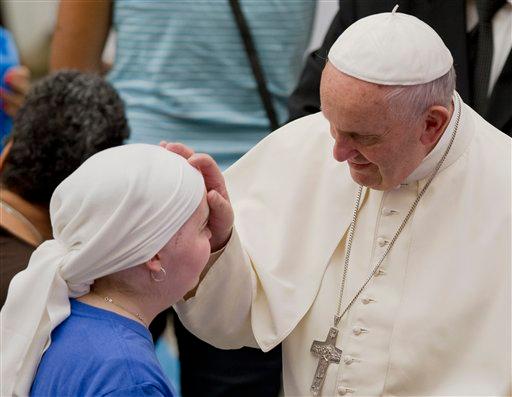
Folks in Philadelphia still speak with pride about the time Pope John Paul II visited the city in 1979. Next month, a new pope, with an even higher profile (and certainly a much larger social media following), will once again bless the City of Brotherly Love with his presence, along with a formidable boost in tourism.
“We know Pope Francis attracts attention wherever he is, and this visit will touch the perception people have of Philadelphia,” said Meryl Levitz, the CEO of Visit Philadelphia. “In addition to being a religious figure, he is a world figure, so we expect tourism in the short term and long term to be affected by his visit.”
Call it a papal bump, if you will. Pope Francis has been a boon for tourism all over the world. In 2013, in the first nine months following his election, 6.6 million tourists visited the Vatican — almost three times as many as the 2.35 million who came the year before.
Hotels and services in the Philippines received a similar bump in January of this year when the Pope made his visit there.
Philippine Chamber of Commerce and Industry President Alfredo Yao called the papal visit “advertising for the Philippines.”
And when the Pope visited Albania in 2014, it was described as nothing short of a game changer.
“The visit of … figure like the Pope is positive PR, and the attention it will draw in the media will counterbalance the unfair image of Albania as Muslim and backward,” Kliton Gerxhani, an Albanian tourism consultant, said at the time.
Next month will be the first trip to the United States for the head of the 1.2 billion-member Catholic Church. While Francis will also be visiting New York and Washington, D.C., during his trip to the States, Philadelphia is the one stop where visitors are expected to be able to see and spend time with the pope in the flesh.
Pope Francis will be attending the World Meeting of Families in Philadelphia. He will arrive on Saturday, Sept. 26, and speak at Independence Hall before celebrating at the Festival of Families, a free party held on Benjamin Franklin Parkway. On the afternoon of Sept. 27, the pope will lead Mass for hundreds of thousands of people, also on the parkway.
The Go Philadelphia! app will work offline in case service is disrupted by the influx of visitors to the city.
Anticipating a demand for information, the World Meeting of Families created the Go Philadelphia! mobile app, which provides a guide to all things papal, including places to visit, emergency information, and public transportation information. The app will also provide real-time translation and captioning in eight languages during portions of the Papal Mass and maps of papal visit locations.
Hotels in the city are being snatched up quickly, and this coming Thursday, the home rental site Airbnb is holding an event in Philadelphia for those thinking about hosting, so they can meet the Airbnb team, other hosts in the area, and local city officials to get advice on how to best prepare their homes for those traveling to the city for the visit.
“We’ve seen a 270 percent increase in listings on Airbnb.com since April, which means more people are starting to list their private rooms or entire homes up on Airbnb.com for events like the Made in America Festival and the papal visit,” said Alex Ward, the general manager of new markets in the United States for Airbnb. “The papal visit has definitely had an effect on demand and as a result, more people are becoming hosts in the city to welcome them.”
The home rental site HomeAway also says it has seen a 795 percent increase in demand in Philadelphia short-term rentals, which is based on a combination of bookings and inquiries compared to the same time last year.
HomeAway has also seen an uptick of 45 percent in demand in D.C. and a 40 percent increase in the surrounding D.C. area across Virginia and Maryland suburbs during the pope’s visit.
The papal bump also seems to have a spillover effect. Lancaster, Pa., about two hours outside of both Philadelphia and Washington D.C., is also preparing for a boost.
“We’re aware of up to two dozen bus groups that are actually staying here in Lancaster and then going on down into Philly,” Joel Cliff, of Discover Lancaster, told local news station Fox 43. “So they’re using hotel rooms here simply because it works better for their itinerary, their costs.”
Cliff is also hoping that groups take a day trip to see the local attractions in the region, which includes Amish Country.
Beyond a spike in September, Philadelphia is hoping to see more long-term effects from the visit.
“There will be a carryover. People will see things that intrigue them and they will come back,” Levitz said.
Other locations around the globe are hoping to see a similar interest from papal tourism. In November, Pope Francis will travel to Africa, where he is scheduled to visit Uganda, Kenya, and the Central African Republic. Francis’s visit to Uganda will be the third by a sitting pope, and the Uganda Tourism Board estimates that around 10 million tourists — both local and international — will turn out for the visit.
Related: Take a Gay and Lesbian Pilgrimage With a Catholic Nun
“Tour operators are expecting to gain from this visit. Many people from different continents will be persuaded to explore more about this East African country as a result of pope’s visit. Being the fact that he will visit some cultural and religious sites like Namugongo shrine, it will help in boosting the country’s tourism,” the tour company Maranatha posted on its website.
“Hopefully this upcoming event will help in boosting the country’s tourism, which has of lately been affected by various happenings in the world.”
Let Yahoo Travel inspire you every day. Hang out with us on Facebook, Twitter, Instagram, and Pinterest. Check out our original adventure travel series, “A Broad Abroad.”
Folks in Philadelphia still speak with pride about the time Pope John Paul II visited the city in 1979. Next month, a new pope, with an even higher profile (and certainly a much larger social media following), will once again bless the City of Brotherly Love with his presence, along with a formidable boost in tourism.
“We know Pope Francis attracts attention wherever he is, and this visit will touch the perception people have of Philadelphia,” said Meryl Levitz, the CEO of Visit Philadelphia. “In addition to being a religious figure, he is a world figure, so we expect tourism in the short term and long term to be affected by his visit.”
Call it a papal bump, if you will. Pope Francis has been a boon for tourism all over the world. In 2013, in the first nine months following his election, 6.6 million tourists visited the Vatican — almost three times as many as the 2.35 million who came the year before.
Hotels and services in the Philippines received a similar bump in January of this year when the Pope made his visit there.
Philippine Chamber of Commerce and Industry President Alfredo Yao called the papal visit “advertising for the Philippines.”
And when the Pope visited Albania in 2014, it was described as nothing short of a game changer.
“The visit of … figure like the Pope is positive PR, and the attention it will draw in the media will counterbalance the unfair image of Albania as Muslim and backward,” Kliton Gerxhani, an Albanian tourism consultant, said at the time.
Next month will be the first trip to the United States for the head of the 1.2 billion-member Catholic Church. While Francis will also be visiting New York and Washington, D.C., during his trip to the States, Philadelphia is the one stop where visitors are expected to be able to see and spend time with the pope in the flesh.
Pope Francis will be attending the World Meeting of Families in Philadelphia. He will arrive on Saturday, Sept. 26, and speak at Independence Hall before celebrating at the Festival of Families, a free party held on Benjamin Franklin Parkway. On the afternoon of Sept. 27, the pope will lead Mass for hundreds of thousands of people, also on the parkway.
The Go Philadelphia! app will work offline in case service is disrupted by the influx of visitors to the city.
Anticipating a demand for information, the World Meeting of Families created the Go Philadelphia! mobile app, which provides a guide to all things papal, including places to visit, emergency information, and public transportation information. The app will also provide real-time translation and captioning in eight languages during portions of the Papal Mass and maps of papal visit locations.
Hotels in the city are being snatched up quickly, and this coming Thursday, the home rental site Airbnb is holding an event in Philadelphia for those thinking about hosting, so they can meet the Airbnb team, other hosts in the area, and local city officials to get advice on how to best prepare their homes for those traveling to the city for the visit.
“We’ve seen a 270 percent increase in listings on Airbnb.com since April, which means more people are starting to list their private rooms or entire homes up on Airbnb.com for events like the Made in America Festival and the papal visit,” said Alex Ward, the general manager of new markets in the United States for Airbnb. “The papal visit has definitely had an effect on demand and as a result, more people are becoming hosts in the city to welcome them.”
The home rental site HomeAway also says it has seen a 795 percent increase in demand in Philadelphia short-term rentals, which is based on a combination of bookings and inquiries compared to the same time last year.
HomeAway has also seen an uptick of 45 percent in demand in D.C. and a 40 percent increase in the surrounding D.C. area across Virginia and Maryland suburbs during the pope’s visit.
The papal bump also seems to have a spillover effect. Lancaster, Pa., about two hours outside of both Philadelphia and Washington D.C., is also preparing for a boost.
“We’re aware of up to two dozen bus groups that are actually staying here in Lancaster and then going on down into Philly,” Joel Cliff, of Discover Lancaster, told local news station Fox 43. “So they’re using hotel rooms here simply because it works better for their itinerary, their costs.”
Cliff is also hoping that groups take a day trip to see the local attractions in the region, which includes Amish Country.
Beyond a spike in September, Philadelphia is hoping to see more long-term effects from the visit.
“There will be a carryover. People will see things that intrigue them and they will come back,” Levitz said.
Other locations around the globe are hoping to see a similar interest from papal tourism. In November, Pope Francis will travel to Africa, where he is scheduled to visit Uganda, Kenya, and the Central African Republic. Francis’s visit to Uganda will be the third by a sitting pope, and the Uganda Tourism Board estimates that around 10 million tourists — both local and international — will turn out for the visit.
Related: Take a Gay and Lesbian Pilgrimage With a Catholic Nun
“Tour operators are expecting to gain from this visit. Many people from different continents will be persuaded to explore more about this East African country as a result of pope’s visit. Being the fact that he will visit some cultural and religious sites like Namugongo shrine, it will help in boosting the country’s tourism,” the tour company Maranatha posted on its website.
“Hopefully this upcoming event will help in boosting the country’s tourism, which has of lately been affected by various happenings in the world.”
Let Yahoo Travel inspire you every day. Hang out with us on Facebook, Twitter, Instagram, and Pinterest. Check out our original adventure travel series, “A Broad Abroad.”
Subscribe to:
Posts (Atom)