Several Filipino devotees were nailed to crosses in a re-enactment of a Good Friday ritual, which one of the men dedicated to the victims of the deadly bombings of two churches in Egypt.
Ruben Enaje, 57, who has been re-enacting Jesus Christ’s suffering and death for the past 31 years, said he always prays for the health of his family during the ritual.
But this time he added the victims of the Egyptian attacks, which killed 45 people and wounded dozens on Palm Sunday.
“As long as we trust in the Lord, praying fervently, it’s never too far that the Lord won’t listen,” Enaje said after he was briefly nailed by the hands and feet, grimacing in pain.
The gory spectacle reflects the Philippines’ unique brand of Catholicism, which merges church traditions with folk superstitions.
Many of the mostly impoverished penitents undergo the ritual to atone for sins, pray for the sick or for a better life, and to give thanks for what they believe were God-given miracles.
The Lenten rituals are frowned upon by church leaders in the Philippines, Asia’s largest Roman Catholic nation, especially if the event is used to boost tourism.
The re-enactments of the crucifixion, however, have persisted and became an awaited tourist attraction in this area some 80 kilometres (50 miles) north of Manila.
All of those who took part were attended by doctors.

Tourism, Travel, Hospitality, Conservation: News,Stories And Experiences From Allover The World
Showing posts with label jesus christ. Show all posts
Showing posts with label jesus christ. Show all posts
Monday, 17 April 2017


Sunday, 5 February 2017
IRAN: Vank Cathedral Isfahan
Among the churches built in the Jolfa District of Isfahan, the magnificent and architecturally significant “Vank” Cathedral is the most famous.
The construction of the cathedral, also known as Amna Perkich and All Savior’s Cathedral, began during the reign of Shah Abbas of the Safavid Dynasty in 1606 and was completed between 1655 and 1664.
The interior of the church is elaborately decorated with wall paintings, tile work and also tableaus depicting the life of Jesus Christ. Apart from the paintings which are imitations of Italian styles, the architecture and all the decorations are totally Iranian.
The cathedral also has a domed sanctuary much alike an Islamic mosque but with the significant addition of a semi-octagonal apse and raised chancel usually observed in western churches. The delicately blue and gold painted central dome depicts the Biblical story of the creation of Adam and Eve as well as their expulsion from Paradise.
The cathedral also houses a rather small but unique museum, a historic printing press, and a large library invaluable for research in Armenian and medieval European languages and arts.
The museum, adding to the significance of the site displays historical objects, manuscripts and documents related to Armenian history. The oldest book printed in Isfahan and some edicts of Iranian kings dating back to the time of Shah Abbas the First are among the exhibits.
The printing press was founded by Bishop Khachatoor in the 17th century and the first book printed here was The Psalms. This unique edition, the only one in the world, is preserved in Oxford, England.
An exemplary specimen of Armenian architectural achievement, the cathedral represents different stages of political, economic and social status of this minority community in Iran since the mid-seventeenth century.
The Vank Cathedral was one of the first churches to be established in Isfahan by Armenian immigrants settled by Shah Abbas I after the Ottoman War of 1603-05.
Tuesday, 29 March 2016
PHILIPPINES: Easter Celebrations With Crucifixions

The gory crucifixions played out in dusty fields throughout the day with thousands of spectators looking on, and as other penitents flogged themselves bloody with whips.
Men dressed as soldiers of the Roman Empire hammered large metal spikes through the hands and feet of Willy Salvador, who grimaced in silence as he lay with his arms spread atop a wooden cross.
"This is my personal way of thanking Him (God) for healing me," the 59-year-old fisherman said, moments before being dragged barefoot through the streets of San Juan village.
"I know you would not believe me, but God helped me recover from a nervous breakdown," said Salvador, who added he had been doing it every year since 2006.
Ritual crucifixions are among the Catholic world's most extreme forms of worship and are done as part of Good Friday celebrations in some small villages in the Philippines, home to 80 million-plus Catholics.
They are held to re-enact the crucifixion of Jesus Christ, whom Christians believe was put to death so humanity could be cleansed of its sins.
The nails go through both hands and both feet, but do not bear the weight of the penitents, who spend only a few minutes on the cross before being taken down and having their bloody wounds treated.
- Souvenir shirts -After Salvador, it was the turn of street vendor Alex Daranang, whose 20th crucifixion fell on the eve of his 60th birthday.
"The wounds heal fast," the gap-toothed grandfather said. "In two days they are practically healed."
The act is frowned upon by the church, but has become a major tourist attraction.
Several thousand sightseers, including more than a dozen Western tourists, descended on the nearby village of San Pedro to witness the mock crucifixions and other extreme forms of piety.
Motivational speaker Benjie Pazcoguin said "there is a symbolic meaning to these crucifixions. Definitely, it reinforces my faith."
"I will come to see it again next year," he said, despite the gore.
Around a knoll where three tall wooden crosses awaited the San Pedro devotees, vendors did brisk business selling souvenir shirts, hats, soft drinks and food.
A giant television screen displayed the macabre events to the rest of the crowd, who shielded themselves from the heat with bright-coloured umbrellas.
On the sun-scalded pavements of the village streets, hundreds of shoeless men, their faces shrouded in black cloths, shuffled in slow processions as they lashed their own backs with whips tipped with bamboo strips.
The men stopped in unison occasionally to lie face down on the pavement, handing over the whips to assistants who administered more punishment.
Blood splattered on the spectators, while one of the penitents sank to his knees and began to throw up.
"You actually feel good, because you know some of your sins are being forgiven," construction worker said.
The extreme practices serve as an alternative to acts of Good Friday penance prescribed by the church, such as abstaining from work or from eating meat, and visiting a series of churches on foot to pray.
"The church discourages these acts because Jesus Christ had already undergone that for all of us. There is no need to repeat it," Father Douglas Badong, rector of the Quiapo Catholic church in central Manila said.
But San Juan village chief Claro Tolentino said crucifixions and self-flagellations were part of the culture of the country, which was converted to Catholicism during the 16th century Spanish colonial conquest.
"This is the culture that we were born into. Everyone should respect the culture and beliefs of our people," he added.
Friday, 18 September 2015
VATICAN: Pope Wears Cross Of Dead Priest

Pope Francis revealed Thursday that he now wears a cross that belonged to a Iraqi priest who was wearing it when he was slain for his faith.
He said he had been given it by another Iraqi priest he met on St Peter's square.
"It is a cross this priest had in his hands when he had his throat cut for refusing to renounce Jesus Christ," the pontiff told a gathering of young monks and nuns. "This cross, I wear it here," he added, indicating his chest.
Francis, who has regularly spoken out on the persecution of Christians in the Middle East, added: "Today we have more martyrs than in the first centuries after Christ."
Iraq is now home to an estimated 400,000 Christians, compared to 1.4 million in 1987.
The rise of the Islamic State grouping is the latest factor driving them out of the country with witnesses having recounted how the militant group threatens them with death or punitive taxes if they do no convert to Islam.
Tuesday, 25 August 2015
LITHUANIA: Hill Of Crosses
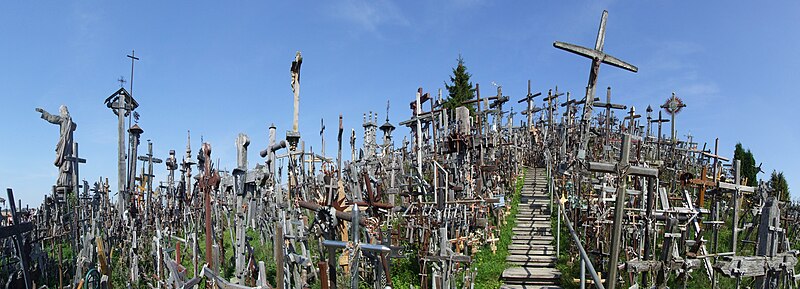
The Hill of Crosses (Lithuanian: About this sound Kryžių kalnas) is a site of pilgrimage about 12 km north of the city of siauliai, in northern Lithuania. The precise origin of the practice of leaving crosses on the hill is uncertain, but it is believed that the first crosses were placed on the former Jurgaiciai or Domantai hill fort after the 1831 Uprising. Over the generations, not only crosses, but giant crucifixes, carvings of Lithuanian patriots, statues of the Virgin Mary and thousands of tiny effigies and rosaries have been brought here by Catholic pilgrims. The exact number of crosses is unknown, but estimates put it at about 55,000 in 1990 and 100,000 in 2006.
Over the generations, the place has come to signify the peaceful endurance of Lithuanian Catholicism despite the threats it faced throughout history. After the 3rd partition of the Polish–Lithuanian Commonwealth in 1795, Lithuania became part of the Russian Empire. Poles and Lithuanians unsuccessfully rebelled against Russian authorities in 1831 and 1863. These two uprisings are connected with the beginnings of the hill: as families could not locate bodies of perished rebels, they started putting up symbolic crosses in place of a former hill fort.
When the old political structure of Eastern Europe fell apart in 1918, Lithuania once again declared its independence. Throughout this time, the Hill of Crosses was used as a place for Lithuanians to pray for peace, for their country, and for the loved ones they had lost during the Wars of Independence.
Most recently, the site took on a special significance during the years 1944–1990, when Lithuania was occupied by the Soviet Union. Continuing to travel to the Hill and leave their tributes, Lithuanians used it to demonstrate their allegiance to their original identity, religion and heritage. It was a venue of peaceful resistance, although the Soviets worked hard to remove new crosses, and bulldozed the site at least three times including attempts in 1963 and 1973.There were even rumors that the authorities planned to build a dam on the nearby Kulvė River, a tributary to Mūša, so that the hill would end up underwater.

On September 7, 1993, Pope John Paul II visited the Hill of Crosses, declaring it a place for hope, peace, love and sacrifice. In 2000 a Franciscan hermitage was opened nearby. The interior decoration draws links with La Verna, the mountain where St. Francis received his stigmata.The hill remains under nobody's jurisdiction; therefore people are free to build crosses as they see fit.
The Hill of Crosses has about 100 000 crosses. It is said that first crosses were erected here by the next-of-kin of the rebels that fell in the 1831 rebellion. The Hill of Crosses ia an historical architectural monument, it is a unique composition of folk art. The Hill of crosses atract's people with it's peace, spirituality, authenticity and sacred nature. The hill of crosses was visited by Pope John Paul II. Even more crosses appeared after the rebellion in 1863. At tht time the traditions of visiting and erecting crosses on the hill of crosses were being formed. The Hill of crosses became a place of vows in Lithuania. In the beginning of the 20th century, the hill was already quite well known. It was being visited by a lot of people, and services and feasts were taking place here. Now It has about 100 000 cross.
Pope John Paul II visiting Hill of Crosses

In 1993 it was visited by Pope John Paul II. The Hill of crosses in Lithuania has left a deap inpression on Pope John Paul II. Also by initiative of Pope was build Monastery close to the hill.
Subscribe to:
Posts (Atom)