Showing posts with label Lithuania. Show all posts

Tuesday, 29 May 2018

KAZAKHSTAN: SCAT Airlines Starts Astana-Vilnius Flights

Kazakhstan’s SCAT airlines based in Shymkent launched May 27 a new Astana-Vilnius, Lithuania service.

The four-hour-and-40-minute Boeing-737 flights depart Thursdays and Sundays with economy return fares starting from $233.

A new route is first and foremost good news for our business community.

Economic ties between Lithuania and Kazakhstan are getting stronger year by year and we have been working hard over the past years to put this important and necessary route on our map.

Besides, exotic Central Asia is not just a business, but a very attractive destination entailing the search for undiscovered places for vacation, said Lithuanian Airports Director Marius Gelžinis at a May 27 press briefing in Vilnius.

Airline representatives said the route will facilitate inbound and outbound tourism, provide more opportunities for tour agencies, guides and the entire tourism infrastructure.

Lithuanian Ambassador to Kazakhstan Vytautas Nauduzas, also present at the press briefing, said the launch of the new route, a result of three years of negotiations, will bring the countries closer to increasing their trade from the current $1.7 billion to $2 billion.

We have good news today. The new route makes a journey from Vilnius to Astana and other cities in the Central Asian region and China more comfortable and less tiring.

The Lithuanian businesses are interested in entering the Kazakh market, yet the potential remains unfulfilled, said the Lithuanian ambassador.

Nauduzas noted Vilnius also offers a convenient link to other European cities.

For instance, you can get to Paris, Barcelona, Milan and many other capitals and cities in Europe, said the ambassador.

Head of SCAT Public Relations Department Viktoria Starozhilova said the ticket prices start from $233.

There is a flexible system of tariffs. There are minimal tariffs and higher. The minimal fare for an economy return ticket will be approximately 200 euros (US$233). Special offers are also frequent,” said Starozhilova.

The new routes are part of the company’s fleet and route network expansion plan.

Last year, the company announced it ordered six Boeing 737 MAX 8 aircrafts at the Dubai Air Show and in March Boeing delivered the first of six such aircraft to SCAT.

The airline plans to launch 14 more new routes, including to Milan, Vienna and Prague.

Another milestone for SCAT came in March as well, when it joined the International Air Transport Association (IATA) and passed the IATA Operational Safety Audit programme (IOSA).

Two years ago, the company passed an audit that examined more than 1,000 elements of its operational activity.

As of today, only two Kazakh airlines – SCAT and Air Astana – hold the IOSA certificate enabling them to fly to Europe.


Tourism Observer

Tuesday, 24 April 2018

VIETNAM: BAA Training Vietnam Established

BAA Training, one of the largest aviation training centres in Northern Europe, has announced the establishment of a new company in Vietnam – BAA Training Vietnam which is to operate a training centre of 4 full flight simulators and Ab Initio flight school by 2023.

According to the Boeing projections Asia Pacific region will require up to 253,000 new pilots until 2036.

Looking at South East Asia alone, the aircraft numbers will grow from 1,410 in 2016 up to 4,200 aircraft by 2036, 77% of which will be made up of single aisle airplanes, mainly A320 and B737 family aircraft.

The total number of A320 fleet is predicted to rise from 120 aircraft in 2017 to 226 aircraft in 2024.

Starting from 2019 a number of Boeing 737 MAX aircraft in the market will multiple, reaching 59 aircraft and will continue to grow reaching 317 Boeing 737 MAX aircraft in the region by 2023.

To respond to the growing training needs in the region, BAA Training Vietnam is building a brand new training facility.

As constructions of the training centre are underway the first Airbus A320 full flight simulator is set to be deployed by the end of 2018.

To continue the development and increase the training centre capabilities Airbus A320 NEO and Boeing 737 MAX full flight simulators are planned to be assembled until 2020.

In addition, BAA Training Vietnam aims to open an Ab Initio flight school in the next five years, in order to provide the region with complex pilot training solutions.

The Vietnamese aviation market has been growing by average 8% per year and is expected to continue its growth in the upcoming 20 years.

By establishing BAA Training Vietnam we aim to share an exceptional know-how built through years of experience of BAA Training operations as well as securing region with the transparent and high standard aviation training for both corporate and private clients, comments Egle Vaitkeviciute, CEO at BAA Training.

The new company in Vietnam is not the only proof of the successful aviation training business development of BAA Training.

Just last year the company announced the accusation of 4 full flight simulators, three Airbus A320 and one Boeing 737 NG, of which three will be located at BAA Training headquarters in Vilnius, Lithuania, by the end of 2018.

Also, the company invested into the renewal of current full flight simulators and assembled a brand new, only of its kind in the Baltic States, Airbus A320 Door and Slide Trainer reaching an investment of approximately 32 mln. euros into training equipment.


Tourism Observer

Friday, 24 November 2017

EUROPE: Some Dangerous Cities

Europe expereiences a high level of safety, violence does occur and patterns of where and when it does can appear.

This is measured from a city's its homicide rate, which is defined as the intentional death of a citizen at the hands of another citizen or citizens.

These rates are calculated to be per capita, so although one city may experience a higher number of murders than another, if their population is larger the murder rate will be lower as a result.

Areas such as Central and South America and Africa can see rates reaching 50 murders per 100,000 residents, and the homicide rate of the United States is around 5 per 100,000.

Tallinn, Estonia - 5.5 homicides per 100,000 people

Tallinn is a city in Estonia, situated on the northern coast of the country. With a relatively small population of 443,894, the city experienced 22 homicides in 2010, bringing its rate to 5.5 per 100,000.

This sits lower than the murder rate of Estonia that was calculated between 1999 and 2001, which was calculated as a high of 9.4 per 100,000 people.

The general trend appears to be that the homicide rate in Tallinn is decreasing, as 40 murders were reported in 2005, standing in contrast to 2010.

However, Tallinn's small population size, relatively large amount of murders per capita, and position on a continent where violent crime is highly uncommon gives it a place at the top of this list.

Glasgow, Scotland - 5.1 homicides per 100,000 people

Glasgow is the largest city of Scotland, located in the United Kingdom.

In 2010, the homicide rate of Glasgow was 5.1 per 100,000 residents, calculated from a total of 30 murders that were experienced in the city that year.

30 is a number that appears to be average for the number of violent deaths in Glasgow every year, a number that may be due to organized gangs and turf wars.

Vilnius, Lithuania - 4.7 homicides per 100,000 people

Vilnius is the capital and largest city of Lithuania, which is located in the Baltic states.

In 2010, Vilnius reported 26 crimes, producing a crime rate of 4.7 per 100,000 inhabitants.

This number was, however, actually a decrease from the crime rates experience prior to 2010, which reached a high in 2008 when 58 homicides were recorded resulting in a rate of 10.4 per 100,000 residents.

Despite these numbers of homicides that appear relatively high for Europe, visitors are still much more likely to encounter petty crime such as pickpocketing and credit card theft.

Moscow, Russia - 4.2 homicides per 100,000 people

Moscow is the capital of Russia and the largest city on the European continent with 12.2 million inhabitants.

It is a major cultural center of Europe and is located on the Moskva River.

In 2010, there were 483 homicides reported in Moscow, although this was a decrease from numbers seen in 2005, 2006 and 2007, where 766, 767, and 629 murders were reported respectively.

This decrease in murders may be a sign that violent crime in Moscow is decreasing, although other crime such as car theft remains a problem in this major city.

Podgorica, Montenegro - 3.5 homicides per 100,000 people

Podgorica is the largest city of Montenegro, as well as serving as the nation's capital. Between 1946 and 1992, when Montenegro was part of the Socialist Federal Republic of Yugoslavia (Yugoslavia), the city was known as Titograd.

In 2010, there were 7 deaths by homicide recorded in Podgorica.

This is a number that seems pretty on-trend for what is reported for Podgorica, although the year 2006 did see an influx of homicides, with 12 in the year bringing the homicide rate of the time up to 6.5 per 100,000 residents.

Belfast, Northern Ireland - 3.3 homicides per 100,000 people

Belfast is the largest city in Northern Ireland, which is part of the United Kingdom and located in the north of the island of Ireland.

In 2010, Belfast reported a homicide rate of 3.3, which was calculated from nine murders, given Belfast's relatively small population of 286,000.

This crime rate, however, is part of a trend in the lowering of homicides in Northern Ireland.

During the Troubles of the 1970s and 80s, the crime rate of Northern Ireland was closer to 31 per 100,000, which is similar to the homicide rate that could be found in Colombia or South Africa during the early 2010s.

Riga, Latvia - 3.3 homicides per 100,000 people

Riga is the largest city in Latvia, a country located in the Baltic states.

In 2010, there were 23 murders in the city, resulting in a homicide rate of 3.3.

Although the historic city is known to be relatively safe, public parks and the heavily-touristed Old Town are known to be areas where crime could be more likely to occur, although much of this may be petty crime such as pickpocketing.

2010, however, appears to have been slightly lower than what is average for Riga, as the years 2005-2009 each saw over 30 reported homicide incidents.

Kiev, Ukraine - 3.2 homicides per 100,000 people

Kiev is the largest city and capital of the Eastern European country of Ukraine. In 2010, 118 of Kiev's residents were victims of homicide, creating a murder rate of 3.2

This appears to be a number that is a somewhat annual average for Kiev, where murder rates are about 100 per year.

The public transit system, including suburban trains, have been singled out as potential hotbeds for violent crime in Kiev due to their tendency to be overcrowded and require repairs.

Zurich, Switzerland - 3.0 homicides per 100,000 people

Zurich is the largest city in the central European nation of Switzerland.

In 2010, there were 11 homicides reported in the city, which creates a murder rate of 3.0 when the city's low population of less than half a million is taken into consideration.

2010, however, does appear to be somewhat of an anomaly for this Swiss urban area, as both the years 2009 and 2011 saw only 4 and 1 murders, respectively.

Brussels, Belgium - 2.8 homicides per 100,000 people

Brussels is the largest city in Belgium, located in Western Europe.

It is also well known for being the capital of the European Union (EU).

In 2010, there were 31 murders in Brussels, a number that appears to be average for the city with the year 2008 being a slight exception when 44 homicides were reported.

In 2001, Brussels was the fourth most crime-ridden city in Europe, although this number also took into other crimes such as burglary and assault.


Tourism Observer

Wednesday, 7 June 2017

SOUTH KOREA: Seoul Hosts First Baltic Tourism Seminar

Latvian Embassy organized its first "Baltic States Tourism Seminar" at the Millennium Seoul Hilton on May 15.

The event brought together 20 representatives from central and local government institutions in the tourism sector and from privately owned travel agencies in the three Baltic states _ Latvia, Lithuania and Estonia.

Inese Sirava, head of the tourism department at Latvia's Investment and Development Agency, led the Latvian delegation. It included representatives from the Riga Tourism Development Bureau (LIVE RIGA) and travel companies Baltic Travel Group, Con-ex Latvia Tours Group and Estravel Latvia.

Latvian Ambassador Peteris Vaivars presented the first publication produced by the Baltic states in the Korean language _ a travel guide translated at the Latvian Embassy.

In its daily contacts with people from Korean tourism businesses, the Latvian Embassy is receiving a clear message about the interests of Korean tourists in the Baltic states, the ambassador said.

I am happy that the Baltic states have agreed to jointly offer the Baltic destination as a single tourism product to Korean visitors, whose number is increasing by the year.

With a special focus on the centenary of the Baltic states in 2018, representatives suggested that the coming year could be declared "Baltic Year" in Korea.

The seminar included presentations about tourist destinations in Latvia, Lithuania and Estonia. Lufthansa and Finnair airlines introduced the shortest and most comfortable flight routes from Korea to the Baltics, the embassy said.

Baltic and Korean tourism organizations and agencies also held business-to-business meetings to build new contacts and answer questions about specific interests.

According to the embassy, the number of Korean travellers to Latvia and the Baltic states is steadily increasing, approaching 10,000 annually.

Latvia aims to reach out to larger numbers of potential travellers through tourism media and Korean travel agencies so that the number of visitors can be raised to at least 20,000 over the five coming years," an embassy spokesperson said.

Friday, 12 May 2017

ROMANIA: About Romania

To mark Romania's independence day, here are a few quirky facts about the country.

1. It’s home to the world’s heaviest building

Bucharest’s vast Palace of the Parliament, begun during the final years of Nicolae Ceaușescu’s rule and not finished until 1997 (seven years after his death), is 240 metres long, 270 metres wide, 86 metres high (12 storeys), and cost a staggering €3 billion (£2.5bn) to build.

The other numbers are remarkable. As many as 100,000 people worked on the site, hundreds of whom are thought to have perished. It has 1,100 rooms (the vast majority of which lie empty) and an annual heating bill of $6m (£4.63m), equivalent to that of a small city. There are eight underground levels, as well as a nuclear bunker linked to other government buildings by 20km of tunnels.

It all adds up to an area 365,000 square metres, second only to The Pentagon as far as administrative buildings are concerned, and it has a volume of 2.55 million square metres, a shade more than the Great Pyramid of Giza.

Inside you’ll find 3,500 tonnes of crystal, 480 chandeliers and 1,409 ceiling lights, while 700,000 tonnes of steel and bronze was used for monumental doors and windows. Guinness World Records recognises it as the heaviest building on the planet.

2. And the world’s most beautiful road

In his search for the “world’s best driving road” Jeremy Clarkson declared that he had found it in the middle of Romania – in the form of the Transfagarasan highway. Whichever way you look at it, it is an extraordinary feat of engineering: a stretch of tarmac packed with tunnels, viaducts and bridges and which takes the skill of navigating hairpin bends to new heights.

The road was another Ceaușescu creation. He wanted to ensure that in the event of a Soviet invasion there was a speedy way of escaping through the strategic (and scenic) mountain passes of the Southern Carpathians (not that it was ever used for that purpose).

3. They love a drink

Romania is the fifth booziest country in the world, behind four more Eastern European states: Belarus, Russia, Moldova and Lithuania. The average Romanian consumes 14.4 litres of pure alcohol each year, compared to 11.6 litres in Britain.

The country places 16th when it comes to wine consumption,not a surprise given that it’s one of the largest wine producers in the world and 10th for beer .

4. Visitors might spot Europe’s largest mammal

Tipping the scales at 1,400lbs, the European bison was nearly hunted to extinction, but in recent years has been reintroduced to several Eastern European countries, including Romania.

“We encountered a herd in a forest clearing near the village of Armenis, in the Tarcu range of the Carpathian Mountains,” wrote Mark Stratton for Telegraph Travel back in 2014 . “Staring towards us in docile fashion, tails metronomically swishing at flies, they were protectively encircling a newborn calf.

Beneath tassels of shaggy fur their powerful, beefy shoulders and bulbous humps elevated them from family saloon cow to V8 turbocharged bovine.”

The country also has Europe’s largest population of brown bears.

5. It’s the real home of Borat

In Sacha Baron Cohen’s film, scenes purporting to show Borat’s Kazakh hometown were shot in the village of Glod, Romania, while its Roma residents were cast as extras. Those same extras later took unsuccessful legal action claiming they were unaware of the film’s subject matter.

Other films shot in Romania include Cold Mountain and, er, Anaconda III starring David Hasselhoff.

6. Bucharest has one of the world’s prettiest bookshops

Cărturești Carusel opened in 2015 in a restored 19th century building. It contains more than 10,000 books, 5,000 albums and DVDs and a top floor bistro.

7. Its 4G network is the envy of the world

Romania is one of the best places in the world for 4G speed, occupying an impressive fourth place out of 78 nations, according to OpenSignal. Users in the country can expect speed of 35.61 Mbps, on average, compared to just 21.16Mbps in the UK.

8. The rail network is also impressive

Romania's 22,298km network is the 15th most extensive on Earth, even though it is only the world's 81st largest country in terms of total area.

9. There’s a dead ringer for the Arc de Triomphe

Who needs Paris? Bucharest has got its own.

10. And an answer to Mount Rushmore

This sculpture, on a rocky outcrop at the river Danube’s Iron Gates gorge, was made between 1994 and 2004 and depicts Decebalus, the last king of Dacia, who fought against the Roman Empire.

12. It also ripped off the Hollywood sign

Brasov and Rasnov have LA quaking in its boots.

13. It’s the surprising birthplace of good coffee

Francesco Illy, the founder of the Italian coffee roasting company, was actually born in Timișoara, Romania. He later moved to Vienna, and then the Italian city of Trieste. He didn’t make a 2006 list of the 100 Greatest Romanians, however, which was topped by Stephen the Great and featured the likes of Nadia Comăneci and Gheorghe Hagi.

14. They made the world’s largest flag

A five-ton flag that measured 349 metres by 227 metres, and used 44 miles of thread, was unfurled in Romania in 2013. Well, why not?

15. And can boast a few other quirky records

Romania was also responsible for the world’s longest sausage. How long? You wouldn’t believe us if we said 39 miles – but it’s true . It will take a determined butcher to break that record.

Guinness World Records also recognises the Chestnut Festival in Baia Mare, Romania, for creating the largest bowl of goulash (7,200 litres), and Romanian firm ING Asigurari de Viata for printing the world’s largest legal document (nine metres x six metres).

Best countries

16. They’ve invented plenty

And not just long sausages. Nicolae Paulescu discovered insulin (though two Canadian scientists were awarded the Nobel Prize in 1923 for their studies on the hormone), Henri Coandă has been credited with inventing the modern jet engine, and Petrache Poenaru created the fountain pen.

The country has four Nobel prize laureates : George Emil Palade (medicine), Elie Wiesel (peace), Herta Müller (literature) and Stefan Hell (chemistry).

17. Its churches are spectacular

Romania has seven UNESCO World Heritage Sites, including the eight churches of northern Moldavia, covered in wonderful frescos (the Voroneț Monastery has been dubbed Romania’s Sistine Chapel), and the wooden churches of Maramureş, of which there is also eight, including Sapanta Peri, which claims to be the tallest wooden church in the world.

18. And there’s one very strange cemetery

The Merry Cemetery in Sapanța eschews sombre memorials in favour of colourful tombstones.


Friday, 17 March 2017

MOLDOVA: Air Moldova Expands With Another Embraer E190,Wizz Air Opens Presence In Moldova

Air Moldova has taken delivery of another Embraer E190 regional jet. The aircraft with the seating capacity for 140 passengers was ferried to Air Moldova’s base airport in Chisinau on November 20, the carrier announced. In line with the carrier’s strategy the aircraft should enable the airline to launch flights to new destinations. Its first flight will be from Moldovan capital to Rome.

With this aircraft, Air Moldova’s fleet now has three Embraer E190s. The latest addition is the aircraft produced in 2009 and previously operated by Lufthansa and Turkish BoraJet. According to open sources the aircraft is a long-range (LR) modification and has tail number ER-ECD.

Notably, Air Moldova is among the world’s leading operators of ERJ190 by flight hours. In August 2016 it demonstrated the best results in terms of operating rate. The average monthly flight hours increased almost 80% compared to July, to 15.18 flight hours per day.

Air Moldova currently operates seven aircraft. Besides the three Embraer E190LRs the airline flies an Airbus A321, two A320s and one A319. The carrier’s route network features over 25 destinations, including Greece, Turkey, Spain, Italy, Belgium, Ireland, Germany, the Great Britain and Portugal. It two destinations in Russia are St. Petersburg and Moscow, and a route to Krasnodar is expected to open next year.

Last year Air Moldova’s passenger traffic for the first time exceeded 1 million passengers. Suspension of air connection between Russia and Ukraine greatly contributed to the carrier’s traffic growth.

Hungarian low-cost carrier Wizz Air will launch a new base at Chisinau Airport, Moldova, from March 2017. The airline has recently opened a base in Kutaisi, Georgia, and is looking into strengthening its presence in Eastern Europe and the former Soviet republics further on.

The airline announces Chisinau will be its 26th base while Moldova will become the 14th country where Wizz Air performs base operations.

The flights from Chisinau will be operated by a single narrow-body A320. Starting from March 2017 the airline will launch two new twice-weekly services to Berlin Schoenefeld and Barcelona.

Considering these new destinations, Wizz Air’s route network from Chisinau will consist of seven routes to four countries.

The company will also increase frequencies on existing routes to Bologna and Venice from two to three and from three to four weekly flights correspondingly.

Wizz Air plans to invest 98 million dollars in the new Chisinau base and hire 36 people as crew members.

Within the post-Soviet area the Hungarian low-cost company performs base operations from Kutaisi (Georgia), Kyev (Ukraine), Vilnus (Lithuania) and Riga (Latvia).

Friday, 2 December 2016

LITHUANIA: Real Is Beautiful

The State Department of Tourism has introduced new concept of Lithuania’s new national tourism brand“Lithuania. Real is beautiful” – this slogan has been chosen as the main focus of state tourism marketing.

“The logo ‘Lithuania is a brave country’ has been used in tourism marketing for almost a decade. However, its image does not focus on tourism and does not reveal the exclusivity of Lithuania as a tourist destination. The design of a new tourism brand required a new set of tasks – to introduce the heritage of Lithuanian nature and culture, to represent our country and differentiate it from other tourist destinations, invite visitors to Lithuania and promise an unforgettable experience. It is also very important to emphasize that the tourism brand of Lithuania is not the brand of the country and that we want to stay away from all possible speculations on the issue of the image strategy of the whole country”, says Jurgita Kazlauskienė, the Head of the State Department of Tourism.

The focus of the visual representation of the tourism brand of Lithuania is a postage stamp. The logo typeface resembles lively, growing tree branches and is contained within a pastel mint symbol of a postage stamp. Complementary images have been created as well, which, along with the logo, help to deliver a more accurate message – namely, “Meet people”, “Taste Food”, “Stay Active”, “See Nature,” or “Explore Culture”. Based on the style of the logo, a souvenir line and communication marketing tools have also been developed.

The concept of the tourism brand of Lithuania was developed in cooperation with the New! advertising agency. It includes the following items:

the logo (graphic symbol);
the brand book;

English slogan for foreign markets, which complements the newly designed logo and is easily integrated into the communication for the priority markets of inbound tourism;
Lithuanian slogan designed for the promotion of local tourism;
marketing tools in the same style.

As Tomas Ramanauskas, the creative director of the New! advertising agency, presented it: “To get a picky traveller interested in visiting a small Northern European country that doesn’t boast spectacular wonders of nature or architectural miracles and is sentenced with a hard-to-pronounce English name is an incredibly tough task. Not to forget, it still lacks direct flights from major cities and most of the world’s citizens know next to nothing about it. The intense white noise of tourism communication does not spare those who talk like everyone else. We need to stand out and be different.”

“We have a message for the world: real things are beautiful to us. Real is beautiful. When you want to get away from fake smiles, the concrete jungle, industrial madness, plastic architecture or the conveyor belt of tourism, visiting Lithuania is a great decision. Lithuania is the place where real things are valued, even if they are a bit off or imperfect. We are proud of our imperfections. In other words, we see the beauty in them. This is our new tourism statement. Unvarnished, free of cosmetic fixes, sincere, real.”

The development of the tourism brand of Lithuania was based on working group discussions, the results of surveys of foreign tourists and other research evaluating Lithuania as tourism country.

The new tourism brand of Lithuania and slogans have already been introduced alongside their associated marketing communicative tools.

Tuesday, 15 November 2016

UAE: Etihad Airways Looking For Pilots In Europe To Fly Airbus And Boeing Fleets

Etihad Airways has embarked on a major recruitment drive to hire additional crew, as it fleet expands.

The UAE’s national carrier said it is looking for pilots in Europe to join both its Airbus and Boeing fleets, with new aircraft expected to arrive between this year and 2025. The main focus of the talent search is to fill posts for First Officers.

Recruiters for the airline were scheduled to be in Europe on Sunday, November 13. They started in Romania and were expected to be in Bulgaria today, Tuesday. They will then make stops in Hungary, Lithuania, Greece, Poland, Belgium and Portugal.

Etihad had earlier announced it would freeze the hiring of non-operational staff, as currency fluctuations, economic uncertainty and market competition are putting pressure on yields. Recruitment of pilots, cabin crew and engineers, however, will continue.

The airline has a range of aircraft including Airbus 330s, 380s, Boeing 777s and B787s, and expects new A380 deliveries next year.

Monday, 22 August 2016

THAILAND: Thailand Doubles Visa-on-arrival For 18 Countries

The new charge will come into effect on 27 September, and apply to the citizens of all 18 countries offered visa-on-arrival in Thailand. These include China, India, Taiwan and Saudi Arabia.

The newspaper reported the Thai Foreign Ministry as saying that the decision to implement a 100% increase was based on the belief that the current charge is lower than the visa fees paid by Thai tourists visiting other countries.

The timing of the decision is not ideal however; Thailand’s tourism authorities are working hard to encourage international travellers not to cancel their trips to the kingdom, following the recent bombings in several resort areas. The reason for the attacks is still unclear.

The other countries offered visa-on-arrival to Thailand are Bulgaria, Bhutan, Cyprus, Ethiopia, Kazakhstan, Latvia, Lithuania, Maldives, Malta, Mauritius, Romania, San Marino, Ukraine and Uzbekistan.

Monday, 25 July 2016

LATVIA: Riga Will Host Baltic Connecting 2016

The most important event in the Baltics for tourism professionals will be organized already for the 10th time.

The aim of the international tourism forum "Baltic Connecting" is to inform tourism industry professionals about tourism opportunities in Latvia, Lithuania and Estonia, by acquainting them with the tourism offers and services in the region, as well as create the opportunity for foreign tourism professionals to meet with potential cooperation partners in the Baltics and establish new contacts.

For the first time “Baltic Connecting 2016” will focus on the growing significance of long-haul markets, inviting to the Baltic region travel trade professionals from Japan, USA, China and South Korea.

The largest and most important event in the Baltics for tourism professionals "Baltic Connecting 2016" will be organized for the 10th time. The event will gather travel trade representatives to promote Latvian, Lithuanian and Estonian tourism products and acquire new business contacts.

The programme will include: a workshop (4.10.2016 Latvia), consisting of destination presentations, scheduled individual B2B meetings and networking with Baltic travel agents and professionals from the different fields of the tourism industry, as well as socializing with representatives of travel companies from long-haul markets; international tourism conference(4.10.2016 Latvia) focusing on market trends, destination marketing and cooperation in attracting tourists from distant markets and study trips to Latvia, Estonia and Lithuania (05.-08.10.2016) for travel trade professionals from long-haul markets, with the aim of introducing the attendees to the diverse tourism opportunities in the region.

Thursday, 21 July 2016

LITHUANIA: Wizz Air Commences Flights

Wizz Air toady announced further expansion of its route network from Lithuania. The airline will start operating another attractive route from Vilnius to Grenoble in France. The new service will commence on 14 January and operate on Saturdays. Tickets are already on sale starting at EUR 24.99.

Grenoble is already the 4th new destination WIZZ added to its low-fare Vilnius network in 2016. With its newest service to France, Wizz Air now offers a total of 33 routes to 14 countries from it’s three Lithuanian airports.

Gabor Vasarhelyi, Communications Manager at Wizz Air said: “We are delighted to announce another attractive route from Vilnius. Grenoble is already the fourth new destination we add to our ever growing Lithuania network in this calendar year and we are sure Vilnius winter sport lovers will enjoy visiting the ‘capital of the Alps’ on our very low fares. Seats on our new Grenoble route are already on sale from just EUR 24.99 on wizzair.com.

Our friendly Lithuanian crew looks forward to welcoming you on board a WIZZ flight with a smile!”

Sunday, 7 February 2016

TURKEY: Fastest Growing Airport In Europe - Sabiha Gokcen International Airport

Passenger traffic in Europe grew by an average +5.2% in 2015, according to Airports Council International Europe (ACI EUROPE).

Amongst Top 30 European Airports, Sabiha Gökçen International Airport (SAW) in Istanbul recorded the fastest growth in passenger numbers, with a 19.7% growth Y-o-Y.

At EU airports, the average increase in passenger traffic was +5.6% with airports in Ireland, Portugal, Greece, Romania, Hungary, Slovakia, Slovenia and Lithuania achieving double-digit growth.

Meanwhile, non-EU airports reported diminished growth of +3.9%. This was mainly due to a significant decline in demand for air travel across Russian and Ukrainian airports, as well as almost flat growth in Norway – despite a stellar increase in passenger traffic in Iceland and sustained growth at most Turkish airports.

Freight traffic at Europe’s airports only grew by +0.7%, as international trade remained subdued. Aircraft movements saw an increase of +2.2%.

ACI EUROPE Director General Olivier Jankovec said:

“2015 has been a very good year in terms of passenger traffic, with European airports welcoming an estimated 1,95 billion passengers. 20% of them achieved a double-digit increase and many broke new traffic records – mostly fueled by the continued growth of low cost airlines and selected non-EU airlines.”

“EU airports generally performed extremely well, despite Germany and France being impacted by airline & ATC strikes and the Paris terror attacks.”

“Remarkably, Istanbul-Atatürk airport became the 3rd busiest European airport with 61,8 million passengers, after London-Heathrow (74,9 million) and Paris-Charles de Gaulle (65,7 million). It should be noted however that small regional airports* across the continent underperformed the European average, with their passenger volume only increasing by +3,8%.”

“This is indicative of traffic growth becoming more concentrated and less inclusive.”

Commenting on the air traffic recovery since the global financial crisis, Jankovec added:

“While the EU economy did not even grow by +3% between 2008 and 2015, passenger traffic at EU airports increased by +13,6% over the same period. Such a wide gap is pointing to a lasting discontinuity in the usual relationship between GDP growth and passenger traffic performance.”

“This is reflective of new market dynamics, changing consumer behaviours and the increased importance of air transport for the European economy.”

Over the full year, airports welcoming more than 25 million passengers per year (Group 1), airports welcoming between 10 and 25 million passengers (Group 2), airports welcoming between 5 and 10 million passengers (Group 3) and airports welcoming less than 5 million passengers per year (Group 4) reported an average adjustment +3.7%, +6.3%, +7.1% and +5.5%.

GROUP 1 Airports: Madrid-Barajas (+12.0%), Istanbul IST (+9.1%), Amsterdam (+6.0%), London LGW and Barcelona El-Prat (+5.7%) and Rome FCO (+5.0%)

GROUP 2 Airports: Istanbul SAW (19.7%), Athens (+19.1%), Dublin (+15.3%), London STN (+12.8%) and Izmir (+12.1%)

GROUP 3 Airports: Milan BGY (+18.6%), Gothenburg GOT (+18.1%), Berlin SXF (+16.9%), Porto (+16.7%) and Glasgow (+12.9%)

GROUP 4 Airports: Ohrid (+53.3%), Ponta Delgada (+29.5%), Astrakhan (+26.1%), Santorini/Thira (+87.6%), Cluj and Timisoara (+25.8%)

Among the airports in the Top 5, several airports will now move to a higher traffic category for 2016.

Friday, 4 December 2015

Ryanair And Wizz Air Passenger Numbers Grow

Budget airline Ryanair has hailed another month of rising passengers’ numbers as it continued with its strategy to modernise aircrafts and improve customer service.

The Dublin-based airline saw a 21 per cent increase to 7.71million passengers, with the load factor – how many seats were filled – increasing by 5 percentage points to 93 per cent.

Chief marketing officer Kenny Jacobs said the ‘record’ monthly traffic figures were a result of lower fares, stronger forward bookings and the continuing success of their ‘Always Getting Better' customer experience programme.

This was unrolled two years ago in a bid to lure passengers back after many deserted the airline for its rude treatment of customers. On a rolling basis, Ryanair’s annual traffic to November grew 17 per cent to 99.9million passengers.

‘Ryanair customers can now look forward to more service enhancements, as we continue Year 2 of our AGB programme, which includes our new car hire service, new website, new app, new cabin interiors, new crew uniforms, and improved inflight menus’, said Jacobs in a statement.

Analysts at Numis said Ryanair’s traffic figures were in line with the recent trend of improving load factors.

‘Slightly surprising this trend has remained so strong even as the comparative toughen, which suggests there may be some more scope for winter load factors to continue to improve with significantly less volume variation between peak and trough months.

‘However, we would expect the seasonality to still be evident in revenue’, Numis said.

Ryanair said more passengers were chosing them because of an improvement in service

Shares in Ryanair were €0.14, or nearly 1 per cent, higher at €14.71

Central and eastern Europe-focused carrier Wizz Air also posted strong November traffic figures today.

The FTSE 250-listed firm saw a 25.5 per cent rise in passengers to 1.5million, up from 1.2million last year, with load factor up 0.6 per cent to 83.6 per cent.

Hungarian Wizz Air continued with its expansion in November, adding new routes from Lithuania and Romania, where it also said it had opened its 23rd base in the city of Iasi. The group said it aimed to increase the number of routes served from Iasi to eight and triple seat capacity to 2650,000 in 2016.

Shares in Wizz Air were up 2p at 1,752p this morning.

Ryanair and Wizz Air's traffic figures come ahead of BA-owner IAG, which releases its November numbers this afternoon, and easyJet’s, which are due tomorrow.

Budget airline easyJet recently posted profits of £686million for 2015, a steep 18.1 per cent increase on its £581 million in 2014. This was the fifth straight year of record profits, as easyJet flew an extra 4 million passengers.


Tuesday, 25 August 2015

LITHUANIA: Hill Of Crosses


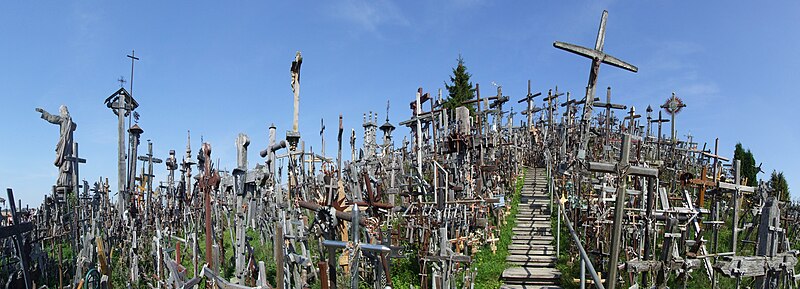
The Hill of Crosses (Lithuanian: About this sound Kryžių kalnas) is a site of pilgrimage about 12 km north of the city of siauliai, in northern Lithuania. The precise origin of the practice of leaving crosses on the hill is uncertain, but it is believed that the first crosses were placed on the former Jurgaiciai or Domantai hill fort after the 1831 Uprising. Over the generations, not only crosses, but giant crucifixes, carvings of Lithuanian patriots, statues of the Virgin Mary and thousands of tiny effigies and rosaries have been brought here by Catholic pilgrims. The exact number of crosses is unknown, but estimates put it at about 55,000 in 1990 and 100,000 in 2006.

Over the generations, the place has come to signify the peaceful endurance of Lithuanian Catholicism despite the threats it faced throughout history. After the 3rd partition of the Polish–Lithuanian Commonwealth in 1795, Lithuania became part of the Russian Empire. Poles and Lithuanians unsuccessfully rebelled against Russian authorities in 1831 and 1863. These two uprisings are connected with the beginnings of the hill: as families could not locate bodies of perished rebels, they started putting up symbolic crosses in place of a former hill fort.

When the old political structure of Eastern Europe fell apart in 1918, Lithuania once again declared its independence. Throughout this time, the Hill of Crosses was used as a place for Lithuanians to pray for peace, for their country, and for the loved ones they had lost during the Wars of Independence.

Most recently, the site took on a special significance during the years 1944–1990, when Lithuania was occupied by the Soviet Union. Continuing to travel to the Hill and leave their tributes, Lithuanians used it to demonstrate their allegiance to their original identity, religion and heritage. It was a venue of peaceful resistance, although the Soviets worked hard to remove new crosses, and bulldozed the site at least three times including attempts in 1963 and 1973.There were even rumors that the authorities planned to build a dam on the nearby Kulvė River, a tributary to Mūša, so that the hill would end up underwater.


On September 7, 1993, Pope John Paul II visited the Hill of Crosses, declaring it a place for hope, peace, love and sacrifice. In 2000 a Franciscan hermitage was opened nearby. The interior decoration draws links with La Verna, the mountain where St. Francis received his stigmata.The hill remains under nobody's jurisdiction; therefore people are free to build crosses as they see fit.


The Hill of Crosses has about 100 000 crosses. It is said that first crosses were erected here by the next-of-kin of the rebels that fell in the 1831 rebellion. The Hill of Crosses ia an historical architectural monument, it is a unique composition of folk art. The Hill of crosses atract's people with it's peace, spirituality, authenticity and sacred nature. The hill of crosses was visited by Pope John Paul II. Even more crosses appeared after the rebellion in 1863. At tht time the traditions of visiting and erecting crosses on the hill of crosses were being formed. The Hill of crosses became a place of vows in Lithuania. In the beginning of the 20th century, the hill was already quite well known. It was being visited by a lot of people, and services and feasts were taking place here. Now It has about 100 000 cross.

Pope John Paul II visiting Hill of Crosses

In 1993 it was visited by Pope John Paul II. The Hill of crosses in Lithuania has left a deap inpression on Pope John Paul II. Also by initiative of Pope was build Monastery close to the hill.