Showing posts with label pilgrimage. Show all posts

Saturday, 4 June 2016

ITALY: Vatican Partnership Encourages Pilgrimages to Rome

Opera Romana Pellegrinaggi works to accompany pilgrims on journeys around the world with adequate spiritual assistance and logistical organization. It promotes pilgrimages to important destinations that have a spiritual and cultural interest. While they have developed many itineraries to Catholic Christian destinations for pilgrims from around the world, they also help to organize customized itineraries based on individual groups' needs and desires.

Opera Romana Pellegrinaggi (ORP) has forged a North American partnership to offer spiritual pilgrimages for American and Canadian travellers. Ornit, the official distributor of Opera Romana Pellegrinaggi services in North America, will offer pilgrimage packages to Rome, Lourdes and other Marian sites, Israel and Palestine, walking pilgrimages to Santiago de Compostela, as well as social justice and event packages. Tours custom-tailored for individuals and groups are also possible.

ORP is a department of the Vatican, the Vatican's Institutional Unit of the Vicariate of Rome, Department of the Holy See, at the direct dependence of the Cardinal Vicariate of the Holy Father. Having the imprimatur of the Holy See, their guides and pastoral leaders are trained Catholics. What distinguishes ORP from other travel agencies, even Catholic operators, is that they are able to "open doors" to special places which may not otherwise be possible. Working with ORP, Ornit's tours assure a faith focus for all their pilgrimages, including daily Mass.

Founded in 1934, Opera Romana Pellegrinaggi works to accompany pilgrims on journeys around the world with adequate spiritual assistance and logistical organization. It promotes pilgrimages to important destinations that have a spiritual and cultural interest. While they have developed many itineraries to Catholic Christian destinations for pilgrims from around the world, they also help to organize customized itineraries based on individual groups' needs and desires. ORP is also committed each day to furthering its other important mission of creating a dialogue, as well as solidarity, charity and peace among people.

"We're living in a globalized world," said Patrizia De Libero Brown, ORP/Ornit's representative for the Eastern US and Canada.

"We believe that a pilgrimage is a lasting inner experience. It is a "journey of the spirit" that stimulates and helps a traveller to feel the presence of Christ in him or her and in others," said De Libero Brown. "It is also a way to explore the beauty of life and its Creations, a search for a face, as result of offering one another. A pilgrimage is a real opportunity for an inner transformation."

"Over the past couple of generations the Catholic Church's spiritual response to those changes has been to recover its spirituality of pilgrimage," said De Libero Brown. Discovering the Catholic Church today means discovering the pilgrim Church, whether it's through a monastic experience in the Holy Land or time travel through the history of the Church in Rome.

In a globalized world, pilgrimage is no longer the privileged experience of relatively wealthy North Americans and Europeans. Increasingly the 750,000 people who take Opera Romana trips each year come from countries like India, Brazil, Indonesia and the Philippines. More than ever, pilgrimages represent an important opportunity to discover and reforge the global unity of the Catholic Church.

"The most important aspect of any ORP/Ornit-organized tour is the opportunity to meet with the local Church and local people, whether it's in a village in the Palestinian Territories or along the streets of Rome," said De Libero Brown. "A journey of the spirit cannot happen without human faces," she said.

A pilgrim should experience both the life of the Church and their own personal Christian journey. "Pilgrimage is a metaphor of our Christian existence," said De Libero Brown.

But just buying a package tour doesn't necessarily lead to conversion.

"There's no magic to it," she said. "If any change is going to take place, it's going to come from within. Our mission here in the United States is to help in some small way to bring that about."

Ornit considers its market the 67 million Catholics in North America. In the last year it has established offices in Texas and Massachusetts, where De Libero Brown is based. Travel agents can book pilgrimages through Ornit, or individuals and groups can deal directly with Ornit by calling Ms. De Libero Brown in the Massachusetts office at 1-978-249-6580.

Tuesday, 8 September 2015

UGANDA: Saudi Arabia Reduces Number Of Ugandan Pilgrims To Mecca

The Saudi Arabia government has cut the number of Ugandans going for the holy pilgrimage to Mecca and Medina to 750 slots.

Uganda had been given a total of 1,500 pilgrims for which Saudi Arabia would issue visas in 2014, but it failed to fill the slots, leading to a penalty that has seen many miss out this year.

Sheikh Ahmada Lubega, a member on the Uganda Bureau of Hajj Association (UBHA), said as a result, at least more than 250 Ugandans will miss this year’s pilgrimage.
“Saudi authorities had issued only 500 visas for Uganda pilgrims this year,” Hajj Lubega said yesterday in an interview.
“We had to plead with them [Saudi embassy to Uganda] to increase the number to 750 visa slots, after realising that more Ugandans had deposited instalments for their travel,” he said.

In fact, at a colourful event at Wandegeya Mosque last Friday, the nominal Muslim leader, Prince Kassim Nakibinge, flagged off at least 750 Muslims going for pilgrimage.

However, not everyone was able to clear the requirements on time, resulting in 250 missing the pilgrimage.

Hajj Lubega observed that most of those who have missed out either cleared late or topped up their installments very late when the Saudi authorities had closed the online registrations.

Registration process
According to the official Saudi Arabia website, the registration process has since 2014 changed from manual to online registration and that if a country fails to meet the deadline, there is no provisional window for a manual process.

According to Sheikh Nuhu Muzaata, the director general of Muzaata and Mission, the delay in payments had been worsened by the fluctuating dollar rates.

“Our people want to pay in instalments and most of them pay in shillings.

Converting that into dollar is a very big challenge for our people to comprehend,” Sheikh Muzaata noted. “Many of our clients brand us as thieves because they don’t understand what is happening with the dollar that is in a free-fall,” Sheikh Muzaata said yesterday in a telephone interview.

Tuesday, 25 August 2015

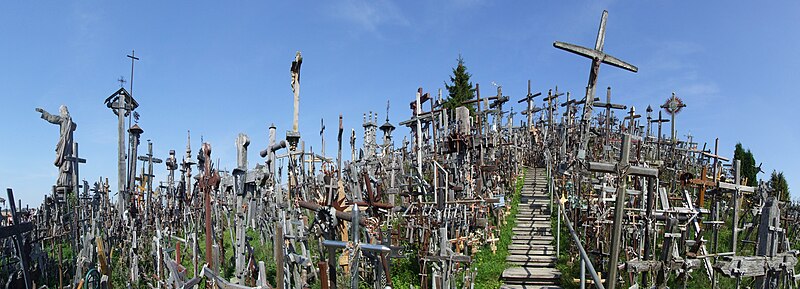
LITHUANIA: Hill Of Crosses


The Hill of Crosses (Lithuanian: About this sound Kryžių kalnas) is a site of pilgrimage about 12 km north of the city of siauliai, in northern Lithuania. The precise origin of the practice of leaving crosses on the hill is uncertain, but it is believed that the first crosses were placed on the former Jurgaiciai or Domantai hill fort after the 1831 Uprising. Over the generations, not only crosses, but giant crucifixes, carvings of Lithuanian patriots, statues of the Virgin Mary and thousands of tiny effigies and rosaries have been brought here by Catholic pilgrims. The exact number of crosses is unknown, but estimates put it at about 55,000 in 1990 and 100,000 in 2006.

Over the generations, the place has come to signify the peaceful endurance of Lithuanian Catholicism despite the threats it faced throughout history. After the 3rd partition of the Polish–Lithuanian Commonwealth in 1795, Lithuania became part of the Russian Empire. Poles and Lithuanians unsuccessfully rebelled against Russian authorities in 1831 and 1863. These two uprisings are connected with the beginnings of the hill: as families could not locate bodies of perished rebels, they started putting up symbolic crosses in place of a former hill fort.

When the old political structure of Eastern Europe fell apart in 1918, Lithuania once again declared its independence. Throughout this time, the Hill of Crosses was used as a place for Lithuanians to pray for peace, for their country, and for the loved ones they had lost during the Wars of Independence.

Most recently, the site took on a special significance during the years 1944–1990, when Lithuania was occupied by the Soviet Union. Continuing to travel to the Hill and leave their tributes, Lithuanians used it to demonstrate their allegiance to their original identity, religion and heritage. It was a venue of peaceful resistance, although the Soviets worked hard to remove new crosses, and bulldozed the site at least three times including attempts in 1963 and 1973.There were even rumors that the authorities planned to build a dam on the nearby Kulvė River, a tributary to Mūša, so that the hill would end up underwater.


On September 7, 1993, Pope John Paul II visited the Hill of Crosses, declaring it a place for hope, peace, love and sacrifice. In 2000 a Franciscan hermitage was opened nearby. The interior decoration draws links with La Verna, the mountain where St. Francis received his stigmata.The hill remains under nobody's jurisdiction; therefore people are free to build crosses as they see fit.


The Hill of Crosses has about 100 000 crosses. It is said that first crosses were erected here by the next-of-kin of the rebels that fell in the 1831 rebellion. The Hill of Crosses ia an historical architectural monument, it is a unique composition of folk art. The Hill of crosses atract's people with it's peace, spirituality, authenticity and sacred nature. The hill of crosses was visited by Pope John Paul II. Even more crosses appeared after the rebellion in 1863. At tht time the traditions of visiting and erecting crosses on the hill of crosses were being formed. The Hill of crosses became a place of vows in Lithuania. In the beginning of the 20th century, the hill was already quite well known. It was being visited by a lot of people, and services and feasts were taking place here. Now It has about 100 000 cross.

Pope John Paul II visiting Hill of Crosses

In 1993 it was visited by Pope John Paul II. The Hill of crosses in Lithuania has left a deap inpression on Pope John Paul II. Also by initiative of Pope was build Monastery close to the hill.