For Barbados holidays, flights and travel information let Totally Barbados be your guide. You can choose from many flights to Barbados or visit us by cruise ship.
When travelling to Barbados by air, there are a large selection of airlines that fly into Barbados.
The inter-island services include Air Jamaica, British West Indies Airlines (BWIA), LIAT, Caribbean Star, Caribbean Sun and American Eagle.
Caribbean Airlines, Caribbean Star, American Airlines, British Airways, Virgin Atlantic, Air Canada, Delta Airlines, LIAT and Air Jamaica all fly to and from Barbados on a regular basis from all over the Caribbean and the World.
When travelling to Barbados, remember that there will be a departure tax of BDS $50 that must be paid at the airport in cash upon departure. Baggage tipping is a suggested $1 U.S. per bag. A valid passport is mandatory for all persons entering the island.
Visas are required for citizens from Eastern European countries, the People's Republic of China, Taiwan, Pakistan, the non-Commonwealth countries of Africa, and all South American countries except Argentina, Brazil, Colombia, and Venezuela.
Barbados is a major tourist location and with all the technical advances of recent years, it is now easier than ever to get here.
Book your entire Barbados vacation, flights and travel plans by using Expedia, the world's most popular online travel agent service listed below, for cheap flights to Barbados, cruises, hotels, care hire or entire packages with special discounts from TotallyBarbados.com.
Or call your travel agent to book your trip to Barbados. Come and see what paradise really looks like.
Because Barbados is an island, a mass of land fully surrounded by water, there are only two ways to get here: by air or sea.
Barbados is a favourite stop for cruise ships, so that's a rather popular way of getting here. For ideas of what to do while travelling to Barbados for one day on a cruise ship, see our shore excursions page in the Barbados Vacation category below.
Barbados is the most easterly island in the Caribbean island chain. St. Lucia is the closest country to us. We are southeast of the United States of America, west of Africa, southwest of the United Kingdom and northeast of Venezuela.
If a cruise ship isn't really your thing, you can still enjoy travelling to Barbados by sail or motor boat from any of our neighbouring islands.
During the winter months, our bays are often full of people who are sailing around the world and who have come for a little stop-off in paradise.

Tourism, Travel, Hospitality, Conservation: News,Stories And Experiences From Allover The World
Showing posts with label liat. Show all posts
Showing posts with label liat. Show all posts
Wednesday, 27 January 2016


Tuesday, 17 November 2015
USA: Air Lease Corporation Announces the Placement of One New ATR 72-600 with LIAT

Air Lease Corporation (NYSE: AL) announced the placement of one new ATR 72-600 aircraft on long term lease with Antigua-based LIAT (Leeward Islands Air Transport). The aircraft is from ALC’s order book with ATR and is scheduled to deliver in the third quarter of 2016.
“We are pleased to place yet another new fuel efficient aircraft with LIAT, who has been a valued customer of ALC for several years. This ATR 72-600 will replace an older Bombardier Dash 8 aircraft to maintain scheduled fleet operations in the Caribbean,” said Kishore Korde, Executive Vice President of Air Lease Corporation.
Forward-Looking Statements
This press release contains forward-looking statements within the meaning of the Private Securities Litigation Reform Act of 1995, including expected delivery dates. Such statements are based on current expectations and projections about our future results, prospects and opportunities and are not guarantees of future performance. Such statements will not be updated unless required by law. Actual results and performance may differ materially from those expressed or forecasted in forward-looking statements due to a number of factors, including those discussed in our filings with the Securities and Exchange Commission.
About Air Lease Corporation (NYSE: AL)
ALC is a leading aircraft leasing company based in Los Angeles, California that has airline customers throughout the world. ALC and its team of dedicated and experienced professionals are principally engaged in purchasing commercial aircraft and leasing them to its airline customers worldwide through customized aircraft leasing and financing solutions. For more information, visit ALC’s website at www.airleasecorp.com.
About LIAT
LIAT is one of the leading Caribbean airlines. It is owned by regional shareholders, with major shareholders being the Governments of Barbados, Antigua & Barbuda and St. Vincent & the Grenadines. More information about LIAT may be found at www.liat.com.
Thursday, 12 November 2015
Security Checks At Piarco Int’l Airport May Cause Delays – LIAT
LIAT, the Caribbean Airline, wishes to advise that while it is operating its normal scheduled services to/from Trinidad, customers should expect delays due to extensive airport authority security checks at Piarco International Airport.
Head of Corporate Communications Desmond Brown said there are long queues at the airport security check points and customers traveling from Trinidad should therefore arrive at the airport at least three hours before departure.
“Customers using the Piarco International Airport are advised to leave their home or hotel earlier than they normally would, giving themselves enough time to pass through airport security,” Brown said.
He further advised that if LIAT is affected by any significant delays in Trinidad, this could affect other LIAT flights in the region.
LIAT sincerely apologises for any inconvenience caused as a result of the extensive airport authority security checks at Piarco International Airport.
Head of Corporate Communications Desmond Brown said there are long queues at the airport security check points and customers traveling from Trinidad should therefore arrive at the airport at least three hours before departure.
“Customers using the Piarco International Airport are advised to leave their home or hotel earlier than they normally would, giving themselves enough time to pass through airport security,” Brown said.
He further advised that if LIAT is affected by any significant delays in Trinidad, this could affect other LIAT flights in the region.
LIAT sincerely apologises for any inconvenience caused as a result of the extensive airport authority security checks at Piarco International Airport.
Wednesday, 30 September 2015
LIAT’s Newest Hire

Regional air carrier LIAT has named Captain Arthur Senhouse its new Director, Flight Operations.
The appointment, which took effect Sept. 1, includes responsibility for “all aspects of the airline’s flight operations.”
Senhouse has been with the company since 1987, having held a number of senior positions including chairman of the Leeward Islands Airline Pilots Association.
“We are pleased to announce the appointment of Captain Senhouse in the role of Director Flight Operations, overseeing one of the most important aspects of our airline’s operations,” said LIAT Chief Executive Officer David Evans. “His extensive experience within the airline will certainly add strength and depth to our senior management team.”
In a statement, Senhouse said he was “humbled” by the decision.
“I have joined the management team of LIAT when the airline is at the crossroads of completing its fleet renewal programme and totally reinventing itself into a Caribbean entity we can be proud of,” he said.
DOMINICA: LIAT Returning To Dominica
LIAT will resume flights to and from Dominica’s Douglas-Charles Airport beginning Friday, September 18, the airline said in a statement.
LIAT was forced to suspend its services to Dominica on August 27 following the passage of Tropical Storm Erika, which resulted in widespread damage to the island and the closure of the airport.
The airline will operate one flight to Dominica on Friday, and then increase its services to two daily flights beginning Saturday.
“We are extremely happy to be returning to Dominica,” said Chief Executive Officer David Evans. “This would not have been possible without the spirit of community and resilience for which Dominica is well known.”
LI 581 will depart V.C. Bird International Airport in Antigua at 7:10 a.m. daily and arrive at the Douglas-Charles Airport at 7:50 a.m., while the return service, LI 580, will depart Dominica at 8:30 a.m. and arrive in Antigua at 9:10 a.m.
Beginning Saturday, LI 364 will depart Grantley Adams International Airport in Barbados at 2:20 p.m. daily, and arrive in Dominica at 3:20 p.m.
LIAT’s service to Guadeloupe and Antigua will continue on Saturday, Tuesday, and Thursday, and its non=stop service to Antigua will continue on Monday, Wednesday and Friday.
The airline recommends that customers traveling from Dominica arrive at the airport at least three hours prior to the scheduled departure time to account for the increased security and baggage checks at the Douglas-Charles Airport.
LIAT was forced to suspend its services to Dominica on August 27 following the passage of Tropical Storm Erika, which resulted in widespread damage to the island and the closure of the airport.
The airline will operate one flight to Dominica on Friday, and then increase its services to two daily flights beginning Saturday.
“We are extremely happy to be returning to Dominica,” said Chief Executive Officer David Evans. “This would not have been possible without the spirit of community and resilience for which Dominica is well known.”
LI 581 will depart V.C. Bird International Airport in Antigua at 7:10 a.m. daily and arrive at the Douglas-Charles Airport at 7:50 a.m., while the return service, LI 580, will depart Dominica at 8:30 a.m. and arrive in Antigua at 9:10 a.m.
Beginning Saturday, LI 364 will depart Grantley Adams International Airport in Barbados at 2:20 p.m. daily, and arrive in Dominica at 3:20 p.m.
LIAT’s service to Guadeloupe and Antigua will continue on Saturday, Tuesday, and Thursday, and its non=stop service to Antigua will continue on Monday, Wednesday and Friday.
The airline recommends that customers traveling from Dominica arrive at the airport at least three hours prior to the scheduled departure time to account for the increased security and baggage checks at the Douglas-Charles Airport.
Sunday, 6 September 2015
DOMINICA: Nature Isle of the Caribbean
The name Dominica comes from the Latin word for Sunday, which was the day on which the island was spotted by explorer Christopher Columbus. Its pre-Columbian name by the Caribs was Wai‘tu kubuli, which means "Tall is her body".The indigenous people of the island were the Island Caribs or Kalinago.

Officially the Commonwealth of Dominica, is an island country in the Lesser Antilles region of the Caribbean Sea, south-southeast of Guadeloupe and northwest of Martinique. Its size is 750 square kilometres (290 sq mi) and the highest point in the country is Morne Diablotins, which has an elevation of 1,447 metres (4,747 ft). The Commonwealth of Dominica had a population of 72,301 at the 2014 Census. The capital is Roseau, located on the leeward side of the island.
Dominica was first discovered by the Spanish, then colonized predominately by the French. Great Britain took it over in 1763 after the Seven Years War and gradually established English as the official language. The island republic gained independence in 1978 and its name is pronounced with emphasis on the third syllable, related to its former Dominique. Dominica has been nicknamed the "Nature Isle of the Caribbean" for its unspoiled natural beauty.It is the youngest island in the Lesser Antilles, still being formed by geothermal-volcanic activity, as evidenced by the world's second-largest hot spring, Boiling Lake. The island features lush mountainous rainforests, and is the home of many rare plants, animals, and bird species. There are xeric areas in some of the western coastal regions, but heavy rainfall occurs inland. The island has 365 rivers. The Sisserou parrot (also known as the imperial amazon), is found only on Dominica and is the island's national bird. It is featured on the national flag. Dominica's economy is depends on tourism and agriculture.
Christopher Columbus named the island after the day of the week on which he spotted it: Sunday (dies Dominica in Latin), 3 November 1493. In the hundred years following, Dominica remained isolated. It was inhabited by the Kalinago people (Island Caribs). As European explorers and settlers entered the region, more indigenous refugees settled there after being driven from surrounding islands. They pushed out the Spanish settlers, who found other areas easier to control and with more resources.
The island became multi-ethnic due to European colonization, which included the importation of numerous African slaves.
Although English is now the official language, an Antillean Creole, based on the French language, West African and Carib influences, is still spoken by many residents, especially people of older generations.
Dominica is an island nation in the Caribbean Sea, the northernmost of the Windward Islands (though it is sometimes considered the southernmost of the Leeward Islands). The size of the country is about 289.5 square miles (750 km2). The capital is Roseau.
The Commonwealth of Dominica is engaged in a long-running dispute with Venezuela over Venezuela's territorial claims to the sea surrounding Isla Aves (literally Bird Island, but in fact called Bird Rock by Dominica authorities), a tiny islet located 140 miles (225 km) west of the island of Dominica.
There are two primary population centres: Roseau (with 14,725 inhabitants in 2011) and Portsmouth (with 4,167 inhabitants in 2011).
TOURISM ATTRACTIONS

Dominica is largely covered by rainforest and is home to the world's second-largest hot spring, Boiling Lake.Dominica has many waterfalls, springs, and rivers. The Calibishie area in the country's northeast has sandy beaches.Some plants and animals thought to be extinct on surrounding islands can still be found in Dominica's forests.The volcanic nature of the island has attracted scuba divers. The island has several protected areas, including Cabrits National Park, as well as 365 rivers.
Morne Trois Pitons National Park is a tropical forest blended with scenic volcanic features. It was recognised as a World Heritage Site on 4 April 1995, a distinction it shares with four other Caribbean islands.
Dominica, known as "The Nature Island of the Caribbean" due to its spectacular, lush, and varied flora and fauna, which are protected by an extensive natural park system; the most mountainous of the Lesser Antilles, its volcanic peaks are cones of lava craters and include Boiling Lake, the second-largest, thermally active lake in the world possesses the most pristine wilderness in the Caribbean.Originally, it was protected by sheer mountains which led the European powers to build ports and agricultural settlements on other islands. More recently, the citizens of this island have sought to preserve its spectacular natural beauty by discouraging the type of high-impact tourism which has damaged nature in most of the Caribbean.
Dominica is mostly volcanic and has few beaches; therefore, tourism has developed more slowly than on neighboring islands. Nevertheless, Dominica's mountains, rainforests, freshwater lakes, hot springs, waterfalls, and diving spots make it an attractive eco-tourism destination. Cruise ship stopovers have increased following the development of modern docking and waterfront facilities in Roseau, the capital.Out of 22 Caribbean islands tracked, Dominica had the fewest visitors in 2008 (55,800 or 0.3% of the total). This was about half as many as visited Haiti.
Visitors can find large tropical forests, including one which is on the UNESCO list of World Heritage sites, hundreds of streams, coastlines and coral reefs.
The Sisserou parrot (Amazona imperialis) is Dominica's national bird and is endemic to its mountain forests. A related species, the Jaco or red-necked parrot (A. arausiaca),. is also a Dominican endemic. Both birds are rare and protected, though some forest is still threatened by logging in addition to the long-standing threat of hurricanes.
The Caribbean Sea offshore of the island of Dominica is home to many cetaceans. Most notably a group of sperm whales live in this area year round. Other cetaceans commonly seen in the area include spinner dolphins, pantropical spotted dolphins and bottlenose dolphins. Less commonly seen animals include killer whales, false killer whales, pygmy sperm whales, dwarf sperm whales, Risso's dolphins, common dolphins, Atlantic spotted dolphins, humpback whales and Bryde's whales. This makes Dominica a destination for tourists interested in whale-watching.
Dominica is especially vulnerable to hurricanes as the island is located in what is referred to as the hurricane region. In 1979, Dominica was hit directly by category 5 Hurricane David, causing widespread and extreme damage. On 17 August 2007, Hurricane Dean, a category 1 at the time, hit the island. A mother and her seven-year-old son died when a landslide caused by the heavy rains crushed their house.In another incident two people were injured when a tree fell on their house.Prime Minister Roosevelt Skerrit estimated that 100 to 125 homes were damaged, and that the agricultural sector was extensively damaged, in particular the banana crop. In August 2015, Tropical Storm Erika caused extensive flooding across the island.
GOVERMENT

Nicholas Liverpool, Dominica's sixth president
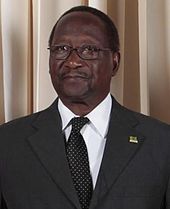
Dominica is a parliamentary democracy within the Commonwealth of Nations and, since 1979, a member of La Francophonie. The Commonwealth of Dominica is one of the Caribbean's few republics. The president is the head of state, while executive power rests with the cabinet, headed by the prime minister. The unicameral parliament consists of the 30-member House of Assembly, which consists of 21 directly elected members and nine senators, who may either be appointed by the president or elected by the other members of the House of Assembly.
Unlike other former British colonies in the region, Dominica was never a Commonwealth realm, instead becoming a republic on independence. Dominica is a full and participating member of the Caribbean Community (CARICOM) and the Organisation of Eastern Caribbean States (OECS).
Dominica is also a member of the International Criminal Court with a Bilateral Immunity Agreement of protection for the US military, as covered under Article 98. In January 2008 Dominica joined the Bolivarian Alternative for the Americas.
Dominica is divided into 10 parishes, given below with their 2011 Census populations:
 Saint Andrew Parish (9,471)
Saint David Parish (6,043)
Saint George Parish (21,241)
Saint John Parish (6,561)
Saint Joseph Parish (5,637)
Saint Luke Parish (1,668)
Saint Mark Parish (1,834)
Saint Patrick Parish (7,622)
Saint Paul Parish (9,786)
Saint Peter Parish (1,430)
Bananas and other agriculture dominate Dominica's economy, and nearly one-third of the labour force works in agriculture. This sector, however, is highly vulnerable to weather conditions and to external events affecting commodity prices. In 2007, Hurricane Dean caused significant damage to the agricultural sector as well as the country's infrastructure, especially roads. In response to reduced European Union (EU) banana trade preferences, the government has diversified the agricultural sector by promoting the production of coffee, patchouli, aloe vera, cut flowers, and exotic fruits such as mango, guava, and papaya. Dominica has also had some success in increasing its manufactured exports, primarily soap.
CURRENCY
Dominica's currency is the East Caribbean Dollar.
TRANSPORT
AIR
There are two small airports on the island. The primary airport, Melville Hall Airport (DOM), is on the northeast coast and is about a 45-minute drive from Portsmouth. The second is Canefield Airport (DCF), about 15 minutes from Roseau on the southwest coast. Melville Hall Airport is suitable for limited use of commercial jets because of runway length. Melville Hall currently has regular service by BVI Airways, Winair, Seaborne Airlines and LIAT using twin turboprop aircraft like the ATR & Saab 340, as well as Conviasa and Amerijet, which, using Boeing 727 Freighters, is the only airline with jet service to the republic. A runway extension and service upgrade project began at Melville Hall around 2006 and was finished in 2010. In March 2013, airline American Eagle halted flights to the island citing high labor costs.
ROAD
The only major highway on the island is the road between Portsmouth and Roseau. It takes about 45 minutes to drive from Portsmouth to Roseau. Private minibuses form the major public transport system. However, this "highway" was under major reconstruction via help from the Chinese and was completed in April 2012.
MORE
The vast majority of Dominicans are of African descent. There is a growing mixed population, along with a significant Indo-Caribbean or East Indian groups, a small European origin minority (descendants of French, British, and Irish colonists) and there are small numbers of Lebanese, Syrians and Asians. Dominica is also the only Eastern Caribbean island that still has a population of pre-Columbian native Caribs, who were exterminated or driven from neighbouring islands. As of 2014 there are more than 3,000 Caribs remaining. They live in eight villages on the east coast of Dominica. This special Carib Territory was granted by the British Crown in 1903.There are also about 1,000 medical students from the United States and Canada who study at the Ross University School of Medicine in Portsmouth.
LANGUAGES
English is the official language of Dominica and is universally spoken and understood. However, because of historic French occupation during different times in history, and the island's location (it lies between the two French-speaking departments of Martinique and Guadeloupe), Antillean Creole, based on French, is spoken by many people on the island. The French creole language is particularly used among the older generation, which also speaks a language known as "patois". Because of a decline in its usage by the younger generation, initiatives have been set up in an effort to increase usage and promote this unique part of the nation's history and culture.
The dialect of Dominica also includes Kokoy, along with Creole—French-based patois. Cocoy, or Kokoy,is a mix of Leeward Island English Creole and Dominican Creole.It is mainly spoken in the north-eastern villages of Marigot and Wesley by immigrants from Montserrat and Antigua. Over time there has been much intermarrying, but there are still traces of difference in origin. As a result of this mixture of languages and heritage, Dominica is a member of both the English-speaking Commonwealth of Nations and the French-speaking La Francophonie.
Island Carib, also known as Igneri (Iñeri, Igñeri, Inyeri), was an Arawakan language historically spoken by the Island Caribs of the Lesser Antilles in the Caribbean. The Island Caribs lived throughout the southern Lesser Antilles such as Dominica, St Vincent and Trinidad, supposedly having conquered them from their previous inhabitants, the Igneri. It went extinct about 1920, but an offshoot survives as Garifuna, primarily in Central America.
RELIGION
About 80% of the population is Roman Catholic, though in recent years a number of Protestant churches have been established. There is also a small Muslim community in Dominica, and the nation's first mosque was built recently near Ross University.
CITIES & TOWNS OF DOMINICA
Rank Name Population.
1 Roseau 16,571
2 Portsmouth 3,633
3 Marigot 2,669
4 Berekua 2,608
5 Mahaut 2,369
6 Saint Joseph 2,184
7 Wesley 1,933
8 Salisbury 1,413
9 Castle Bruce 1,387
10 La Plaine 1,332
CUISINE
Dominica's cuisine is similar to that of other Caribbean islands, particularly Trinidad and St Lucia. Like other Commonwealth Caribbean islands, Dominicans have developed a distinct twist to their cuisine. Breakfast is an important daily meal, typically including saltfish, dried and salted codfish, and "bakes", fried dough. Saltfish and bakes are combined for a fast food snack that can be eaten throughout the day; vendors on Dominica's streets sell these snacks to passersby, together with fried chicken, fish and fruit and yogurt "smoothies". Other breakfast meals include cornmeal porridge, which is made with fine cornmeal or polenta, milk and condensed milk and sugar to sweeten. Traditional British-influenced dishes, such as eggs, bacon and toast, are also popular, as are fried fish and plantains.
 Common vegetables include Plantain, Tania (a root vegetable), Yam, Potato, rice and peas. Meat and poultry typically eaten include chicken (which is very popular), beef, and fish. These are often prepared in stews with onions, carrots, garlic, ginger and herbs like thyme. The vegetables and meat are browned to create a rich dark sauce. Popular meals include rice and peas, brown stew chicken, stew beef, fried and stewed fish, and many different types of hearty fish broths and soups. These are filled with dumplings, carrots and ground provisions.
Dominica's cuisine is similar to many other Caribbean islands including that of Trinidad and St Lucia. Though separated by water Dominica like many other Commonwealth Caribbean islands have their distinct twist to their meals. Breakfast is an important meal in Dominica and is eaten everyday, typically eaten meals include saltfish which are dried and salted codfish and Bakes made by making a dough and frying in oil prove popular before a long days at work.
Saltfish and bakes however is also doubled up as a fast food snack that can be eaten throughout the day, vendors and Dominica's streets sell these snacks to passers by alongside Fried chicken, Fish and tasty smoothies. Other breakfast meals include cornmeal porridge which is made with fine cornmeal or polenta, milk and condensed milk and sugar to sweeten, more British influenced meals like Eggs, bacon and toast are also popular alongside fried fish and plantains. During Lunchtime or Dinner Common vegetables eaten are Plantain, Tania, Yam, Potato, rice and peas.
Meat and poultry typically eaten include Chicken (which is very popular), beef, fish which are normally stewed down with onions, carrots, garlic, ginger and herbs like thyme and using the browning method to create a rich dark sauce. Popular meals include rice and peas, Stew chicken, Stew beef, fried and stewed fish and many different types of hearty fish broths and Soups which are packed full with dumplings, carrots and ground provisions.
Roadside stands and small-town restaurants typically serve fried chicken, fish-and-chips and "tasty bakes" which are fried dough made with flour, water and sugar or sometimes salt, along with cold drinks. The island produces numerous exotic fruits, including bananas, coconuts, papayas, guavas, pineapples, and mangoes which can be eaten as dessert and be pureed or liquefied.
Dominica's national dish is the mountain chicken, which are snares of the legs of a frog called the Crapaud, which is endemic to Dominica and Montserrat. Found at higher elevations, it's a protected species and can only be caught between autumn and February.
BEVERAGES
Rivers flowing down from the mountains provide Dominica with an abundant supply of freshwater. Drinks include rum punch and freshly made smoothies.
Dominica tea culture has a long history. Many traditional medicinal teas have origins with the original Carib culture of the island. Dominica brews its own beer under the Kubuli label.
Officially the Commonwealth of Dominica, is an island country in the Lesser Antilles region of the Caribbean Sea, south-southeast of Guadeloupe and northwest of Martinique. Its size is 750 square kilometres (290 sq mi) and the highest point in the country is Morne Diablotins, which has an elevation of 1,447 metres (4,747 ft). The Commonwealth of Dominica had a population of 72,301 at the 2014 Census. The capital is Roseau, located on the leeward side of the island.
Dominica was first discovered by the Spanish, then colonized predominately by the French. Great Britain took it over in 1763 after the Seven Years War and gradually established English as the official language. The island republic gained independence in 1978 and its name is pronounced with emphasis on the third syllable, related to its former Dominique. Dominica has been nicknamed the "Nature Isle of the Caribbean" for its unspoiled natural beauty.It is the youngest island in the Lesser Antilles, still being formed by geothermal-volcanic activity, as evidenced by the world's second-largest hot spring, Boiling Lake. The island features lush mountainous rainforests, and is the home of many rare plants, animals, and bird species. There are xeric areas in some of the western coastal regions, but heavy rainfall occurs inland. The island has 365 rivers. The Sisserou parrot (also known as the imperial amazon), is found only on Dominica and is the island's national bird. It is featured on the national flag. Dominica's economy is depends on tourism and agriculture.
Christopher Columbus named the island after the day of the week on which he spotted it: Sunday (dies Dominica in Latin), 3 November 1493. In the hundred years following, Dominica remained isolated. It was inhabited by the Kalinago people (Island Caribs). As European explorers and settlers entered the region, more indigenous refugees settled there after being driven from surrounding islands. They pushed out the Spanish settlers, who found other areas easier to control and with more resources.
The island became multi-ethnic due to European colonization, which included the importation of numerous African slaves.
Although English is now the official language, an Antillean Creole, based on the French language, West African and Carib influences, is still spoken by many residents, especially people of older generations.
Dominica is an island nation in the Caribbean Sea, the northernmost of the Windward Islands (though it is sometimes considered the southernmost of the Leeward Islands). The size of the country is about 289.5 square miles (750 km2). The capital is Roseau.
The Commonwealth of Dominica is engaged in a long-running dispute with Venezuela over Venezuela's territorial claims to the sea surrounding Isla Aves (literally Bird Island, but in fact called Bird Rock by Dominica authorities), a tiny islet located 140 miles (225 km) west of the island of Dominica.
There are two primary population centres: Roseau (with 14,725 inhabitants in 2011) and Portsmouth (with 4,167 inhabitants in 2011).
TOURISM ATTRACTIONS
Dominica is largely covered by rainforest and is home to the world's second-largest hot spring, Boiling Lake.Dominica has many waterfalls, springs, and rivers. The Calibishie area in the country's northeast has sandy beaches.Some plants and animals thought to be extinct on surrounding islands can still be found in Dominica's forests.The volcanic nature of the island has attracted scuba divers. The island has several protected areas, including Cabrits National Park, as well as 365 rivers.
Morne Trois Pitons National Park is a tropical forest blended with scenic volcanic features. It was recognised as a World Heritage Site on 4 April 1995, a distinction it shares with four other Caribbean islands.
Dominica, known as "The Nature Island of the Caribbean" due to its spectacular, lush, and varied flora and fauna, which are protected by an extensive natural park system; the most mountainous of the Lesser Antilles, its volcanic peaks are cones of lava craters and include Boiling Lake, the second-largest, thermally active lake in the world possesses the most pristine wilderness in the Caribbean.Originally, it was protected by sheer mountains which led the European powers to build ports and agricultural settlements on other islands. More recently, the citizens of this island have sought to preserve its spectacular natural beauty by discouraging the type of high-impact tourism which has damaged nature in most of the Caribbean.
Dominica is mostly volcanic and has few beaches; therefore, tourism has developed more slowly than on neighboring islands. Nevertheless, Dominica's mountains, rainforests, freshwater lakes, hot springs, waterfalls, and diving spots make it an attractive eco-tourism destination. Cruise ship stopovers have increased following the development of modern docking and waterfront facilities in Roseau, the capital.Out of 22 Caribbean islands tracked, Dominica had the fewest visitors in 2008 (55,800 or 0.3% of the total). This was about half as many as visited Haiti.
Visitors can find large tropical forests, including one which is on the UNESCO list of World Heritage sites, hundreds of streams, coastlines and coral reefs.
The Sisserou parrot (Amazona imperialis) is Dominica's national bird and is endemic to its mountain forests. A related species, the Jaco or red-necked parrot (A. arausiaca),. is also a Dominican endemic. Both birds are rare and protected, though some forest is still threatened by logging in addition to the long-standing threat of hurricanes.
The Caribbean Sea offshore of the island of Dominica is home to many cetaceans. Most notably a group of sperm whales live in this area year round. Other cetaceans commonly seen in the area include spinner dolphins, pantropical spotted dolphins and bottlenose dolphins. Less commonly seen animals include killer whales, false killer whales, pygmy sperm whales, dwarf sperm whales, Risso's dolphins, common dolphins, Atlantic spotted dolphins, humpback whales and Bryde's whales. This makes Dominica a destination for tourists interested in whale-watching.
Dominica is especially vulnerable to hurricanes as the island is located in what is referred to as the hurricane region. In 1979, Dominica was hit directly by category 5 Hurricane David, causing widespread and extreme damage. On 17 August 2007, Hurricane Dean, a category 1 at the time, hit the island. A mother and her seven-year-old son died when a landslide caused by the heavy rains crushed their house.In another incident two people were injured when a tree fell on their house.Prime Minister Roosevelt Skerrit estimated that 100 to 125 homes were damaged, and that the agricultural sector was extensively damaged, in particular the banana crop. In August 2015, Tropical Storm Erika caused extensive flooding across the island.
GOVERMENT
Nicholas Liverpool, Dominica's sixth president
Dominica is a parliamentary democracy within the Commonwealth of Nations and, since 1979, a member of La Francophonie. The Commonwealth of Dominica is one of the Caribbean's few republics. The president is the head of state, while executive power rests with the cabinet, headed by the prime minister. The unicameral parliament consists of the 30-member House of Assembly, which consists of 21 directly elected members and nine senators, who may either be appointed by the president or elected by the other members of the House of Assembly.
Unlike other former British colonies in the region, Dominica was never a Commonwealth realm, instead becoming a republic on independence. Dominica is a full and participating member of the Caribbean Community (CARICOM) and the Organisation of Eastern Caribbean States (OECS).
Dominica is also a member of the International Criminal Court with a Bilateral Immunity Agreement of protection for the US military, as covered under Article 98. In January 2008 Dominica joined the Bolivarian Alternative for the Americas.
Dominica is divided into 10 parishes, given below with their 2011 Census populations:

Saint David Parish (6,043)
Saint George Parish (21,241)
Saint John Parish (6,561)
Saint Joseph Parish (5,637)
Saint Luke Parish (1,668)
Saint Mark Parish (1,834)
Saint Patrick Parish (7,622)
Saint Paul Parish (9,786)
Saint Peter Parish (1,430)
Bananas and other agriculture dominate Dominica's economy, and nearly one-third of the labour force works in agriculture. This sector, however, is highly vulnerable to weather conditions and to external events affecting commodity prices. In 2007, Hurricane Dean caused significant damage to the agricultural sector as well as the country's infrastructure, especially roads. In response to reduced European Union (EU) banana trade preferences, the government has diversified the agricultural sector by promoting the production of coffee, patchouli, aloe vera, cut flowers, and exotic fruits such as mango, guava, and papaya. Dominica has also had some success in increasing its manufactured exports, primarily soap.
CURRENCY
Dominica's currency is the East Caribbean Dollar.
TRANSPORT
AIR
There are two small airports on the island. The primary airport, Melville Hall Airport (DOM), is on the northeast coast and is about a 45-minute drive from Portsmouth. The second is Canefield Airport (DCF), about 15 minutes from Roseau on the southwest coast. Melville Hall Airport is suitable for limited use of commercial jets because of runway length. Melville Hall currently has regular service by BVI Airways, Winair, Seaborne Airlines and LIAT using twin turboprop aircraft like the ATR & Saab 340, as well as Conviasa and Amerijet, which, using Boeing 727 Freighters, is the only airline with jet service to the republic. A runway extension and service upgrade project began at Melville Hall around 2006 and was finished in 2010. In March 2013, airline American Eagle halted flights to the island citing high labor costs.
ROAD
The only major highway on the island is the road between Portsmouth and Roseau. It takes about 45 minutes to drive from Portsmouth to Roseau. Private minibuses form the major public transport system. However, this "highway" was under major reconstruction via help from the Chinese and was completed in April 2012.
MORE
The vast majority of Dominicans are of African descent. There is a growing mixed population, along with a significant Indo-Caribbean or East Indian groups, a small European origin minority (descendants of French, British, and Irish colonists) and there are small numbers of Lebanese, Syrians and Asians. Dominica is also the only Eastern Caribbean island that still has a population of pre-Columbian native Caribs, who were exterminated or driven from neighbouring islands. As of 2014 there are more than 3,000 Caribs remaining. They live in eight villages on the east coast of Dominica. This special Carib Territory was granted by the British Crown in 1903.There are also about 1,000 medical students from the United States and Canada who study at the Ross University School of Medicine in Portsmouth.
LANGUAGES
English is the official language of Dominica and is universally spoken and understood. However, because of historic French occupation during different times in history, and the island's location (it lies between the two French-speaking departments of Martinique and Guadeloupe), Antillean Creole, based on French, is spoken by many people on the island. The French creole language is particularly used among the older generation, which also speaks a language known as "patois". Because of a decline in its usage by the younger generation, initiatives have been set up in an effort to increase usage and promote this unique part of the nation's history and culture.
The dialect of Dominica also includes Kokoy, along with Creole—French-based patois. Cocoy, or Kokoy,is a mix of Leeward Island English Creole and Dominican Creole.It is mainly spoken in the north-eastern villages of Marigot and Wesley by immigrants from Montserrat and Antigua. Over time there has been much intermarrying, but there are still traces of difference in origin. As a result of this mixture of languages and heritage, Dominica is a member of both the English-speaking Commonwealth of Nations and the French-speaking La Francophonie.
Island Carib, also known as Igneri (Iñeri, Igñeri, Inyeri), was an Arawakan language historically spoken by the Island Caribs of the Lesser Antilles in the Caribbean. The Island Caribs lived throughout the southern Lesser Antilles such as Dominica, St Vincent and Trinidad, supposedly having conquered them from their previous inhabitants, the Igneri. It went extinct about 1920, but an offshoot survives as Garifuna, primarily in Central America.
RELIGION
About 80% of the population is Roman Catholic, though in recent years a number of Protestant churches have been established. There is also a small Muslim community in Dominica, and the nation's first mosque was built recently near Ross University.
CITIES & TOWNS OF DOMINICA
Rank Name Population.
1 Roseau 16,571
2 Portsmouth 3,633
3 Marigot 2,669
4 Berekua 2,608
5 Mahaut 2,369
6 Saint Joseph 2,184
7 Wesley 1,933
8 Salisbury 1,413
9 Castle Bruce 1,387
10 La Plaine 1,332
CUISINE
Dominica's cuisine is similar to that of other Caribbean islands, particularly Trinidad and St Lucia. Like other Commonwealth Caribbean islands, Dominicans have developed a distinct twist to their cuisine. Breakfast is an important daily meal, typically including saltfish, dried and salted codfish, and "bakes", fried dough. Saltfish and bakes are combined for a fast food snack that can be eaten throughout the day; vendors on Dominica's streets sell these snacks to passersby, together with fried chicken, fish and fruit and yogurt "smoothies". Other breakfast meals include cornmeal porridge, which is made with fine cornmeal or polenta, milk and condensed milk and sugar to sweeten. Traditional British-influenced dishes, such as eggs, bacon and toast, are also popular, as are fried fish and plantains.

Dominica's cuisine is similar to many other Caribbean islands including that of Trinidad and St Lucia. Though separated by water Dominica like many other Commonwealth Caribbean islands have their distinct twist to their meals. Breakfast is an important meal in Dominica and is eaten everyday, typically eaten meals include saltfish which are dried and salted codfish and Bakes made by making a dough and frying in oil prove popular before a long days at work.
Saltfish and bakes however is also doubled up as a fast food snack that can be eaten throughout the day, vendors and Dominica's streets sell these snacks to passers by alongside Fried chicken, Fish and tasty smoothies. Other breakfast meals include cornmeal porridge which is made with fine cornmeal or polenta, milk and condensed milk and sugar to sweeten, more British influenced meals like Eggs, bacon and toast are also popular alongside fried fish and plantains. During Lunchtime or Dinner Common vegetables eaten are Plantain, Tania, Yam, Potato, rice and peas.
Meat and poultry typically eaten include Chicken (which is very popular), beef, fish which are normally stewed down with onions, carrots, garlic, ginger and herbs like thyme and using the browning method to create a rich dark sauce. Popular meals include rice and peas, Stew chicken, Stew beef, fried and stewed fish and many different types of hearty fish broths and Soups which are packed full with dumplings, carrots and ground provisions.
Roadside stands and small-town restaurants typically serve fried chicken, fish-and-chips and "tasty bakes" which are fried dough made with flour, water and sugar or sometimes salt, along with cold drinks. The island produces numerous exotic fruits, including bananas, coconuts, papayas, guavas, pineapples, and mangoes which can be eaten as dessert and be pureed or liquefied.
Dominica's national dish is the mountain chicken, which are snares of the legs of a frog called the Crapaud, which is endemic to Dominica and Montserrat. Found at higher elevations, it's a protected species and can only be caught between autumn and February.
BEVERAGES
Rivers flowing down from the mountains provide Dominica with an abundant supply of freshwater. Drinks include rum punch and freshly made smoothies.
Dominica tea culture has a long history. Many traditional medicinal teas have origins with the original Carib culture of the island. Dominica brews its own beer under the Kubuli label.
Subscribe to:
Posts (Atom)