Another seizure of exotic animals smuggled surreptitiously into Malaysia. This time alert customs officials seized 330 tortoises flown into Kuala Lumpur International Airport (KLIA), which has been serving as a favored destination for international smuggling syndicates.
Acting on a tip-off, Malaysian officials discovered 325 Indian radiated tortoises and five ploughshare tortoises packed into five boxes, which had been labelled as containing stones and registered with a fake business address in Selangor.
The reptiles, which had been wrapped in tissue and packed tightly into the boxes, managed to survive the ordeal. They would have been worth RM1.2 million ($277,000) on the black market. They had been flown into Malaysia on an Etihad Airways flight from Antanaviro Airport in Madagascar via Abu Dhabi.
Both radiated tortoises and ploughshare tortoises are highly sought as exotic pets despite being endangered and fully protected in Madagascar. All trade in them is prohibited by the Convention on International Trade in Endangered Species of Wild Fauna and Flora (CITES).
People found guilty of illegally importing the reptiles into Malaysia face a fine of up to 20 times the value of the smuggled items and three years in prison, or both.
We are very serious about tackling wildlife crime involving Malaysia, especially through KLIA, said Abdull Wahid Sulong, customs deputy director for Enforcement and Compliance. He has called on the public to provide information about the smugglers, who remain at large.
This seizure of the turtles comes hard on the heels of recent discoveries of large illegal shipments of rhino horns and pangolin scales flown into Malaysia via KLIA. It further highlights the need for Malaysian officials to remain vigilant with the country continuing to serve as a major trafficking hub into and out of Southeast Asia.
Conservationists have hailed the latest success in seizing illegally trafficked wildlife from smuggling rings, especially because in this case the trafficked animals are still alive.
The string of seizures certainly shows that Malaysian Customs means business and TRAFFIC is glad to see this action against organized criminal wildlife trafficking, said Kanitha Krishnasamy, senior program manager for TRAFFIC in Southeast Asia.
However, it’s worrying that shipments headed for Southeast Asia from Africa via the Middle East are only detected in the region: it clearly points towards the need for greater scrutiny at airports both at points of origin and at transit points such as Doha, Dubai and Abu Dhabi, she added.
This is the third time this year, TRAFFIC notes, that Malaysia has been linked to a seizure of critically endangered ploughshare tortoises. Last week a Malaysian man was caught at Taoyuan International Airport in Taiwan for attempting to smuggle three Ploughshare Tortoises from Malaysia into Taiwan.
In March, a Plougshare Tortoise was among other species discovered in Taiwan in a shipment of shoes from Penang, Malaysia," the nonprofit explains.
In 2015, Malagasy Customs seized over 700 Radiated and Ploughshare Tortoises bound for Malaysia, it adds. In 2010, Malaysian authorities sentenced two Malagasy women to a year in jail for trafficking 369 Radiated and five Plougshare Tortoises into the country and just a month prior to that foiled an attempt to smuggle 285 Radiated Tortoises into the country in suitcases that also contained drugs.
Sadly, widespread trafficking in one of the world’s rarest reptiles indicates that there remains a thriving black market in these tortoises as well as other endangered animals within Malaysia.
We can all do our part to stop that by rolling back demand at source for these endangered animals. Report any sign of trafficking and educate exotic animal enthusiasts about the need to stop buying endangered animals.

Tourism, Travel, Hospitality, Conservation: News,Stories And Experiences From Allover The World
Showing posts with label pangolin. Show all posts
Showing posts with label pangolin. Show all posts
Friday, 9 June 2017


Monday, 21 November 2016
TANZANIA: Infant Rats Training To Detect Trafficked Pangolin Parts And Smuggled Hardwood Timber In Morogoro

A pilot project to turn African giant pouched rats into conservationist sleuths is literally in its infancy — the 10 to 15 rodents being reared in Tanzania to detect pungent pangolin remains as well as smuggled hardwood timber are just a few weeks old and most are still with their mothers.
The US Fish and Wildlife Service , however, is on board with the vermin trial, which organisers hope can eventually be used to find hidden elephant ivory and rhino horn. The American agency has provided $100,000 to support what it says could be “an innovative tool in combating illegal wildlife trade.”
The challenge seems overwhelming.
Conservationists describe the pangolin as the world’s most heavily trafficked mammal because its meat is considered a delicacy in Vietnam and some parts of China, and its scales are used in traditional Chinese medicine. Wildlife contraband is concealed among vast numbers of shipping containers that annually leave Dar es Salaam in Tanzania, Mombasa in Kenya and other African ports.
Yet APOPO , a non-profit group based in Tanzania, already harnesses the rats’ keen sense of smell to find mines and other explosive material on old battlefields in Angola, Mozambique and, more recently, Cambodia. The organization also uses rats to detect tuberculosis in sputum samples of patients in Tanzania and Mozambique.
The rats in the conservation project will start “socialisation training,” which means being carried around on people’s shoulders and in their pockets, being driven around and generally getting used to sights and sounds, APOPO spokesman James Pursey said.
Then comes “click and reward” training in which the rats are fed a treat whenever they hear a clicking sound, and they’ll eventually learn to link the gamey smell of pangolin scales with edible rewards.
Later, the intensity of the pangolin smell will be reduced and other smells will be added to confuse the rats. The ultimate aim is to train the rodents to scratch or linger over the pangolin or hardwood aroma for three seconds, tipping handlers to a possible find.
APOPO is confident it can get rats to discriminate between a pangolin scent and other smells, and “the challenge is going to be how the rats actually test the containers,” Pursey said.
The Endangered Wildlife Trust , a South African group leading the project, said the trial “builds on the use of scent detection by dogs, but will take advantage of the rats’ added agility and ability to access the container vents, which would provide the most air from the container, and potentially the most scent. Alternatively, the rats will detect scents sampled onto a filter through the vents.”
Handlers can dispatch rats with leashes and harnesses into hard-to-reach areas, but then “how are they going to tell us that they’ve found something?” said Kirsty Brebner of the Endangered Wildlife Trust.
One option being considered is to install small cameras on the backs of the rats, an idea that has been discussed for the detection of people trapped in collapsed buildings after an earthquake or bombing.
WWF and TRAFFIC have supported “successful” tests using dogs and air-filtering technology to detect wildlife contraband, “but we are still learning the best ways to apply the system for prime time, permanent applications,” said Crawford Allan, a leader of an anti-wildlife crime initiative launched by the two conservation groups.
“Dogs do need a lot of care and we won’t risk them crawling into tight spaces where they could be injured — so bringing in a conservation ‘pied piper’ and a squad of rats could help in those circumstances where they can move freely, with low risk in more cramped conditions inside shipping containers or on the back of trucks etc.,” Allan said in an email. He is not involved in the rat research.
If the training goes well, it could still be another year or so before the rats finally get to work. They’ll stick to cargo perusal rather than, for example, checking out people’s luggage in airports. Travelers, Pursey of APOPO said, wouldn’t be “particularly enamored” to have vermin crawling on their belongings.
Sunday, 22 May 2016
Illegal Pangolin Trade Threatens Rare Species

Pangolins are disappearing in China and across their ranges in East and Southeast Asia. They have become the most frequently seized mammal in Asia's illegal wildlife trade, as smugglers sell the creatures to meet culinary and medicinal demand.
The pangolin decline comes despite national legislation that bans hunting the species throughout its Southeast Asia range. Meanwhile, the Convention on International Trade in Endangered Species of Wild Fauna and Flora (CITES) prohibits the pangolin trade across borders.
Chris Shepherd, acting director for Southeast Asia for the wildlife trade monitoring network TRAFFIC, said the pangolin plight reflects the difficulty in enforcing the international wildlife convention.
"The ongoing massive-scale trade in these species does highlight a failure of the Convention," Shepherd said. "CITES is a very useful conservation tool, but like any tool, it is only useful when effectively used."
The pangolin or scaly ant-eater (Manis penta-dactyla dalmanni) is the most primitive of Chinese mammals, and although it is fully protected by law in the colony and island of Hong-Kong, the demand for its carcass makes more extensive protection in South China necessary (Hong Kong Naturalist, July 1937, 79). The animal itself is eaten, but a greater danger arises from the belief that the scales have medicinal value.
Fresh scales are never used, but dried scales are roasted, ashed, cooked in oil, butter, vinegar, boy’s urine, or roasted with earth or oyster-shells, to cure a variety of ills. Amongst these are excessive nervousness and hysterical crying in children, women possessed by devils and ogres, malarial fever and deafness.
So much are pangolin scales in request for these purposes that yearly the scales from some 4,000 or 5,000 individuals were imported from Java, with a value of 3,700 guilders. But recent regulations in Java, which prohibit capturing and killing of pangolins and the export of scales, will turn the attention of the Chinese medicine men more forcibly towards the native product.
Pangolin researchers gathered earlier this month in Singapore and concluded that increased demand from China has led to "great declines" in pangolin populations across Cambodia, Vietnam, and Laos. Some researchers concluded that pangolins from Indonesia and Malaysia now supply the bulk of East Asian markets. The panel said traders are importing pangolins into China from as far away as Africa, where four of the eight known species of the anteater live.
Pangolins have been a staple of traditional Chinese medicine for thousands of years, but growing human populations and greater wealth across China have increased demand. Pangolin fetuses, scales, and blood are used in medicine, the meat is considered a delicacy, and stuffed pangolins are sold as souvenirs.
The decline in pangolin populations and intensified efforts to curb the illegal trade have led to rising prices for pangolin products - further enticing organized crime rings to smuggle the endangered animals. A kilogram of pangolin scales that earned only 80 yuan (US$10) in the early 1990s would now yield 1,200 yuan ($175) on the black market, according to Zhang Yue, a wildlife trade expert in China's State Forestry Administration.
An estimated 25,000-50,000 wild pangolins lived in China in 2000, according to a national survey. Populations in Guangdong and Hunan provinces have since dropped as low as 10 percent of the 2000 estimate, and populations in Hainan, Henan, and Jiangsu provinces are likely extinct, according to a study led by Li Zhang, the technical director of Conservation International's China program.
Tallies of the creatures are generally unreliable, however, due to their solitary and nocturnal habits. The International Union of Conservation of Nature acknowledges that there is "very little information available on the population status anywhere in the species' range." But the organization concurs that pangolin populations are decreasing.
"Trade surveys and interviews with hunters and traders in many parts of Southeast Asia have indicated that populations of pangolins are in serious decline and in many locations are gone altogether," Shepherd said.
According to data on wildlife seizures, at least 49,662 pangolins have been smuggled from Indonesia since 2002. In Thailand, border officials seized 7,734 pangolins between 2003 and June 2008.
The pangolin or scaly ant-eater (Manis penta-dactyla dalmanni) is the most primitive of Chinese mammals, and although it is fully protected by law in the colony and island of Hong-Kong, the demand for its carcass makes more extensive protection in South China necessary (Hong Kong Naturalist, July 1937, 79).
The animal itself is eaten, but a greater danger arises from the belief that the scales have medicinal value. Fresh scales are never used, but dried scales are roasted, ashed, cooked in oil, butter, vinegar, boy’s urine, or roasted with earth or oyster-shells, to cure a variety of ills.
Amongst these are excessive nervousness and hysterical crying in children, women possessed by devils and ogres, malarial fever and deafness. So much are pangolin scales in request for these purposes that yearly the scales from some 4,000 or 5,000 individuals were imported from Java, with a value of 3,700 guilders.
But recent regulations in Java, which prohibit capturing and killing of pangolins and the export of scales, will turn the attention of the Chinese medicine men more forcibly towards the native product.
Most governments in the pangolins' range have implemented bans on hunting or trading the animals, and violators face harsh penalties with potential imprisonment. Range countries acknowledge, however, that enforcement is generally weak due to a lack of wildlife management personnel and funding.
Shepherd said that even in countries with strict penalties, violators are rarely punished to the full extent of the law. "Penalties need to serve as a deterrent and until this happens, the trade will continue," he said.
China is a member of CITES, but the country permits some pangolin consumption to respect medicinal traditions. Pangolin scales may be used in clinical treatment and in the manufacturing of patented Chinese medicines. Both uses are permitted only in designated hospitals, not through retail sales.
To control the pangolin influx from Indonesia - where Shepherd said that middlemen regularly establish "buying stations" in villages before shipping the anteaters to China - Indonesian wildlife officials have proposed a legalized trade based on a quota system. The market would be strictly monitored and limited to a period of three to five years.
Gono Semiadi, a biologist at the Indonesia Institute for Sciences, said at a panel during the Singapore conference that a legal market would allow wildlife officials to create a rivalry between legal and illegal traders, enabling officials to better understand trade routes and trafficking data.
Given the high market value for pangolins, continued demand, and difficulty in enforcing wildlife laws in Indonesia, some conservationists are concerned that traders would illegally exceed the legal pangolin exchange quota.
"Managing a regulated trade and preventing illegal trade would prove extremely difficult, especially since the illegal trade network is so well organized," Shepherd said. "The focus should be purely on stopping the illegal trade. Allowing a regulated trade would only open a loophole for laundering of illegally sourced pangolins."
Friday, 20 May 2016
CAMBODIA: Price Of Pangolin Meat And Scales

Across Asia, the average price to buy a pangolin for sale is $1,000.
In the first nine months of 2013, wildlife officials in Cambodia seized over 2,000 live animals and over 2,300 dead animals while arresting 125 wildlife traffickers. Back in 2001, officials were seizing around 4,400 live animals such as elephants, tigers and bears.
Experts state that the decline in seizures is caused because the population of those animals have been declining due to poaching.
Tuesday, 10 May 2016
Sale Of Bushmeat In Sabah
Locals in Nabawan sell bushmeat on the side of the road
 Many locals in Sabah seem to view the state's forests as their own backyards: the animals that inhabit those woods, these people apparently believe, are simply there for the taking – through the barrels of hunting rifles.
Reportedly, the bushmeat trade in the state continues to flourish despite a ban on game hunting. A citizen's group that goes by the name of the Wildlife Watchers of Sabah has documented several examples of bushmeat on sale at roadside farmers' markets in the district of Nabawan in recent weeks. Wild boars, barking deer, civet cats, pangolins – game hunters, if given a chance, will kill them all indiscriminately for their meat.
In response, officials at the Sabah Wildlife Department have reiterated their pledge to clamp down on game hunters. “We are going after the suppliers of bushmeat and we think this is the best approach in dealing with this problem,” said Augustine Tuuga, the department's chief of enforcement.
According to the Wildlife Watchers of Sabah, however, there has so far been little sign of a crackdown by officials on the sale of bushmeat, despite the Wildlife Department's promises to the contrary.
Complicating enforcement measures is the fact that not only is there great demand for bushmeat among locals, but that many of them do not consider game hunting to be wrong at all. There is also a risk, Augustine noted, that some of the bushmeat sellers might turn on wildlife officials or others if they are challenged over their possession of bushmeat.
They did just that last November, when a licensed hunter reported that he had been threatened by local bushmeat sellers for trying to take pictures of their fare in Nabawan. The meat being sold illegally at the time, he said, came from several protected species: sambar deer, barking deer, bearded pig, pangolin and porcupine.
"One of them pointed his finger at me and shouted: 'Jangan kau ambi gambar kami di sini. Kalu tidak kami pukul kau!' (Don't take our photos here, or we will hurt you)," the man recalled in a media report at the time. "I sensed something was wrong when 12-15 men started to gather around us," he added. "I quietly walked away. The last words that came out of his mouth was 'If I meet you in the jungle, I will kill you!'"
William Baya, director of the Sabah Wildlife Department, acknowledged the problem posed by some locals. "We are having problems with these people," he explained. "They are not cooperative and, worse, they don't recognise our laws. They claimed that hunting is part of their culture."
Be that as it may, their wanton disregard of wildlife protection laws cannot be allowed to go unchallenged. If it is, many endangered species in Sabah's forests will be driven ever closer to the brink of extinction.

Reportedly, the bushmeat trade in the state continues to flourish despite a ban on game hunting. A citizen's group that goes by the name of the Wildlife Watchers of Sabah has documented several examples of bushmeat on sale at roadside farmers' markets in the district of Nabawan in recent weeks. Wild boars, barking deer, civet cats, pangolins – game hunters, if given a chance, will kill them all indiscriminately for their meat.
In response, officials at the Sabah Wildlife Department have reiterated their pledge to clamp down on game hunters. “We are going after the suppliers of bushmeat and we think this is the best approach in dealing with this problem,” said Augustine Tuuga, the department's chief of enforcement.
According to the Wildlife Watchers of Sabah, however, there has so far been little sign of a crackdown by officials on the sale of bushmeat, despite the Wildlife Department's promises to the contrary.
Complicating enforcement measures is the fact that not only is there great demand for bushmeat among locals, but that many of them do not consider game hunting to be wrong at all. There is also a risk, Augustine noted, that some of the bushmeat sellers might turn on wildlife officials or others if they are challenged over their possession of bushmeat.
They did just that last November, when a licensed hunter reported that he had been threatened by local bushmeat sellers for trying to take pictures of their fare in Nabawan. The meat being sold illegally at the time, he said, came from several protected species: sambar deer, barking deer, bearded pig, pangolin and porcupine.
"One of them pointed his finger at me and shouted: 'Jangan kau ambi gambar kami di sini. Kalu tidak kami pukul kau!' (Don't take our photos here, or we will hurt you)," the man recalled in a media report at the time. "I sensed something was wrong when 12-15 men started to gather around us," he added. "I quietly walked away. The last words that came out of his mouth was 'If I meet you in the jungle, I will kill you!'"
William Baya, director of the Sabah Wildlife Department, acknowledged the problem posed by some locals. "We are having problems with these people," he explained. "They are not cooperative and, worse, they don't recognise our laws. They claimed that hunting is part of their culture."
Be that as it may, their wanton disregard of wildlife protection laws cannot be allowed to go unchallenged. If it is, many endangered species in Sabah's forests will be driven ever closer to the brink of extinction.
Wednesday, 17 February 2016
MALAYSIA: Pangolins Might Receive Full Protection in Sabah But Not Very Soon

Unfortunately for these unique mammals, however, some people like to feed on them. In several countries across the region – including China, Vietnam, Myanmar and, sadly, Malaysia – pangolins are regarded as fine delicacies, while their scales are believed to possess medicinal properties (which they don't). That, needless to say, means that there is an insatiable demand for wild pangolins so the animals, which are also known as "scaly anteaters," routinely end up as victims of the illegal wildlife trade.
In a move (which comes not a moment too soon) to protect its diminishing local pangolin populations, Sabah is now considering outlawing the hunting of pangolins in the state's forests. Currently, the scaly mammals can be hunted with a license. “It is high time for us to look into the status of the pangolin in the state and within the wildlife enactment,” said Masidi Manjun, the state's minister of Tourism, Culture and Environment. High time indeed. The four subspecies of pangolin that live around the region are now listed as either endangered or critically endangered. Among the latter is Malaysia's own Sunda, or Malayan, pangolin (manis javanica), which live in Sabah's forests. Environmentalists are concerned that unless the animals are better protected in the wild, they will soon be driven extinct from Sabah's forests.
Complicating matters, however, is the fact that poachers often kill and butcher trapped pangolins on the spot so as to disguise their meat. "If it's a meat product packed nicely, it's difficult to distinguish whether it is pangolin, [which] makes it easier for it to be smuggled," Masidi said. Huge demand for the animals' meat, he added, "motivates a lot of people to hunt for pangolins in the jungle."
Not long ago wildlife rangers intercepted a shipment of a staggering five tons of pangolin meat (worth RM3.9 million on the black market) on a boat in the Sandakan area of Sabah. “It was shocking to me. Can you imagine the number of pangolins killed over a long period of time?” the minister recalled. We can hardly begin to imagine the extent of the brutal slaughter involved since a fully grown Sunda pangolin weighs only a maximum of 10 kilograms or so.
Saturday, 19 December 2015
ZAMBIA: ZAWA Protects The Pangolin
In the past week, Zambia Wildlife Authority (ZAWA) has rescued six pangolins through four separate operations across western Zambia. These scaly anteaters had been illegally captured from the wild by poachers and were being sold as part of the illegal wildlife trade.
GRI Wildlife Veterinary Project has assisted ZAWA in releasing four of the pangolins back into wild in Kafue National Park. Sadly two died as a result of their capture, one of which was a premature newborn whose mother gave birth due to stress.
Pangolins are often trafficked because their scales are prized in traditional Chinese medicine. In Zambia it has been reported that some cultures put a pangolin scale in their business cash box to protect their money. Other cultures believe that if the pangolin is fed special foods for a few days and then killed and opened a diamond will be found inside.
CITES (the Convention on International Trade in Endangered Species of Wild Fauna and Flora) has reported that these scaly anteaters are now the most hunted animal on the planet. Making matters worse, the female pangolin only gestates once per year, so opportunities for reproduction are limited.
GRI Wildlife Crime Prevention Project provides operational support to the ZAWA Intelligence and Investigations Unit involved in these anti-trafficking operations to deter and prevent the illegal wildlife trade in Zambia.
GRI Wildlife Veterinary Project has assisted ZAWA in releasing four of the pangolins back into wild in Kafue National Park. Sadly two died as a result of their capture, one of which was a premature newborn whose mother gave birth due to stress.
Pangolins are often trafficked because their scales are prized in traditional Chinese medicine. In Zambia it has been reported that some cultures put a pangolin scale in their business cash box to protect their money. Other cultures believe that if the pangolin is fed special foods for a few days and then killed and opened a diamond will be found inside.
CITES (the Convention on International Trade in Endangered Species of Wild Fauna and Flora) has reported that these scaly anteaters are now the most hunted animal on the planet. Making matters worse, the female pangolin only gestates once per year, so opportunities for reproduction are limited.
GRI Wildlife Crime Prevention Project provides operational support to the ZAWA Intelligence and Investigations Unit involved in these anti-trafficking operations to deter and prevent the illegal wildlife trade in Zambia.
Saturday, 12 December 2015
CONGO: Congo Designates Three Wetland Areas As Ramsar Sites

With these new designations Congo now has 13 Ramsar Sites within its territory, with the total surface of all the Sites covering nearly 137,000 km2. These zones make a significant contribution to the local economies by supporting water supply, fishing and agriculture. They are also of exceptional value to the region’s biodiversity.
Characterized by a range of habitats including dryland gallery forests, swamp forests and river bodies, the Loubetsi-Nyanga is an important biological reserve which supports varied flora, macroinvertebrates, fish, reptiles, birds and terrestrial mammals, and provides refuge for several notable species including the forest elephant, gorilla, chimpanzee, hippopotamus, hyena, leopard, and the giant ground pangolin.
The Site is also home to the Nile crocodile, African dwarf crocodile and the critically endangered slender-snouted crocodile. The local communities, estimated at 12,500 inhabitants, are highly dependent on the numerous resources of the Site for food, medicine, transportation and goods for trading with nearby towns.
The Leketi-Mbama is a unique inland wetland with a mixture of varied habitats including lakes, marshes and floodplains. It supports a wide range of animals including the critically endangered western lowland gorilla, the endangered chimpanzee, the vulnerable hippopotamus and the African elephant. Its floating meadows, savannah and swamp forests also provide a safe haven for migratory bird species, the African darter and the woolly-necked stork. Traditional agriculture, fishing, hunting and collection of non-timber forest products are some of the activities in the Site.
The Tchikapika-Owando is a biodiversity-rich wetland which supports fish, reptiles, birds, mammals, and invertebrate species and plays an important role in the hydrological regulation of the Congo river basin. The Site is known to support a multitude of species of fauna and flora, with its grassy savannah, rainforest and rural complexes particularly characteristic of the Guinean-Congolese/Zambezian biogeographic region.
Notable species include the leopard, water chevrotain, forest elephant, hippopotamus, African civet, side-striped jackal, the critically endangered western gorilla, crocodiles, tortoises and reptiles. The local population depends on the resources of the Site for its livelihoods, such as traditional fishing, hunting, subsistence farming, livestock rearing, collection of non-timber forest products and medicinal plants.
Tuesday, 24 November 2015
INDIA: Pangolin Poaching Racket With International Links Busted
Forest officials on Friday claimed to have busted a pangolin poaching racket with possible international links in Erode, with the arrest of three poachers hailing from Coimbatore.
In a joint operation, forest personnel from Coimbatore and Erode have seized 500gm of pangolin scales and detained five other poachers from Coimbatore.
A team has, meanwhile, left for Chennai to nab the kingpin of the gang, identified as Ravikumar. He is suspected to have illegally exported pangolin scales to China.
Indian pangolins are an endangered species and are given highest level of protection by including them in Schedule I of the Wildlife Protection Act 1972.
Forest officials said the racket was involved in poaching of Pangolins for the past five years in Coimbatore and Sathyamangalam forest divisions. The gang sold pangolin scales to Ravikumar, who then exported the same to buyers in China. Pangolin scales are considered to have medicinal properties and are also used as fashion accessory.
The arrested three have been identified as J Ezhumalai, 36, M Rangan, 37, both hailing from Karamadai, and Y Ponnaian, 37, of Thudiyalur in Coimbatore district. They have been booked under sections 39, 44 and 48 (b) of Wild Life (protection) Act 1972.
According to forest department sources, the trio used to visit villages located near the forest boundaries in the garb of vegetables traders. They then befriend a few villagers and share with them their mobile phone numbers, requesting to inform them about pangolin movement in nearby forests.
"The villagers were paid a meagre amount for the information. Some of the villagers would also trap pangolins and inform the gang,'' a forest officer said.
The trio would visit the villages and buy the trapped pangolins for Rs1,000 or Rs1,500. "They would then kill the pangolins, use the meat for food and sell the scales for around Rs15,000 to Sivakumar,'' the officer said. Often, they also sold the meat.
"The scales would be couriered to Ravikumar in Chennai. Initial questioning has revealed that he would send them to China for an exorbitant amount,'' a senior officer said.
K Kalidasan, president of OSai, an environmental NGO, said unless the government takes concerted steps to control the mafia, poaching with not end. "Villagers are just pawns,'' he said. While appreciating the government for focusing on tiger and elephant conservation, Kalidasan said, "But smaller species also face threat. Laws should be made more stringent and their enforcement strict."
In a joint operation, forest personnel from Coimbatore and Erode have seized 500gm of pangolin scales and detained five other poachers from Coimbatore.
A team has, meanwhile, left for Chennai to nab the kingpin of the gang, identified as Ravikumar. He is suspected to have illegally exported pangolin scales to China.
Indian pangolins are an endangered species and are given highest level of protection by including them in Schedule I of the Wildlife Protection Act 1972.
Forest officials said the racket was involved in poaching of Pangolins for the past five years in Coimbatore and Sathyamangalam forest divisions. The gang sold pangolin scales to Ravikumar, who then exported the same to buyers in China. Pangolin scales are considered to have medicinal properties and are also used as fashion accessory.
The arrested three have been identified as J Ezhumalai, 36, M Rangan, 37, both hailing from Karamadai, and Y Ponnaian, 37, of Thudiyalur in Coimbatore district. They have been booked under sections 39, 44 and 48 (b) of Wild Life (protection) Act 1972.
According to forest department sources, the trio used to visit villages located near the forest boundaries in the garb of vegetables traders. They then befriend a few villagers and share with them their mobile phone numbers, requesting to inform them about pangolin movement in nearby forests.
"The villagers were paid a meagre amount for the information. Some of the villagers would also trap pangolins and inform the gang,'' a forest officer said.
The trio would visit the villages and buy the trapped pangolins for Rs1,000 or Rs1,500. "They would then kill the pangolins, use the meat for food and sell the scales for around Rs15,000 to Sivakumar,'' the officer said. Often, they also sold the meat.
"The scales would be couriered to Ravikumar in Chennai. Initial questioning has revealed that he would send them to China for an exorbitant amount,'' a senior officer said.
K Kalidasan, president of OSai, an environmental NGO, said unless the government takes concerted steps to control the mafia, poaching with not end. "Villagers are just pawns,'' he said. While appreciating the government for focusing on tiger and elephant conservation, Kalidasan said, "But smaller species also face threat. Laws should be made more stringent and their enforcement strict."
Tuesday, 3 November 2015
Pangolin

Pangolins (also referred to as scaly anteaters or trenggiling) are mammals of the order Pholidota. The one extant family, Manidae, has three genera, Manis which comprises four species living in Asia, Phataginus which comprises two species living in Africa, and Smutsia which comprises two species also living in Africa.These species range in size from 30 to 100 centimetres (12 to 39 in). A number of extinct pangolin species are also known. The name pangolin comes from the Malay word "pengguling", meaning "something that rolls up". It is found naturally in tropical regions throughout Africa and Asia.
Pangolins have large, protective keratin scales covering their skin; they are the only known mammals with this adaptation. They live in hollow trees or burrows, depending on the species. Pangolins are nocturnal, and their diet consists of mainly ants and termites which they capture using their long, specially adapted tongues. They tend to be solitary animals, meeting only to mate and produce a litter of one to three offspring which are raised for about two years. Pangolins are threatened by hunting for their meat and armor and heavy deforestation of their natural habitats. They are the most trafficked mammal in the world. All eight pangolin species are listed as threatened on the IUCN Red List of Threatened Species.
The physical appearance of a pangolin is marked by large, hardened, overlapping plate-like scales. The scales, which are soft on newborn pangolins but harden as the animal matures, are made of keratin, the same material of which human fingernails and tetrapod claws are made. The pangolin's scaled body is comparable to a pine cone or globe artichoke. It can curl up into a ball when threatened, with its overlapping scales acting as armour and its face tucked under its tail. The scales are sharp, providing extra defense. The front claws are so long they are unsuited for walking, so the animal walks with its fore paws curled over to protect them.
Pangolins can also emit a noxious-smelling chemical from glands near the anus, similar to the spray of a skunk. They have short legs, with sharp claws which they use for burrowing into termite and ant mounds, as well as climbing.
The size of pangolins varies by species, ranging from 30 to 100 centimetres (12 to 39 in). Females are generally smaller than males.
The tongues of pangolins are extremely elongated and extend into the abdominal cavity. By convergent evolution, pangolins, the giant anteater, and the tube-lipped nectar bat all have tongues that are not attached to their hyoid bone and extend past their pharynx deep into the thorax. This extension lies between the sternum and the trachea. Large pangolins can extend their tongues as much as 40 centimetres (16 in), with a diameter of only 0.5 centimetres (0.20 in).
Most pangolins are nocturnal animals that use their well-developed sense of smell to find insects. The long-tailed pangolin is also active by day, while other species of pangolins spend most of the daytime sleeping, curled up into a ball.
Arboreal pangolins live in hollow trees, whereas the ground dwelling species dig tunnels underground, to a depth of 3.5 metres (11 ft). Pangolins are also good swimmers.
Pangolins are insectivorous. Most of their diet consists of various species of ants and termites and may be supplemented by other insects, especially larvae. They are somewhat particular and tend to consume only one or two species of insects, even when many species are available to them. A pangolin will consume an average of 140 to 200 g (4.9 to 7.1 oz) of insects per day.
Pangolins have a very poor sense of vision, and therefore rely heavily on smell and hearing. After locating their prey, they tear open the anthills or termite mounds with their powerful front claws. Their front claws are so large that their front feet are not useful for walking. The animal uses its long tail to counterbalance its torso as it walks on its two hind legs. After tearing open the ant or termite mound, it uses its long tongue to probe inside the insect tunnels and retrieve its prey. They have glands in their chests to lubricate the tongue with sticky, ant-catching saliva. The tongue extends all the way into a cavity of the abdomen and is longer than the pangolin's entire body length. Pangolins lack teeth and, therefore, the ability to chew, however, they ingest small stones while foraging, which accumulate in the muscular stomach and help to grind up ants.
Some species, such as the tree pangolin, use their strong, prehensile tails to hang from tree branches and strip away bark from the trunk, exposing insect nests inside.
Pangolins are solitary and meet only to mate. Males are larger than females, weighing up to 50% more. While there is no defined mating season, they typically mate once each year, usually during the summer or autumn months. Rather than the males seeking out the females, males mark their location with urine or feces and the females will find them. If there is competition over a female, the males will use their tails as clubs to fight for the opportunity to mate with her.
Gestation lasts for approximately 120–150 days. African pangolin females usually give birth to a single offspring at a time, but the Asiatic species may give birth from one to three. Weight at birth is 80 to 450 g (2.8 to 15.9 oz) and the average length is 150 millimetres (5.9 in). At the time of birth, the scales are soft and white. After several days, they harden and darken to resemble those of an adult pangolin. During the vulnerable stage, the mother stays with her offspring in the burrow, nursing it, and will wrap her body around it if she senses danger. The young cling to the mother's tail as she moves about, although in burrowing species, they remain in the burrow for the first two to four weeks of life. At one month, they first leave the burrow riding on the mother's back. Weaning takes place at approximately three months of age, at which stage the young begin to eat insects in addition to nursing. At two years of age, the offspring are sexually mature and are abandoned by the mother.
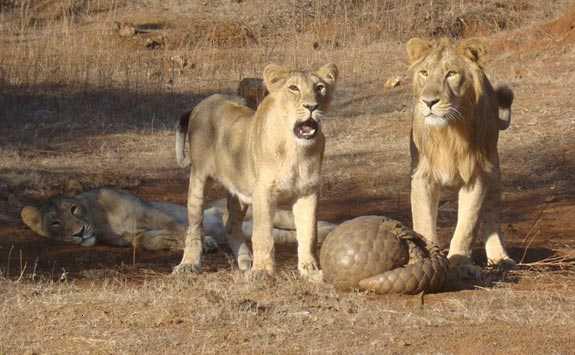
Pangolins are hunted and eaten in many parts of Africa and are one of the more popular types of bush meat. They are also in great demand in China and Vietnam because their meat is considered a delicacy and some believe pangolin scales have medicinal qualities. This, coupled with deforestation, has led to a large decrease in the numbers of giant pangolins. In November 2010, pangolins were added to the Zoological Society of London's list of genetically distinct and endangered mammals. All eight species of pangolin are classified by the IUCN as threatened to extinction, while two are classified as critically endangered.
Though pangolin are protected by an international ban on their trade, populations have suffered from illegal trafficking due to unfounded beliefs in Asia that their ground-up scales can stimulate lactation or cure cancer or asthma. In the past decade there have been numerous seizures of illegally trafficked pangolin and pangolin meat in Asia. In one such incident during 2013, 10,000 kilograms of pangolin meat was seized from a Chinese vessel that ran aground in the Philippines.
As a result of increasing threats to pangolins, mainly in the form of illegal, international trade in pangolin skin, scales, and meat, these species have received increasing conservation attention in recent years. For example, in 2014, the IUCN (International Union for the Conservation of Nature) re-categorised all eight species of pangolin on its Red List of Threatened Species, and each species is now threatened with extinction. Also, the IUCN SSC Pangolin Specialist Group launched a global action plan to conserve pangolins, dubbed 'Scaling up Pangolin Conservation' in July 2014.
Pangolins were formerly classified with various other orders, for example Xenarthra, which includes the ordinary anteaters, sloths, and the similar-looking armadillos. Newer genetic evidence, however, indicates their closest living relatives are the Carnivora with which they form the clade Ferae. Some palaeontologists placed Ernanodonta in a separate suborder of Cimolesta near Pholidota, have classified the pangolins in the order Cimolesta, together with several extinct groups indicated below, though this idea has fallen out of favor since cimolestids have been determined to have not been placental mammals.
Until recently, all species of pangolin had been attributed to the genus Manis. Recent research has supported the splitting of pangolins into three genera: Manis, Phataginus, and Smutsia.
Subscribe to:
Posts (Atom)