Showing posts with label international union for the conservation of nature. Show all posts

Tuesday, 6 March 2018

MALAWI: African Parks Reintroduces Lions In Liwonde National Park

Four years after the last lion was seen in Liwonde, African Parks have reintroduced the first of several wild lions back into the National Park.

In partnership with the Department of National Parks and Wildlife (DNPW), and with support from the Dutch Government and the Lion Recovery Fund, two mature males were released into enclosed bomas in the park after being safely translocated from Majete Wildlife Reserve, where lions were reintroduced in 2012.

They will remain in bomas for several weeks to allow close monitoring of their wellbeing, adjustment, and bonding with two lionesses which will be translocated from South Africa in March, before they are all released in to the wider park.

While the translocation hails the return of this iconic predator to Liwonde, it is also symbolic of Majete’s extraordinary restoration.

Majete’s pride was entirely poached out decades ago, but since their reintroduction, the population has grown to the extent that it can assist in repopulating Liwonde, 200 km north-east of Majete.

African Parks will further supplement the populations in both parks over the coming months, with the translocation of up to 12 additional lions from South Africa.

This is an important milestone for lion conservation in Malawi, where populations of the vulnerable species are being revitalised as part of an effort to restore the country’s parks, rehabilitate wildlife populations and encourage tourism for the benefit of local communities.

The reintroduction of lions is fundamentally enriching for Liwonde said African Parks’ Liwonde Park Manager, Craig Reid.

It restores a key species that is critical to the healthy functioning of the natural system, contributes to the establishment of an important local predator population, and will significantly benefit tourism as a mechanism for socio-economic growth.

The arrival of these big cats lays the foundation for a secure national population of lions, helping to further distinguish Malawi as an emerging premier wildlife destination.

With the UN World Wildlife Day on Saturday 3rd March highlighting the plight of big cats across the world, Malawi’s lion translocation is an extraordinary example of the conservation measures being taken to secure a future for Africa's most iconic cat.

Just over a century ago, more than 200,000 wild lions were living throughout Africa, but in just two decades, Africa’s lion population has decreased by 42%.

Today, wild lions are extinct in 26 African countries, and there are only about 20,000 lions left in wilderness areas, prompting the International Union for the Conservation of Nature (IUCN) to classify lions as Vulnerable on the Red List of Threatened Species.

Threatened by habitat loss, human-wildlife conflict and loss of prey, their numbers are steadily decreasing, and unless urgent actions are taken to ensure their survival, it is likely that lions will become an endangered species.

African Parks assumed management of Liwonde in partnership with the DNPW in 2015, and since then has completely overhauled law enforcement to secure the park.

They have constructed a robust perimeter fence enclosing the entire park, established rigorous ranger patrols, and worked extensively with local communities, making significant progress in revitalising habitat and wildlife populations through the reduction of poaching and mitigation of human-wildlife conflict.

The lions have each been fitted with tracking collars to facilitate intensive daily monitoring.

For a long time Malawi’s stunning beaches, beautiful and varied landscapes and fascinating and friendly cultural experiences have been some of the best that Africa has to offer.

With the wildlife transformations currently underway courtesy of African Parks, Malawi’s safari experiences are now starting to match its other attractions as it emerges as one of the most complete destinations in Africa.


Tourism Observer

Tuesday, 6 September 2016

Elephants In Africa.

It took two years, 81 aircraft and 286 crew flying 494 000 kilometres across 18 countries and the support of 90 scientists to count Africa’s savanna elephants. The final tally was an extremely worrying 352 271.

The team was led by Mike Chase of Elephants Without Borders and supported by a $7-million grant from Microsoft co-founder Paul Allen and his sister, Jody, and was the largest African wildlife survey ever undertaken.

The results of the Great Elephant Census (GEC) are a wake-up call. Elephant numbers in all but a few African states are declining, some alarmingly. In the countries surveyed, savanna elephants are dropping by eight per cent a year, mainly due to poaching. The population in the countries surveyed now stands at an estimated 352 271.

Between 2007 and 2014, in 15 countries where reliable previous counts were available for comparison, populations were found to have declined by 144 000 or 30%. In Tanzania the population has plummeted by a shocking 60% in five years, in Mozambique by 53% over the same period.

The GEC forms the crucial backbone of an elephant status report to be issued by the International Union for the Conservation of Nature (IUCN) in Hawaii on Friday. [Subs Sept 2] Two counts will probably be added: Namibia with 22 711 and South Africa with an extra 9 000 (only Kruger Park and Tuli enclave were included in the GEC survey).

Forest elephants counts are unreliable varying from 50 000 and 190 000 following a 2011 census. Since then poaching has escalated dramatically. If taken at 50 000, that would put Africa’s elephant population at around 434 000.

According to the GEC report to be issued in the PeerJ Journal tomorrow [Subs: Sept 1], Africa is estimated to have been home to around 20 million elephants before European colonization. As recently as the 1970s this stood at around one million. A wave of poaching in the 1970s and 1980s decimated populations in many areas and a renewed outbreak beginning around 2005 led to the deaths of a further 30 000 elephants a year.

When the GEC census began, elephant counts in many areas were out of date or mere guesses. Its goals were to discover the number and distribution of savanna elephants over most of their range and provide a continental baseline for future surveys.

The count excluded forest elephants which require labour-intensive ground tallies. Their numbers there are not encouraging. A forest survey was done in 2013 and found that between 2002 and that year the forest elephant population declined by 62%, losing 30% of its geographical range.

Important findings by the survey team were that:
– Across the entire research area, elephant deaths are exceeding the birthrate.
Poaching in Niassa (Mozambique) and Selous (Tanzania) reduced the elephant population by 75% in 10 years.

– Populations in the West Zambezi ecosystem in Zambia plummeted from 900 to just 48 elephants between 2004 and 2015.

– Elephants are likely to become locally extinct in Mali, Chad and Cameroon if current trends continue.

– Protected areas are failing to shield elephants from poaching. And 16% of savana elephants (50 000) are not in protected areas.

– Botswana, South Africa, Zambia and Zimbabwe are the good news, with relatively large elephant populations which are increasing or declining only slightly.

– Of the total African savana population counted by the GEC, Botswana has 37%, Zimbabwe 23%, Tanzania 12% and South Africa 8%.

– According to the PeerJ report, the census recorded 201 poacher’s camps and 3.39 million head of cattle in the survey area. ‘This suggests that conflict between humans and elephants is widespread. In elephant range areas, human populations are projected to double by 2050.’

According to the report, it is ‘hoped that this survey will encourage people across Africa and around the world to protect and conserve elephant populations.

‘The future of savanna elephants depends on the resolve of governments, conservation organizations and people to apply the GEC’s findings by fighting poaching, conserving elephant habitats and mitigating human-elephant conflict. With populations plunging in many areas, urgent action is needed to reverse these ongoing declines.’

Tuesday, 3 November 2015

Pangolin


Pangolins (also referred to as scaly anteaters or trenggiling) are mammals of the order Pholidota. The one extant family, Manidae, has three genera, Manis which comprises four species living in Asia, Phataginus which comprises two species living in Africa, and Smutsia which comprises two species also living in Africa.These species range in size from 30 to 100 centimetres (12 to 39 in). A number of extinct pangolin species are also known. The name pangolin comes from the Malay word "pengguling", meaning "something that rolls up". It is found naturally in tropical regions throughout Africa and Asia.

Pangolins have large, protective keratin scales covering their skin; they are the only known mammals with this adaptation. They live in hollow trees or burrows, depending on the species. Pangolins are nocturnal, and their diet consists of mainly ants and termites which they capture using their long, specially adapted tongues. They tend to be solitary animals, meeting only to mate and produce a litter of one to three offspring which are raised for about two years. Pangolins are threatened by hunting for their meat and armor and heavy deforestation of their natural habitats. They are the most trafficked mammal in the world. All eight pangolin species are listed as threatened on the IUCN Red List of Threatened Species.

The physical appearance of a pangolin is marked by large, hardened, overlapping plate-like scales. The scales, which are soft on newborn pangolins but harden as the animal matures, are made of keratin, the same material of which human fingernails and tetrapod claws are made. The pangolin's scaled body is comparable to a pine cone or globe artichoke. It can curl up into a ball when threatened, with its overlapping scales acting as armour and its face tucked under its tail. The scales are sharp, providing extra defense. The front claws are so long they are unsuited for walking, so the animal walks with its fore paws curled over to protect them.

Pangolins can also emit a noxious-smelling chemical from glands near the anus, similar to the spray of a skunk. They have short legs, with sharp claws which they use for burrowing into termite and ant mounds, as well as climbing.

The size of pangolins varies by species, ranging from 30 to 100 centimetres (12 to 39 in). Females are generally smaller than males.

The tongues of pangolins are extremely elongated and extend into the abdominal cavity. By convergent evolution, pangolins, the giant anteater, and the tube-lipped nectar bat all have tongues that are not attached to their hyoid bone and extend past their pharynx deep into the thorax. This extension lies between the sternum and the trachea. Large pangolins can extend their tongues as much as 40 centimetres (16 in), with a diameter of only 0.5 centimetres (0.20 in).

Most pangolins are nocturnal animals that use their well-developed sense of smell to find insects. The long-tailed pangolin is also active by day, while other species of pangolins spend most of the daytime sleeping, curled up into a ball.

Arboreal pangolins live in hollow trees, whereas the ground dwelling species dig tunnels underground, to a depth of 3.5 metres (11 ft). Pangolins are also good swimmers.

Pangolins are insectivorous. Most of their diet consists of various species of ants and termites and may be supplemented by other insects, especially larvae. They are somewhat particular and tend to consume only one or two species of insects, even when many species are available to them. A pangolin will consume an average of 140 to 200 g (4.9 to 7.1 oz) of insects per day.

Pangolins have a very poor sense of vision, and therefore rely heavily on smell and hearing. After locating their prey, they tear open the anthills or termite mounds with their powerful front claws. Their front claws are so large that their front feet are not useful for walking. The animal uses its long tail to counterbalance its torso as it walks on its two hind legs. After tearing open the ant or termite mound, it uses its long tongue to probe inside the insect tunnels and retrieve its prey. They have glands in their chests to lubricate the tongue with sticky, ant-catching saliva. The tongue extends all the way into a cavity of the abdomen and is longer than the pangolin's entire body length. Pangolins lack teeth and, therefore, the ability to chew, however, they ingest small stones while foraging, which accumulate in the muscular stomach and help to grind up ants.

Some species, such as the tree pangolin, use their strong, prehensile tails to hang from tree branches and strip away bark from the trunk, exposing insect nests inside.

Pangolins are solitary and meet only to mate. Males are larger than females, weighing up to 50% more. While there is no defined mating season, they typically mate once each year, usually during the summer or autumn months. Rather than the males seeking out the females, males mark their location with urine or feces and the females will find them. If there is competition over a female, the males will use their tails as clubs to fight for the opportunity to mate with her.

Gestation lasts for approximately 120–150 days. African pangolin females usually give birth to a single offspring at a time, but the Asiatic species may give birth from one to three. Weight at birth is 80 to 450 g (2.8 to 15.9 oz) and the average length is 150 millimetres (5.9 in). At the time of birth, the scales are soft and white. After several days, they harden and darken to resemble those of an adult pangolin. During the vulnerable stage, the mother stays with her offspring in the burrow, nursing it, and will wrap her body around it if she senses danger. The young cling to the mother's tail as she moves about, although in burrowing species, they remain in the burrow for the first two to four weeks of life. At one month, they first leave the burrow riding on the mother's back. Weaning takes place at approximately three months of age, at which stage the young begin to eat insects in addition to nursing. At two years of age, the offspring are sexually mature and are abandoned by the mother.
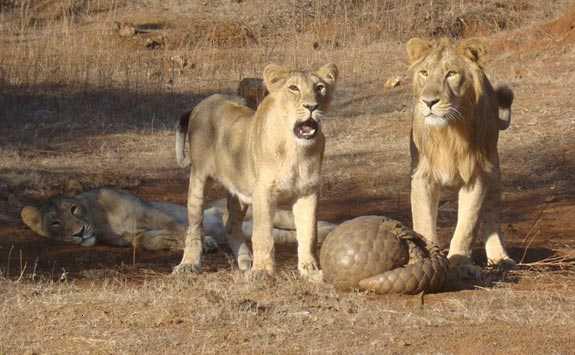


Pangolins are hunted and eaten in many parts of Africa and are one of the more popular types of bush meat. They are also in great demand in China and Vietnam because their meat is considered a delicacy and some believe pangolin scales have medicinal qualities. This, coupled with deforestation, has led to a large decrease in the numbers of giant pangolins. In November 2010, pangolins were added to the Zoological Society of London's list of genetically distinct and endangered mammals. All eight species of pangolin are classified by the IUCN as threatened to extinction, while two are classified as critically endangered.

Though pangolin are protected by an international ban on their trade, populations have suffered from illegal trafficking due to unfounded beliefs in Asia that their ground-up scales can stimulate lactation or cure cancer or asthma. In the past decade there have been numerous seizures of illegally trafficked pangolin and pangolin meat in Asia. In one such incident during 2013, 10,000 kilograms of pangolin meat was seized from a Chinese vessel that ran aground in the Philippines.

As a result of increasing threats to pangolins, mainly in the form of illegal, international trade in pangolin skin, scales, and meat, these species have received increasing conservation attention in recent years. For example, in 2014, the IUCN (International Union for the Conservation of Nature) re-categorised all eight species of pangolin on its Red List of Threatened Species, and each species is now threatened with extinction. Also, the IUCN SSC Pangolin Specialist Group launched a global action plan to conserve pangolins, dubbed 'Scaling up Pangolin Conservation' in July 2014.

Pangolins were formerly classified with various other orders, for example Xenarthra, which includes the ordinary anteaters, sloths, and the similar-looking armadillos. Newer genetic evidence, however, indicates their closest living relatives are the Carnivora with which they form the clade Ferae. Some palaeontologists placed Ernanodonta in a separate suborder of Cimolesta near Pholidota, have classified the pangolins in the order Cimolesta, together with several extinct groups indicated below, though this idea has fallen out of favor since cimolestids have been determined to have not been placental mammals.

Until recently, all species of pangolin had been attributed to the genus Manis. Recent research has supported the splitting of pangolins into three genera: Manis, Phataginus, and Smutsia.


Thursday, 8 October 2015

CHINA: China Businessman Jailed For 13 Years Over Tiger Feast


A Chinese businessman who bought and ate three tigers has been sentenced to 13 years in prison, state media reported Tuesday.

The wealthy real estate developer, identified only by his surname Xu, has "a special hobby of grilling tiger bones, boning tiger paws, storing tiger penis, eating tiger meat and drinking tiger blood alcohol," the official Xinhua news agency said in June when he went on trial.

Xu organised three separate trips last year for a total of 15 people, including himself, to Leizhou in the southern province of Guangdong, where they bought tigers for a "huge amount of money" that were killed and dismembered as they watched, the government-run news portal gxnews.com.cn reported Tuesday.

One of them filmed the entire process of a tiger slaughter with his mobile phone. The footage was later obtained by police.

Police seized eight pieces of animal meat and bones from a refrigerator in Xu's home, some of which were later identified as tiger parts, including a penis, the report said, adding that 16 geckos and a cobra were also found.

A court in Guangxi earlier this year convicted the 15 of "illegally transporting precious and endangered wild animal products" but the conviction was not reported at the time.

Xu was sentenced to 13 years in prison and a fine of 1.55 million yuan (US$25,000), gxnews.com.cn said, with the others jailed for terms between five and six and a half years, and given smaller fines.

They appealed and a higher court upheld the ruling on Monday, the report said.

Tiger bones have long been an ingredient of traditional Chinese medicine, supposedly for a capacity to strengthen the human body, and while they have been removed from its official ingredient list the belief persists among some.

It is a long-held belief across parts of Asia that penises of animals such as tigers and seals can boost men's sexual performance.

There is no orthodox scientific evidence for such claims.

Decades of trafficking and habitat destruction have slashed the tiger population from 100,000 a century ago to approximately 3,000, according to the International Union for the Conservation of Nature's Red List of threatened species, where the tiger is classed as endangered.

Wednesday, 7 October 2015

Fight Against Poaching Turning From Guns To Smart Phones

Poaching remains a serious existential threat for many species, in spite of global efforts to combat it. But an innovative app could help thwart poachers in remote areas and beyond.

The digital age might be a good thing for man, but the same doesn't ring true for beast. Mobile technology has enabled wildlife traffickers to decimate animal stock around the world by placing a simple phone call. And that is a massive problem.

According to the International Union for the Conservation of Nature (IUCN), Southeast Asia is ground zero for setting the pace toward an extinction crisis. The organization lists 150 land and water species native to the region as critically endangered. Some face being eaten out of existence; yet others are poised to be eradicated as a result of wildlife trafficking.

In Central Africa, studies estimate that systematic poaching has resulted in the loss of 100,000 forest elephants - a 64 percent decline over the past 10 years.

But rather than engage poachers in firefights bullet for bullet - which is dangerous, not to mention being a drain on resources - an international consortium of conservation organizations has embarked on a new high-tech strategy to combat such losses.

Hunting the illegal hunters

New York-based nonprofit organization Wildlife Conservation Society (WCS), working with seven conservation groups, has developed software aimed at helping rangers in remote locations to anticipate poaching activity rather than merely reacting to it.

The SMART (Spatial Monitoring and Reporting Tool) application, as it is known, provides users with information on illegal hunting, telling them what happened and where. Designed to work in tandem with GPS-enabled devices, such as heavy-duty cell phones, it also allows conservation managers to map and follow a ranger's activities.

"You can collect data on where rangers have been, while on patrol, but also make observations on what they've seen," SMART program coordinator Alexa Montefiore said. "What's key about SMART is that it also operates in offline environments. It streamlines collecting data to make it more efficient."

What results is that patrol data is no longer stored at isolated field stations, rather transferred to and stored on secure servers at headquarters. After rangers enter information into a handheld device, this is then fed into data visualization software. From there, patterns emerge that Montefiore says enable site managers to direct rangers and resources to critical areas.

This ability to gather field intelligence on animals and well-armed poachers could be a game-changer - especially for rangers and non-governmental organizations facing multiple threats in the Global South.

Conservation groups have already implemented SMART in 130 protected areas across 29 countries in Africa, Asia and Latin America, and the technology is also slated to be adopted elsewhere.

Colombia, for example, intends to implement the free and open software throughout its vast network of 58 parks, Montefiore told DW.

Exploiting the mobile phone rise
Although not a cure-all for illegal activity, an observant ranger equipped with a handheld device capitalizes on two technological trends. Firstly, the system enables users to upload and share information over digital networks.

Secondly, it's cheaper. "Rugged" mobile devices, which range in price from around 120 euros to 500 euros, are far cheaper than the old equipment, which was bulky and expensive. These days, smart phones function much like laptops did 10 years ago.

Moreover, mobile phone use in Asia and Africa has skyrocketed. According to a Gallup Poll from 2013, nearly two-thirds of all households in sub-Saharan Africa own at least one cell phone.

Smart phones also play a major role in modern life in Southeast Asia. In Cambodia, for example, 58 percent of the urban population and 47 percent of the rural population own a mobile phone.

"In many of the places we're working, people already embrace technology," says Antony Lynam, program manager for the WCS Asia programs. "They're already using smart phones to text and communicate - SMART is another piece of technology that they can get into," Lynam explains. SMART is going to be rolled out at five or six pilot sites, he added.

App plus people power

Other research institutions and NGOs are testing similar approaches to conservation and the battle against poaching. For example, one crowd-funded conservation project hopes to put smart phones in the hands of the JulHoansi people, hunter- gatherers who serve as the guardians in the Nyae Nyae Conservancy in Namibia.

The site Crowdfunder describes how the JulHoansi intend to use smart phones to monitor the illegal encroachment of cattle onto their ancestral homelands.

Yet another app called Sapelli is a mapping tool, created to help indigenous people living in the Congo Basin to monitor and chart the illegal activities of poachers operating in their area.

But Lynam says the technology is only as effective as those using it. "Poachers can compromise rangers quickly, especially in regions with luxury timber and high value species to poach," he says. "Pretty soon, traders get to these rangers and start to corrupt them."

Lynam, who is a lifelong wildlife conservationist, says traffickers pay rangers large sums of money to turn a blind eye.

Technological risks
But there are also risks to embracing such technology. If a wildlife trafficker were to bribe or hack their way into a SMART database, that could have devastating consequences for conservation personnel and the species they try to protect.

But the battle is on. And with well-organized traffickers having what Lynam describes as the "best communications gear, vehicles and networks of people" to help shift illegal goods through international checkpoints, anti-poaching efforts need good weapons, too.

Lynman welcomes SMART and its ability to reveal the true state of protected areas to stakeholders - and to provide conservationists with the information required to take action.