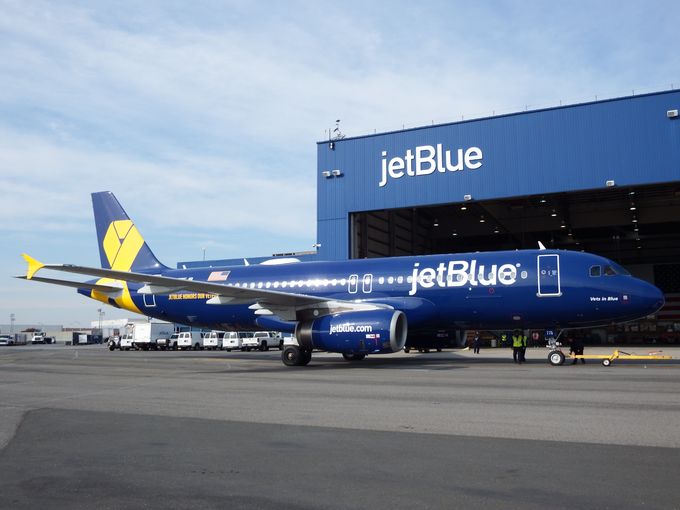
The start-up U.S. airline code-named “Moxy” has signed a firm order with Airbus to purchase 60 A220-300 aircraft.
Moxy is the new airline venture led by David Neeleman, one of the industry’s most innovative entrepreneurs and founder of JetBlue Airways. In addition to JetBlue, Neeleman also founded Azul Brazilian Airlines and is the controlling investor in the revitalization of TAP Air Portugal.
Plans for Moxy, a low-cost airline, were unveiled at the Farnborough International Air Show in July.
The A220-300 is the right airplane for a new airline that will be focused on passenger service and satisfaction, said Neeleman.
With a low cost of operation and spacious cabin, the A220 will allow us to provide passengers with lower fares and a high quality, comfortable flying experience. The A220’s ability to operate profitably in thin, under served markets across a broad spectrum of ranges is unique.
Moxy has its sights set on the future, so I can’t think of a better aircraft to put into their fleet than the A220, said Christian Scherer, Airbus Chief Commercial Officer.
We believe the A220 really is the future of this segment of the market, and the flying public will know from the minute they set foot on board that they’re experiencing the best our industry has to offer.
The order was completed the final week of December. Airbus will produce the A220-300 at a new U.S. assembly facility in Mobile, Alabama. Construction of that plant, to be located adjacent to the existing Airbus A320 assembly facility, will begin later this month.
The A220 is the only aircraft purpose-built for the 100-150 seat market; it delivers unbeatable fuel efficiency and true wide body comfort in a single-aisle aircraft.
The A220 brings together state-of-the-art aerodynamics, advanced materials and Pratt & Whitney’s latest-generation PW1500G geared turbofan engines to offer at least 20 percent lower fuel burn per seat compared to previous generation aircraft.
With a range of up to 3,200 nm (5,020 km), the A220 offers the performance of larger single-aisle aircraft.
With an order book of more than 500 aircraft to date, the A220 has all the credentials to win the lion’s share of the 100- to 150-seat aircraft market estimated to represent at least 7,000 aircraft over the next 20 years.
Tourism Observer
Showing posts with label jetblue airways. Show all posts
Friday, 4 January 2019
Thursday, 6 September 2018
CANADA: WestJet To Cease Flights To Mexico City In October 2018
WestJet will exit Mexico City in October, becoming the latest among several North American airlines to retrench from Mexico's capital city.
This only seven months after WestJet entered the Mexico City market with routes from Calgary and Vancouver.
It's just not performing up to the standards that we would like to see, WestJet chief financial officer Harry Taylor says of Mexico City. We don't want to be cost subsidizing at this point.
Taylor adds that despite retrenching, WestJet still sees long term opportunity to serve Mexico City and could return.
Long term there's something there.
WestJet will operate its last Vancouver-Mexico City flight on 3 October, followed by its final Calgary-Mexico City flight on 27 October.
The carrier launched both routes in March and does not serve Mexico City from any other destination, data shows.
WestJet's move mirrors cuts by other airlines.
Alaska Airlines will stop serving Mexico City on 7 November when it operates it last flight from Los Angeles.
Alaska called that route underperforming and said that the change frees aircraft to launch new routes, such as Seattle to Columbus, Ohio, which the airline plans to start in March 2019.
Alaska also had served Mexico City from San Francisco, but ended that route in May.
Likewise, United Airlines will also cut its Los Angeles-Mexico City flight in October, schedules data shows.
Capacity in available seats from North America to Mexico City jumped 9% year-over-year in the third quarter of 2018, primarily reflecting expansion by low-cost carriers Aeromar, JetBlue Airways, Southwest Airlines, VivaAerobus and Volaris, schedules data shows.
WestJet's move comes as the airline seeks to tighten its operation and bolster its finances.
The carrier has seen costs swell in recent quarters, and posted a second quarter operating loss.
The financial challenges hit amid a broad, companywide transformation under which WestJet is moving upscale, acquiring Boeing 787s, installing business class seats on 737s and adding flights at its hubs.
Tourism Observer
This only seven months after WestJet entered the Mexico City market with routes from Calgary and Vancouver.
It's just not performing up to the standards that we would like to see, WestJet chief financial officer Harry Taylor says of Mexico City. We don't want to be cost subsidizing at this point.
Taylor adds that despite retrenching, WestJet still sees long term opportunity to serve Mexico City and could return.
Long term there's something there.
WestJet will operate its last Vancouver-Mexico City flight on 3 October, followed by its final Calgary-Mexico City flight on 27 October.
The carrier launched both routes in March and does not serve Mexico City from any other destination, data shows.
WestJet's move mirrors cuts by other airlines.
Alaska Airlines will stop serving Mexico City on 7 November when it operates it last flight from Los Angeles.
Alaska called that route underperforming and said that the change frees aircraft to launch new routes, such as Seattle to Columbus, Ohio, which the airline plans to start in March 2019.
Alaska also had served Mexico City from San Francisco, but ended that route in May.
Likewise, United Airlines will also cut its Los Angeles-Mexico City flight in October, schedules data shows.
Capacity in available seats from North America to Mexico City jumped 9% year-over-year in the third quarter of 2018, primarily reflecting expansion by low-cost carriers Aeromar, JetBlue Airways, Southwest Airlines, VivaAerobus and Volaris, schedules data shows.
WestJet's move comes as the airline seeks to tighten its operation and bolster its finances.
The carrier has seen costs swell in recent quarters, and posted a second quarter operating loss.
The financial challenges hit amid a broad, companywide transformation under which WestJet is moving upscale, acquiring Boeing 787s, installing business class seats on 737s and adding flights at its hubs.
Tourism Observer
Saturday, 29 July 2017
USA: JetBlue Seeks Devolper For New Terminal At New York JFK
JetBlue Airways is seeking a developer for a new terminal at New York JFK airport as the carrier targets expansion of its international facilities there.
New York-based JetBlue has released a request for qualifications (RFQ) to developers.
The terminal would be built in phases on the site of the former Terminal 6 and possibly the existing Terminal 7 at JFK, says the airline.
It wants additional international gates and arrival processing capabilities, more curb frontage to complement its existing space in Terminal 5, and an enhanced connection with the airport’s AirTrain system, the RFQ states.
The notice does not include a potential price tag.
JetBlue opened Terminal 5 in 2008 and added international facilities, under a project dubbed T5i, in 2014. The terminal has 29 gates, six of which can handle international arrivals.
This project lays the groundwork for JetBlue’s future leadership in our largest focus city, states Lisa Reifer, the airline’s vice-president of infrastructure, properties and development.
We are seeking innovative, cost- and capital-efficient approaches to governor Andrew Cuomo’s ambitious vision for JFK to deliver a world-class airport experience for our customers and crew members while allowing us to maximise the value of our strategic airport assets.
In January, New York state governor Cuomo announced plans for a roughly $8 billion overhaul and expansion of the terminal complex at JFK. The proposal included expanding Terminal 5, replacing Terminal 7 and realigning the airport’s roadways and taxiways.
JetBlue strongly supports governor Cuomo’s masterplan for a 21st Century JFK, said the carrier’s chief executive Robin Hayes in response to the governor’s proposal in January.
While JetBlue holds the rights to redevelop the site of Terminal 6, which was demolished in 2011, the airline does not have the rights for Terminal 7, which is controlled by British Airways.
The UK carrier is planning to make a $65 million investment in Terminal 7, its lease on which runs through 2022.
We are pleased that we will remain at JFK Terminal 7 until 2022 when our lease expires and will work with the Port Authority for our future options at JFK,” says a BA spokeswoman.
Qualifications from potential developers are due 11 August, with JetBlue aiming to release a request for proposals in September and award the terminal project in the first quarter of 2018.
Corgan – which has designed terminals for Delta Air Lines and Southwest Airlines around the USA – and ICF are technical advisers to JetBlue on the JFK project.
Goldman Sachs is financial adviser.
Tourism Observer
www.tourismobserver.com
New York-based JetBlue has released a request for qualifications (RFQ) to developers.
The terminal would be built in phases on the site of the former Terminal 6 and possibly the existing Terminal 7 at JFK, says the airline.
It wants additional international gates and arrival processing capabilities, more curb frontage to complement its existing space in Terminal 5, and an enhanced connection with the airport’s AirTrain system, the RFQ states.
The notice does not include a potential price tag.
JetBlue opened Terminal 5 in 2008 and added international facilities, under a project dubbed T5i, in 2014. The terminal has 29 gates, six of which can handle international arrivals.
This project lays the groundwork for JetBlue’s future leadership in our largest focus city, states Lisa Reifer, the airline’s vice-president of infrastructure, properties and development.
We are seeking innovative, cost- and capital-efficient approaches to governor Andrew Cuomo’s ambitious vision for JFK to deliver a world-class airport experience for our customers and crew members while allowing us to maximise the value of our strategic airport assets.
In January, New York state governor Cuomo announced plans for a roughly $8 billion overhaul and expansion of the terminal complex at JFK. The proposal included expanding Terminal 5, replacing Terminal 7 and realigning the airport’s roadways and taxiways.
JetBlue strongly supports governor Cuomo’s masterplan for a 21st Century JFK, said the carrier’s chief executive Robin Hayes in response to the governor’s proposal in January.
While JetBlue holds the rights to redevelop the site of Terminal 6, which was demolished in 2011, the airline does not have the rights for Terminal 7, which is controlled by British Airways.
The UK carrier is planning to make a $65 million investment in Terminal 7, its lease on which runs through 2022.
We are pleased that we will remain at JFK Terminal 7 until 2022 when our lease expires and will work with the Port Authority for our future options at JFK,” says a BA spokeswoman.
Qualifications from potential developers are due 11 August, with JetBlue aiming to release a request for proposals in September and award the terminal project in the first quarter of 2018.
Corgan – which has designed terminals for Delta Air Lines and Southwest Airlines around the USA – and ICF are technical advisers to JetBlue on the JFK project.
Goldman Sachs is financial adviser.
Tourism Observer
www.tourismobserver.com
Friday, 12 May 2017
CARIBBEAN: Caribbean Islands LGBT Friendly Places
Curacao
LoAnn Halden, communications director for the International Gay & Lesbian Travel Association (IGLTA), says the most LGBT-welcoming island in the Caribbean is “Curacao, Curacao, Curacao!”
Known for its unique architecture, 60-plus dive sites, wide range of adventure opportunities and year-round warm weather, Curacao is currently considered one of the hottest escapes for seasoned Caribbean clients looking for something different in the region.
And now, with new nonstop flights via JetBlue Airways from New York, the island is poised to become an option even for the first-time Caribbean visitor.
There are still some Caribbean islands that are not onboard with the acceptance of LGBT vacationers, but Curacao is certainly not one of them.
The island’s European influence and the open, friendly nature of its people, along with events such as Gay Pride Week and South Caribbean Pride Week, have put the island on the frontline of LGBT tourism in the Caribbean.
Known by many as the most LGBT-friendly hotel on the island, the 72-suite Floris Suite Hotel & Spa Curacao is the site of the annual Curacao Pride festival celebrating the Caribbean LGBT community. General Manager Frank Holtslag is also the president of Curacao Gay Pro, which works to organize LGBT events on the island.
Floris Suite has a brand new fitness center with steam room, a sauna and new fitness equipment and the courtyard has a private pool, and it is the only hotel on island that caters to guests 18 and older.
Another great feature for LGBT clients is the hotel’s “Out and About” list, which is a list given to the concierge that details LGBT friendly activities throughout the island.
Staff training is so important, says Hotslag. "Our guests are comfortable enough to hold hands and kiss around the pool and snuggle in the ocean without anyone giggling or giving them strange looks. LGBT clients feel comfortable, but also all guests here feel comfortable because there is a very accepting vibe here."
Visit www.florissuitehotel.com
Saba
While Curacao is on the fast track to the mainstream tourist market, Saba is still most popular amongst the seasoned Caribbean travelers looking for an island they haven’t been to yet.
With increasing numbers of gay and lesbian tour packages being offered by the island, and with American travelers not only accepting the LGBT community, but embracing it, we expect Saba to get on the mainstream map very soon. So, tell clients to go now while it’s still a secret.
Saba is very easy to get to and is located within a cluster of other impressive Dutch islands that make Saba the perfect starting point for an island-hopping tour.
Tell clients to fly to St. Maarten and take a short, scenic ferry ride to Saba. Saba can also be reached by air from St. Maarten via a 12-minute flight from Windward Islands Airways.
While an agent’s prime market for Saba is the LGBT community, you can target seasoned Caribbean travelers who would opt for adventure and nature over a casino, a beach and a nightclub.
But don’t ignore the newbies, as long as you pair Saba up with a few nights in either neighboring St.Maarten/St. Martin or Anguilla.
Located in the hills of Saba is another all-time favorite amongst LGBT experts for two reasons: the seclusion and the food. The small, yet attentive, staff is very hands-on at the Queens Gardens Resort, catering to every guest’s individual needs.
The outstanding Caribbean cuisine is prepared by Chef Kevin Hollans, while the hotel also houses a robust selection of rums from Martinique and Guadeloupe. The kicker, however, is that every room has its own open-air Jacuzzi facing the valley below. Think Jade Mountainin St. Lucia but for way cheaper.
Visit www.queensaba.com
St. Maarten/St. Martin
Both the Dutch and the French have traditionally been pretty accepting of the LGBT community for years, so it’s no surprise that both the French side of St. Martin and the Dutch side of St. Maarten are good fits for the LGBT client.
LGBT clients looking for some fun in the sun will love Cupecoy Beach in St. Maarten, often considered a popular retreat among LGBT clients.
As a Dutch island, St. Maarten tends to be a bit more LGBT-welcoming than other islands in the Caribbean. While same-sex marriage is not legal, the island does offer an array of symbolic wedding ceremonies and vow renewals. St. Martin, as we previously mentioned, just began conducting symbolic same-sex marriages this year.
Belmond La Samanna, an IGLTA certified hotel, is located in the LGBT-welcoming destination of St. Martin and is arguably the best hotel in general on the island. The Belmond company as a whole is very LGBT-welcoming and is actively marketing toward this clientele.
In fact, Belmond, a global collection of 46 iconic hotels, trains and river cruises, appointed Tom Alderink back in May as the company's first director of LGBT sales.
The property offers all the amenities one would expect from a five-star hotel, from swanky beach cabanas to a 15-foot-long infinity pool. This is also a great spot for LGBT clients with families, as the hotel also offers its unique Camp La Samanna, which provides such activities as treasure hunts for children.
Visit www.belmond.com/lasamanna
Puerto Rico
There are pockets of Puerto Rico that are more LGBT-welcoming than others, but you can’t do wrong pitching San Juan to a Caribbean-bound LGBT traveler, as it is often considered one of the best spots for LGBT travelers in the Caribbean.
Specifically, the Condado District is currently booming with LGBT visitors. The area has seen a resurgence in general as many new hotels have popped up recently including the re-opening of the famous Condado Vanderbilt earlier this year. This is where you dine out and stay out until you’re ready to sleep.
“Puerto Rico is the best of all worlds, a vast collection of islands, the main one offering verdant rain forests, colonial Old San Juan, top resorts like the new Ritz Carlton Dorado Beach and the St Regis Bahia Beach and more,” says John Clifford, president of International Travel Management, which is affiliated with Tzell Your Travel Center, a branch of the Tzell Travel Group.
The opposite are windswept and funky Culebra and little sister, laid back Vieques Island where the chic W Retreat & Spa Vieques is the isle’s only full service resort and so much more than a thumping night club, coming complete with an airport welcome suite, massive oceanfront digs and a talented 'Whatever, Whenever' team.
The 486 all-suite Gran Melia Puerto Rico is located in the tropics of the El Yunque rainforest, allowing ample privacy for LGBT clients, although they can still feel comfortable walking the streets of the surrounding neighborhood, as this area of Puerto Rico is deemed extremely LGBT welcoming.
The hotel is scattered over 20 two-story bungalows, a YHI Spa and the Trump International Golf Club, with two 18-hole championship golf courses designed by PGA pro Tom Kite.
Visit www.melia.com
The U.S. Virgin Islands
All of the U.S. Virgin Islands are LGBT-welcoming, but none more than the small island of St. Croix. Because it is a U.S. territory, the island is very Americanized and shares a lot of the same general principles of Americans. To put it simply, a gay tourist is nothing new here.
You just need to visit the hotel’s website to get how LGBT-welcoming the Sand Castle on the Beach Resort on St. Croix is. From photos of gay couples kissing on the beach to a proclamation that “We Celebrate Inclusion and Diversity. We do not Discriminate,” the Sand Castle on the Beach is pretty open about including everyone at their hotel.
The hotel offers LGBT clients seven room types from beachfront villas to economical studios. All accommodations are air-conditioned, have private baths, overhead fans, cable TV and a beach cooler.
All of the Suites and Beachfront Villas are equipped with kitchens, separate living areas, and a sleeper sofa.
Visit www.sandcastleonthebeach.com
St. Bart’s
As is the case of St. Martin, LGBT clients are also accepted here do to the accepting nature of the French culture. This small French-Caribbean island offers so many secluded, high-end villas and cottages to make anyone feel safe, but by no means does an LGBT client need to stay put at the resort.
Food, art and culture are also top priorities of Caribbean-bound LGBT clients and St. Bart’s has plenty of all three.
Although it is not IGLTA certified, Le Guanahani, St. Bart’s private enclave, invites the LGBT community to experience the luxurious, secluded, tropical escape that is St. Bart’s.
The newly renovated, five-star hotel is located on a private 16-acre peninsula between Marigot Bay and Grand Cul de Sac.
LGBT travelers can enjoy two beaches, two pools, a restorative Spa by Clarins, a full suite of water sports, two restaurants with al fresco settings, a fitness center, flood-lit tennis courts, and engaging children’s programs.
The hotel and staff are very LGBT-friendly and inclusive, whether it’s hosting LGBT couples or planning a symbolic LGBT wedding or honeymoon.
Visit www.leguanahani.com
Aruba
Aruba, although its joins Curacao and St. Maarten as the Dutch islands where same-sex marriage is illegal, has a long history of priding itself on its diversity. LGBT visibility, especially in the hotels and restaurants, is pretty apparent here. La Vie Lounge Aruba is the spot to be for LGBT clients looking for some nightlife. The club often hosts drag queen shows and other fun LGBT-oriented events.
At the Aruba Marriott Resort & Stellaris Casino, LGBT clients can enjoy luxurious Aruba accommodations that feature spacious guestrooms, upscale bedding and bathrooms, high-tech amenities and some of the largest balconies in Aruba. LGBT clients will love the relaxing H2Oasis Adult Pool or the more exciting Stellaris Casino. The hotel culinary offerings are lead by the always-popular Ruth’s Chris Steak House.
Visit www.marriott.com
LoAnn Halden, communications director for the International Gay & Lesbian Travel Association (IGLTA), says the most LGBT-welcoming island in the Caribbean is “Curacao, Curacao, Curacao!”
Known for its unique architecture, 60-plus dive sites, wide range of adventure opportunities and year-round warm weather, Curacao is currently considered one of the hottest escapes for seasoned Caribbean clients looking for something different in the region.
And now, with new nonstop flights via JetBlue Airways from New York, the island is poised to become an option even for the first-time Caribbean visitor.
There are still some Caribbean islands that are not onboard with the acceptance of LGBT vacationers, but Curacao is certainly not one of them.
The island’s European influence and the open, friendly nature of its people, along with events such as Gay Pride Week and South Caribbean Pride Week, have put the island on the frontline of LGBT tourism in the Caribbean.
Known by many as the most LGBT-friendly hotel on the island, the 72-suite Floris Suite Hotel & Spa Curacao is the site of the annual Curacao Pride festival celebrating the Caribbean LGBT community. General Manager Frank Holtslag is also the president of Curacao Gay Pro, which works to organize LGBT events on the island.
Floris Suite has a brand new fitness center with steam room, a sauna and new fitness equipment and the courtyard has a private pool, and it is the only hotel on island that caters to guests 18 and older.
Another great feature for LGBT clients is the hotel’s “Out and About” list, which is a list given to the concierge that details LGBT friendly activities throughout the island.
Staff training is so important, says Hotslag. "Our guests are comfortable enough to hold hands and kiss around the pool and snuggle in the ocean without anyone giggling or giving them strange looks. LGBT clients feel comfortable, but also all guests here feel comfortable because there is a very accepting vibe here."
Visit www.florissuitehotel.com
Saba
While Curacao is on the fast track to the mainstream tourist market, Saba is still most popular amongst the seasoned Caribbean travelers looking for an island they haven’t been to yet.
With increasing numbers of gay and lesbian tour packages being offered by the island, and with American travelers not only accepting the LGBT community, but embracing it, we expect Saba to get on the mainstream map very soon. So, tell clients to go now while it’s still a secret.
Saba is very easy to get to and is located within a cluster of other impressive Dutch islands that make Saba the perfect starting point for an island-hopping tour.
Tell clients to fly to St. Maarten and take a short, scenic ferry ride to Saba. Saba can also be reached by air from St. Maarten via a 12-minute flight from Windward Islands Airways.
While an agent’s prime market for Saba is the LGBT community, you can target seasoned Caribbean travelers who would opt for adventure and nature over a casino, a beach and a nightclub.
But don’t ignore the newbies, as long as you pair Saba up with a few nights in either neighboring St.Maarten/St. Martin or Anguilla.
Located in the hills of Saba is another all-time favorite amongst LGBT experts for two reasons: the seclusion and the food. The small, yet attentive, staff is very hands-on at the Queens Gardens Resort, catering to every guest’s individual needs.
The outstanding Caribbean cuisine is prepared by Chef Kevin Hollans, while the hotel also houses a robust selection of rums from Martinique and Guadeloupe. The kicker, however, is that every room has its own open-air Jacuzzi facing the valley below. Think Jade Mountainin St. Lucia but for way cheaper.
Visit www.queensaba.com
St. Maarten/St. Martin
Both the Dutch and the French have traditionally been pretty accepting of the LGBT community for years, so it’s no surprise that both the French side of St. Martin and the Dutch side of St. Maarten are good fits for the LGBT client.
LGBT clients looking for some fun in the sun will love Cupecoy Beach in St. Maarten, often considered a popular retreat among LGBT clients.
As a Dutch island, St. Maarten tends to be a bit more LGBT-welcoming than other islands in the Caribbean. While same-sex marriage is not legal, the island does offer an array of symbolic wedding ceremonies and vow renewals. St. Martin, as we previously mentioned, just began conducting symbolic same-sex marriages this year.
Belmond La Samanna, an IGLTA certified hotel, is located in the LGBT-welcoming destination of St. Martin and is arguably the best hotel in general on the island. The Belmond company as a whole is very LGBT-welcoming and is actively marketing toward this clientele.
In fact, Belmond, a global collection of 46 iconic hotels, trains and river cruises, appointed Tom Alderink back in May as the company's first director of LGBT sales.
The property offers all the amenities one would expect from a five-star hotel, from swanky beach cabanas to a 15-foot-long infinity pool. This is also a great spot for LGBT clients with families, as the hotel also offers its unique Camp La Samanna, which provides such activities as treasure hunts for children.
Visit www.belmond.com/lasamanna
Puerto Rico
There are pockets of Puerto Rico that are more LGBT-welcoming than others, but you can’t do wrong pitching San Juan to a Caribbean-bound LGBT traveler, as it is often considered one of the best spots for LGBT travelers in the Caribbean.
Specifically, the Condado District is currently booming with LGBT visitors. The area has seen a resurgence in general as many new hotels have popped up recently including the re-opening of the famous Condado Vanderbilt earlier this year. This is where you dine out and stay out until you’re ready to sleep.
“Puerto Rico is the best of all worlds, a vast collection of islands, the main one offering verdant rain forests, colonial Old San Juan, top resorts like the new Ritz Carlton Dorado Beach and the St Regis Bahia Beach and more,” says John Clifford, president of International Travel Management, which is affiliated with Tzell Your Travel Center, a branch of the Tzell Travel Group.
The opposite are windswept and funky Culebra and little sister, laid back Vieques Island where the chic W Retreat & Spa Vieques is the isle’s only full service resort and so much more than a thumping night club, coming complete with an airport welcome suite, massive oceanfront digs and a talented 'Whatever, Whenever' team.
The 486 all-suite Gran Melia Puerto Rico is located in the tropics of the El Yunque rainforest, allowing ample privacy for LGBT clients, although they can still feel comfortable walking the streets of the surrounding neighborhood, as this area of Puerto Rico is deemed extremely LGBT welcoming.
The hotel is scattered over 20 two-story bungalows, a YHI Spa and the Trump International Golf Club, with two 18-hole championship golf courses designed by PGA pro Tom Kite.
Visit www.melia.com
The U.S. Virgin Islands
All of the U.S. Virgin Islands are LGBT-welcoming, but none more than the small island of St. Croix. Because it is a U.S. territory, the island is very Americanized and shares a lot of the same general principles of Americans. To put it simply, a gay tourist is nothing new here.
You just need to visit the hotel’s website to get how LGBT-welcoming the Sand Castle on the Beach Resort on St. Croix is. From photos of gay couples kissing on the beach to a proclamation that “We Celebrate Inclusion and Diversity. We do not Discriminate,” the Sand Castle on the Beach is pretty open about including everyone at their hotel.
The hotel offers LGBT clients seven room types from beachfront villas to economical studios. All accommodations are air-conditioned, have private baths, overhead fans, cable TV and a beach cooler.
All of the Suites and Beachfront Villas are equipped with kitchens, separate living areas, and a sleeper sofa.
Visit www.sandcastleonthebeach.com
St. Bart’s
As is the case of St. Martin, LGBT clients are also accepted here do to the accepting nature of the French culture. This small French-Caribbean island offers so many secluded, high-end villas and cottages to make anyone feel safe, but by no means does an LGBT client need to stay put at the resort.
Food, art and culture are also top priorities of Caribbean-bound LGBT clients and St. Bart’s has plenty of all three.
Although it is not IGLTA certified, Le Guanahani, St. Bart’s private enclave, invites the LGBT community to experience the luxurious, secluded, tropical escape that is St. Bart’s.
The newly renovated, five-star hotel is located on a private 16-acre peninsula between Marigot Bay and Grand Cul de Sac.
LGBT travelers can enjoy two beaches, two pools, a restorative Spa by Clarins, a full suite of water sports, two restaurants with al fresco settings, a fitness center, flood-lit tennis courts, and engaging children’s programs.
The hotel and staff are very LGBT-friendly and inclusive, whether it’s hosting LGBT couples or planning a symbolic LGBT wedding or honeymoon.
Visit www.leguanahani.com
Aruba
Aruba, although its joins Curacao and St. Maarten as the Dutch islands where same-sex marriage is illegal, has a long history of priding itself on its diversity. LGBT visibility, especially in the hotels and restaurants, is pretty apparent here. La Vie Lounge Aruba is the spot to be for LGBT clients looking for some nightlife. The club often hosts drag queen shows and other fun LGBT-oriented events.
At the Aruba Marriott Resort & Stellaris Casino, LGBT clients can enjoy luxurious Aruba accommodations that feature spacious guestrooms, upscale bedding and bathrooms, high-tech amenities and some of the largest balconies in Aruba. LGBT clients will love the relaxing H2Oasis Adult Pool or the more exciting Stellaris Casino. The hotel culinary offerings are lead by the always-popular Ruth’s Chris Steak House.
Visit www.marriott.com
Wednesday, 1 February 2017
USA: TWA Hotel At New York JFK
Upon arriving in the U.S. for the first time in 1978 to study architecture at Harvard University, Mina Marefat walked off of her plane at New York's JFK Airport into the most stunning building she'd ever laid eyes on.
She found herself in the TWA Flight Center, the sweeping, birdlike airport terminal that was designed by Finnish architect Eero Saarinen. It opened in 1962, a symbol of the dawn of the Jet Age.
TWA lost her luggage that day, but that did nothing to dim her enthusiasm for the building's sunken lounge, swooping lines and crimson-and-white color scheme.
"I'm walking around thinking this is the most magnificent building I've seen in my life," said Marefat, a Washington-based architect and Georgetown University professor who was later inspired to curate a traveling museum exhibit based on Saarinen's work. "I was totally blown away."
One New York-based hotel developer is aiming for a similar reaction the next time the now-shuttered building is opened to the general public. MCR Development, whose 90 owned and managed hotels include Manhattan's High Line Hotel, will redevelop the terminal as the TWA Hotel, a 505-room, "four-plus-star" property that will include 50,000 square feet of meetings space, a 10,000-square-foot observation deck overlooking the airport's runways and on the tarmac, a Lockheed Constellation, a classic four-engine prop plane, that will be converted into a lounge near the building's two pedestrian tubes.
The fully restored terminal, which broke ground on its redevelopment last month, will house as many as eight restaurants and six bars, while the hotel rooms will be in two newly built, six-story towers behind the existing building. The former first-class lounge will be converted into a restaurant called the Admirals Club, while the ticket-counter area will be rebuilt as a food hall featuring yet-to-be-identified purveyors from the New York boroughs of Brooklyn and Queens. MCR will also preserve and restore the custom-built furniture designed by midcentury designer Charles Eames as well as a sculpture created by Isamu Noguchi.
JetBlue Airways, whose Terminal 5 is adjacent to the site and will be connectable via one of the tubes, has a 5% stake in the $265 million project, which is slated to open in 2018.
"We opened the building a couple of weeks ago for a couple hours and 10,000 people came," MCR Development CEO Tyler Morse said in an interview earlier this month. "It's a spectacular building. You have to see it to believe it."
The hotel, which will be the first within the confines of JFK since it opened as Idlewild Airport in 1948, will compete in the Queens market that, while not as lucrative as Manhattan's, generates occupancy and room rates that far exceed the national averages.
For the first 11 months of last year, hotels closest to the airport, which range from upper-upscale properties such as Sheraton and Hilton to more budget-oriented hotels such as Howard Johnson and Rodeway Inn, had an occupancy rate of 87% while commanding a nightly room-rate average of $147, or about $100 a night less than New York's overall average, according to research firm STR.
In addition to its location, the TWA Hotel's size will provide another competitive advantage, said Mark VanStekelenburg, New York-based managing director at CBRE Hotels Consulting. While the Hilton New York JFK Airport and Sheraton JFK are both within two miles of the airport, the former hotel has 356 rooms while the latter has 150, compared with TWA Hotel's proposed 505 rooms.
Morse said that the hotel's architectural pedigree, cachet and full-service amenities will enable it to fetch nightly rates in the $250 range while competing against hotels in Manhattan, which can be accessed by rail in about 45 minutes via the TWA terminal's AirTrain stop nearby, which offers a connection to the city's subway line.
A far cry from the branded, select-service properties that surround most major U.S. airports, the TWA Hotel is envisioned as part of a newer crop of higher-end, architecturally significant on-site airport hotels that are built to be destinations in their own right.
That includes the 519-room Westin Denver International Airport, which opened in November 2015; the 433-room Hilton Amsterdam Airport Schiphol, which opened the following month; and the 350-room Grand Hyatt San Francisco International Airport, which is scheduled to open in 2019.
"It's a game changer for JFK, and there's certainly a need for it," said VanStekelenburg, adding that Manhattan's high room rates have enabled markets such as northern New Jersey and Queens' Long Island City to flourish. "While Manhattan has had certain challenges over the past two years, a lot of this new development outside of Manhattan has held its own."
With that in mind, MCR is banking on a future for the TWA Hotel that's more stable than the building's 39-year history as a functioning airport terminal. Then owned by Howard Hughes, TWA commissioned the site in 1956 amid a battle against Pan Am for international aviation supremacy and tapped Saarinen, whose works included the St. Louis Gateway Arch and Washington Dulles Airport. Both of those landmarks and the TWA Flight Center were completed after Saarinen's death in 1961 at the age of 51.
The building, which is said to be devoid of right angles, was designed to accommodate a fleet of 55-passenger Lockheed Constellations, which in 1956 was considered the world's most advanced passenger plane.
The aviation industry was surging at the time, as U.S. commercial-airline capacity jumped 81% between 1955 and 1960, according to the Air Transport Association of America.
But prop planes were not to be the future. By the time the building opened, six years after being commissioned, Boeing's first passenger jet, the 707, with twice the passenger capacity, had replaced "the Connie" as major airlines' aircraft of choice.
As a result, Morse said, "The building was overwhelmed the day it opened."
After Hughes sold off his TWA shares in 1966, the carrier subsequently took on more debt, especially following the airline industry's 1978 deregulation. It filed for bankruptcy for the first time in 1992 and was ultimately acquired by American Airlines in 2001. That same year, the TWA Flight Center shut down. In 2005, the building was added to the National Register of Historic Places.
Reimagining the building as a potential hospitality site, the Port Authority of New York & New Jersey reached an agreement in 2013 with Standard Hotels founder Andre Balazs (who now owns New York's the Mercer, London's Chiltern Firehouse and West Hollywood, Calif.'s Chateau Marmont) to redevelop the building into a hotel and conference center.
That deal ultimately fell through, and Rick Garlick, global travel and hospitality practice leader at J.D. Power, said the current developers could face further challenges and find it difficult for the prospective hotel to avoid a fate similar to that of the defunct terminal.
Part of the problem is that JFK, which accommodated a record 60 million passengers last year, has a reputation as one of the least user-friendly airports in the country. According to the J.D. Power 2016 North America Airport Satisfaction Study, JFK finished 24th out of the 31 ranked airports though it did finish ahead of both of the metropolitan New York area's other major airports, Newark Liberty and New York LaGuardia.
"When you look at the area around JFK, there's a bazillion hotels, so there's going to be competition from every single level," Garlick said. "And JFK has been consistently rated among the poorest airports."
The bigger challenge, however, might be getting domestic travelers, especially time-crunched New Yorkers, to change their travel habits enough for people to regard the TWA Hotel as either a lodging option or a food or entertainment destination and allow for extra time to explore the landmark.
"Unlike international terminals in Rome, London and Hong Kong, where people see airports as a destination, we don't see any example like that in the U.S.," Garlick said. "You're talking about a fundamental change in the way people utilize airports."
The New York state government is pledging to do its part to make JFK more user-friendly. Earlier this month, New York Gov. Andrew Cuomo unveiled a plan that will include improving pedestrian connections between terminals, redesigning airport roadways into a "ring road" and investing as much as $2 billion to improve the roadways leading into JFK.
The state, which estimates that its improvements will generate as much as $7 billion in private-sector investment in airport improvements, is also mulling a plan that would reconfigure the local rail network to eliminate the need to transfer between AirTrain and the subway line and offer a "one-seat" rail option between the airport and Manhattan. Morse estimates that such a move would shave about 15 minutes off the typical commute time between the airport and Manhattan.
Such improvements would complement MCR's. As it is, Morse said, 35,000 people, on average, experience layovers of at least four hours at Kennedy Airport every day.
With that in mind, Morse said his company is "talking to the best food and beverage guys in the U.S." about operating outlets at the project. He declined to disclose which hospitality companies MCR has contacted.
Additionally, with more than half of JFK's passengers flying international routes, Morse estimated that the hotel will further benefit from being a five-minute walk from Terminal 4, which serves more than 30 domestic and international carriers.
Morse added that the TWA Hotel will be the only facility at the airport with meetings spaces, enabling business executives to fly into New York and hold conferences without having to leave the airport.
VanStekelenburg agreed that the TWA Hotel's location would be a draw for both business and leisure meeting planners, estimating that the Newark Liberty International Airport Marriott hosts about 30 weddings a year.
"If we can provide a terrific experience through food and beverage, guest rooms and architecture, for a conference or wedding, and you can do that without taking the hour or 45 minutes to get into Manhattan, why wouldn't you do that?" Morse said.
As for the TWA Flight Center's use as a hotel, architect Marefat has mixed feelings about the prospect, wishing that the building still had use as an airport terminal. She said that Saarinen's early death deprived him of the opportunity to achieve the architectural notoriety of contemporaries like Frank Lloyd Wright, who completed notable works such as Pennsylvania's Fallingwater and New York's Guggenheim Museum after the age of 60. He died at 91.
Marefat said Saarinen "was very aware that the building had a dual function of being viewed from both the ground and the air. That represented the best of flight, and now it's considered no longer useful."
Still, she said that the redevelopment is preferable to tearing down the architectural landmark, and she is pleased that the TWA Flight Center is slated to join the ranks of Union Station in Denver and in Washington among travel sites that either have been or will be redeveloped and expanded to include travel facilities beyond their original use instead of being demolished.
When the original terminal was constructed, she said, "Travel was much more of a leisurely experience than we have today. It wasn't as hectic, and the TWA Flight Center functioned as a more loungelike experience. So maybe having it be a hotel isn't such a bad idea. Buildings go through multiple lives, and maybe this is the next life."
She found herself in the TWA Flight Center, the sweeping, birdlike airport terminal that was designed by Finnish architect Eero Saarinen. It opened in 1962, a symbol of the dawn of the Jet Age.
TWA lost her luggage that day, but that did nothing to dim her enthusiasm for the building's sunken lounge, swooping lines and crimson-and-white color scheme.
"I'm walking around thinking this is the most magnificent building I've seen in my life," said Marefat, a Washington-based architect and Georgetown University professor who was later inspired to curate a traveling museum exhibit based on Saarinen's work. "I was totally blown away."
One New York-based hotel developer is aiming for a similar reaction the next time the now-shuttered building is opened to the general public. MCR Development, whose 90 owned and managed hotels include Manhattan's High Line Hotel, will redevelop the terminal as the TWA Hotel, a 505-room, "four-plus-star" property that will include 50,000 square feet of meetings space, a 10,000-square-foot observation deck overlooking the airport's runways and on the tarmac, a Lockheed Constellation, a classic four-engine prop plane, that will be converted into a lounge near the building's two pedestrian tubes.
The fully restored terminal, which broke ground on its redevelopment last month, will house as many as eight restaurants and six bars, while the hotel rooms will be in two newly built, six-story towers behind the existing building. The former first-class lounge will be converted into a restaurant called the Admirals Club, while the ticket-counter area will be rebuilt as a food hall featuring yet-to-be-identified purveyors from the New York boroughs of Brooklyn and Queens. MCR will also preserve and restore the custom-built furniture designed by midcentury designer Charles Eames as well as a sculpture created by Isamu Noguchi.
JetBlue Airways, whose Terminal 5 is adjacent to the site and will be connectable via one of the tubes, has a 5% stake in the $265 million project, which is slated to open in 2018.
"We opened the building a couple of weeks ago for a couple hours and 10,000 people came," MCR Development CEO Tyler Morse said in an interview earlier this month. "It's a spectacular building. You have to see it to believe it."
The hotel, which will be the first within the confines of JFK since it opened as Idlewild Airport in 1948, will compete in the Queens market that, while not as lucrative as Manhattan's, generates occupancy and room rates that far exceed the national averages.
For the first 11 months of last year, hotels closest to the airport, which range from upper-upscale properties such as Sheraton and Hilton to more budget-oriented hotels such as Howard Johnson and Rodeway Inn, had an occupancy rate of 87% while commanding a nightly room-rate average of $147, or about $100 a night less than New York's overall average, according to research firm STR.
In addition to its location, the TWA Hotel's size will provide another competitive advantage, said Mark VanStekelenburg, New York-based managing director at CBRE Hotels Consulting. While the Hilton New York JFK Airport and Sheraton JFK are both within two miles of the airport, the former hotel has 356 rooms while the latter has 150, compared with TWA Hotel's proposed 505 rooms.
Morse said that the hotel's architectural pedigree, cachet and full-service amenities will enable it to fetch nightly rates in the $250 range while competing against hotels in Manhattan, which can be accessed by rail in about 45 minutes via the TWA terminal's AirTrain stop nearby, which offers a connection to the city's subway line.
A far cry from the branded, select-service properties that surround most major U.S. airports, the TWA Hotel is envisioned as part of a newer crop of higher-end, architecturally significant on-site airport hotels that are built to be destinations in their own right.
That includes the 519-room Westin Denver International Airport, which opened in November 2015; the 433-room Hilton Amsterdam Airport Schiphol, which opened the following month; and the 350-room Grand Hyatt San Francisco International Airport, which is scheduled to open in 2019.
"It's a game changer for JFK, and there's certainly a need for it," said VanStekelenburg, adding that Manhattan's high room rates have enabled markets such as northern New Jersey and Queens' Long Island City to flourish. "While Manhattan has had certain challenges over the past two years, a lot of this new development outside of Manhattan has held its own."
With that in mind, MCR is banking on a future for the TWA Hotel that's more stable than the building's 39-year history as a functioning airport terminal. Then owned by Howard Hughes, TWA commissioned the site in 1956 amid a battle against Pan Am for international aviation supremacy and tapped Saarinen, whose works included the St. Louis Gateway Arch and Washington Dulles Airport. Both of those landmarks and the TWA Flight Center were completed after Saarinen's death in 1961 at the age of 51.
The building, which is said to be devoid of right angles, was designed to accommodate a fleet of 55-passenger Lockheed Constellations, which in 1956 was considered the world's most advanced passenger plane.
The aviation industry was surging at the time, as U.S. commercial-airline capacity jumped 81% between 1955 and 1960, according to the Air Transport Association of America.
But prop planes were not to be the future. By the time the building opened, six years after being commissioned, Boeing's first passenger jet, the 707, with twice the passenger capacity, had replaced "the Connie" as major airlines' aircraft of choice.
As a result, Morse said, "The building was overwhelmed the day it opened."
After Hughes sold off his TWA shares in 1966, the carrier subsequently took on more debt, especially following the airline industry's 1978 deregulation. It filed for bankruptcy for the first time in 1992 and was ultimately acquired by American Airlines in 2001. That same year, the TWA Flight Center shut down. In 2005, the building was added to the National Register of Historic Places.
Reimagining the building as a potential hospitality site, the Port Authority of New York & New Jersey reached an agreement in 2013 with Standard Hotels founder Andre Balazs (who now owns New York's the Mercer, London's Chiltern Firehouse and West Hollywood, Calif.'s Chateau Marmont) to redevelop the building into a hotel and conference center.
That deal ultimately fell through, and Rick Garlick, global travel and hospitality practice leader at J.D. Power, said the current developers could face further challenges and find it difficult for the prospective hotel to avoid a fate similar to that of the defunct terminal.
Part of the problem is that JFK, which accommodated a record 60 million passengers last year, has a reputation as one of the least user-friendly airports in the country. According to the J.D. Power 2016 North America Airport Satisfaction Study, JFK finished 24th out of the 31 ranked airports though it did finish ahead of both of the metropolitan New York area's other major airports, Newark Liberty and New York LaGuardia.
"When you look at the area around JFK, there's a bazillion hotels, so there's going to be competition from every single level," Garlick said. "And JFK has been consistently rated among the poorest airports."
The bigger challenge, however, might be getting domestic travelers, especially time-crunched New Yorkers, to change their travel habits enough for people to regard the TWA Hotel as either a lodging option or a food or entertainment destination and allow for extra time to explore the landmark.
"Unlike international terminals in Rome, London and Hong Kong, where people see airports as a destination, we don't see any example like that in the U.S.," Garlick said. "You're talking about a fundamental change in the way people utilize airports."
The New York state government is pledging to do its part to make JFK more user-friendly. Earlier this month, New York Gov. Andrew Cuomo unveiled a plan that will include improving pedestrian connections between terminals, redesigning airport roadways into a "ring road" and investing as much as $2 billion to improve the roadways leading into JFK.
The state, which estimates that its improvements will generate as much as $7 billion in private-sector investment in airport improvements, is also mulling a plan that would reconfigure the local rail network to eliminate the need to transfer between AirTrain and the subway line and offer a "one-seat" rail option between the airport and Manhattan. Morse estimates that such a move would shave about 15 minutes off the typical commute time between the airport and Manhattan.
Such improvements would complement MCR's. As it is, Morse said, 35,000 people, on average, experience layovers of at least four hours at Kennedy Airport every day.
With that in mind, Morse said his company is "talking to the best food and beverage guys in the U.S." about operating outlets at the project. He declined to disclose which hospitality companies MCR has contacted.
Additionally, with more than half of JFK's passengers flying international routes, Morse estimated that the hotel will further benefit from being a five-minute walk from Terminal 4, which serves more than 30 domestic and international carriers.
Morse added that the TWA Hotel will be the only facility at the airport with meetings spaces, enabling business executives to fly into New York and hold conferences without having to leave the airport.
VanStekelenburg agreed that the TWA Hotel's location would be a draw for both business and leisure meeting planners, estimating that the Newark Liberty International Airport Marriott hosts about 30 weddings a year.
"If we can provide a terrific experience through food and beverage, guest rooms and architecture, for a conference or wedding, and you can do that without taking the hour or 45 minutes to get into Manhattan, why wouldn't you do that?" Morse said.
As for the TWA Flight Center's use as a hotel, architect Marefat has mixed feelings about the prospect, wishing that the building still had use as an airport terminal. She said that Saarinen's early death deprived him of the opportunity to achieve the architectural notoriety of contemporaries like Frank Lloyd Wright, who completed notable works such as Pennsylvania's Fallingwater and New York's Guggenheim Museum after the age of 60. He died at 91.
Marefat said Saarinen "was very aware that the building had a dual function of being viewed from both the ground and the air. That represented the best of flight, and now it's considered no longer useful."
Still, she said that the redevelopment is preferable to tearing down the architectural landmark, and she is pleased that the TWA Flight Center is slated to join the ranks of Union Station in Denver and in Washington among travel sites that either have been or will be redeveloped and expanded to include travel facilities beyond their original use instead of being demolished.
When the original terminal was constructed, she said, "Travel was much more of a leisurely experience than we have today. It wasn't as hectic, and the TWA Flight Center functioned as a more loungelike experience. So maybe having it be a hotel isn't such a bad idea. Buildings go through multiple lives, and maybe this is the next life."
Tuesday, 6 December 2016
MALAYSIA: AirAsia has been named the World’s Leading Low-Cost Airline
AirAsia has been named the World’s Leading Low-Cost Airline for the fourth year in a row and its maiden title as the World's Leading Inflight Service at the 23rd World Travel Awards (WTA) Grand Final held in Male, Maldives.
Asia's largest low-cost carrier beat contenders from five continents to secure the award, including Ryanair, easyJet, Jetstar Airways, Southwest Airlines, JetBlue Airways, Norwegian, Kulula, Mango, fastjet, flydubai, Air Arabia, flynas and West Air. "What a thrill to win World’s Leading Low-Cost Airline for the fourth straight year.
It's a great honour to round out what has been a great year for AirAsia, not just financially but in terms of recognition from the industry," Group Chief Executive Officer, Tan Sri Tony Fernandes said today. AirAsia also won the World's Leading Inflight Service title for the first time ever, beating full-service carriers Etihad Airways, Japan Airlines, Singapore Airlines, Thai Airways, Qantas Airways, Lufthansa, American Airlines and Air Canada.
The win builds on AirAsia's success earlier this year when it secured Asia's Leading Inflight Service award from WTA for the first time. "I’m also super proud of our first World’s Leading Inflight Service award. I've always said we have amazing crew and amazing inflight products, and we've proven it by beating not one, not two, not three, but eight full-service carriers for the prize," he said in a statement.
He said there are more to come for AirAsia as the airline is always working on more innovations, and not just for inflight. "Right now, we are exploring ways to make the airport experience better. One thing we're looking at is fast-tracking guests who share their travel profile with immigration authorities.
We expect to run the trial at selected airports in Asean in the not-too-distant future, so keep an eye out for it," he said. The WTA serves to acknowledge, reward and celebrate excellence across all sectors of the travel and tourism industry, as chosen by thousands of travel professionals and high-end tourism consumers.
Airlines are judged on customer satisfaction and service quality, overall business performance, product innovation, staff relations and development, corporate social responsibility and contribution to local community, commitment to sustainable policies and fulfillment of long-term corporate vision. AirAsia is Asia's leading low-cost carrier, with an extensive network of more than 120 destinations in Asia, Australia and New Zealand, the Middle East and Africa.
It is also the only airline to fly direct to all 10 Asean countries, including some 60 unique routes in the region. AirAsia was also named World's Best Low-Cost Airline for the eighth year in a row at the 2016 Skytrax World Airline Awards in July. --Bernama
Asia's largest low-cost carrier beat contenders from five continents to secure the award, including Ryanair, easyJet, Jetstar Airways, Southwest Airlines, JetBlue Airways, Norwegian, Kulula, Mango, fastjet, flydubai, Air Arabia, flynas and West Air. "What a thrill to win World’s Leading Low-Cost Airline for the fourth straight year.
It's a great honour to round out what has been a great year for AirAsia, not just financially but in terms of recognition from the industry," Group Chief Executive Officer, Tan Sri Tony Fernandes said today. AirAsia also won the World's Leading Inflight Service title for the first time ever, beating full-service carriers Etihad Airways, Japan Airlines, Singapore Airlines, Thai Airways, Qantas Airways, Lufthansa, American Airlines and Air Canada.
The win builds on AirAsia's success earlier this year when it secured Asia's Leading Inflight Service award from WTA for the first time. "I’m also super proud of our first World’s Leading Inflight Service award. I've always said we have amazing crew and amazing inflight products, and we've proven it by beating not one, not two, not three, but eight full-service carriers for the prize," he said in a statement.
He said there are more to come for AirAsia as the airline is always working on more innovations, and not just for inflight. "Right now, we are exploring ways to make the airport experience better. One thing we're looking at is fast-tracking guests who share their travel profile with immigration authorities.
We expect to run the trial at selected airports in Asean in the not-too-distant future, so keep an eye out for it," he said. The WTA serves to acknowledge, reward and celebrate excellence across all sectors of the travel and tourism industry, as chosen by thousands of travel professionals and high-end tourism consumers.
Airlines are judged on customer satisfaction and service quality, overall business performance, product innovation, staff relations and development, corporate social responsibility and contribution to local community, commitment to sustainable policies and fulfillment of long-term corporate vision. AirAsia is Asia's leading low-cost carrier, with an extensive network of more than 120 destinations in Asia, Australia and New Zealand, the Middle East and Africa.
It is also the only airline to fly direct to all 10 Asean countries, including some 60 unique routes in the region. AirAsia was also named World's Best Low-Cost Airline for the eighth year in a row at the 2016 Skytrax World Airline Awards in July. --Bernama
Friday, 28 October 2016
JetBlue Airways Invests In JetSuite
JetBlue Airways has made a minority equity investment in JetSuite, helping the private jet operator to accelerate the growth of its JetSuiteX service.
JetSuiteX serves Burbank, Las Vegas, San Jose, Carlsbad, Concord, Mammoth and Bozeman with its fleet of 30-seat Embraer 135s. The company says it provides passengers with “a private jet experience that is affordable and accessible to a broad audience”. This includes the ability to check in just 15 minutes before a flight, free Wi-Fi, free checked bags, free seat assignments, free drinks and free snacks.
“We are delighted to have JetBlue join us as a strategic partner and shareholder,” said Alex Wilcox, CEO, JetSuite. “The partnership with JetBlue will allow us to accelerate our growth and we are excited to work together to deliver new and unique experiences for all JetSuite and JetBlue customers.”
Wilcox was one of the founders of JetBlue Airways when it launched in 2000.
Members of JetBlue’s customer loyalty programme, TrueBlue, are already able to earn points on all JetSuiteX flights. The companies are also exploring other ways they can cooperate to benefit their customers.
As part of JetBlue’s investment, the airline will be able to nominate someone to be appointed to the JetSuite board of directors.
Robin Hayes, JetBlue’s President and CEO, said: “JetBlue and JetSuite share a passion for delivering a high-quality customer experience at a competitive price point in underserved markets. Our investment in JetSuite makes sense as we continue to execute on our west coast plan and invest in innovative ideas that reflect the disruptive spirit of JetBlue.”
JetSuiteX serves Burbank, Las Vegas, San Jose, Carlsbad, Concord, Mammoth and Bozeman with its fleet of 30-seat Embraer 135s. The company says it provides passengers with “a private jet experience that is affordable and accessible to a broad audience”. This includes the ability to check in just 15 minutes before a flight, free Wi-Fi, free checked bags, free seat assignments, free drinks and free snacks.
“We are delighted to have JetBlue join us as a strategic partner and shareholder,” said Alex Wilcox, CEO, JetSuite. “The partnership with JetBlue will allow us to accelerate our growth and we are excited to work together to deliver new and unique experiences for all JetSuite and JetBlue customers.”
Wilcox was one of the founders of JetBlue Airways when it launched in 2000.
Members of JetBlue’s customer loyalty programme, TrueBlue, are already able to earn points on all JetSuiteX flights. The companies are also exploring other ways they can cooperate to benefit their customers.
As part of JetBlue’s investment, the airline will be able to nominate someone to be appointed to the JetSuite board of directors.
Robin Hayes, JetBlue’s President and CEO, said: “JetBlue and JetSuite share a passion for delivering a high-quality customer experience at a competitive price point in underserved markets. Our investment in JetSuite makes sense as we continue to execute on our west coast plan and invest in innovative ideas that reflect the disruptive spirit of JetBlue.”
Saturday, 24 September 2016
JetBlue Airways Expands To Caribbean
JetBlue Airways says its continuing to expand its services to the Caribbean as it filed an intent to serve Antigua’s V.C. Bird International Airport (ANU) three times weekly from New York’s John F. Kennedy International Airport (JFK).
The airline said on Monday that its aim is to launch service in Antigua and Barbuda on Nov. 5, “subject to receipt of government operating authority.”
Additionally, the airline will add seasonal weekly service from Boston’s Logan International Airport (BOS) to Barbados’ Grantley Adams International Airport (BGI), which will launch Nov. 7, subject also to “receipt of government operating authority.”
“We offer customers more flights to the Caribbean than any other airline, and the beautiful destination of Antigua will be a great addition to our network for those wanting to discover something new,” said Dave Clark, vice president, network planning, JetBlue.
“A gorgeous Caribbean island, Antigua offers beaches, history and romance, along with world-class resorts like Sandals Grande Antigua,” he added.
Clarke said Barbados has “proven to be a favorite for our New York customers, and we’re happy to provide Bostonians the chance to experience the beauty and culture of Barbados.”
He said Antigua is one of the largest Caribbean markets not currently served by JetBlue, adding that it “will grow the airline’s robust JFK leisure route portfolio.”
“We are excited to be bringing JetBlue to Antigua and Barbuda following successful negotiations,” said Antigua and Barbuda’s Minister of Tourism, Economic Development, Investment and Energy Asot A. Michael.
“As a new airline flying into Antigua, JetBlue will make the destination more accessible to visitors searching for affordable and direct same-day connections,” he added.
JetBlue said the Boston-Barbados flight is the fifth new seasonal service to the Caribbean and Latin America launched from Boston in the last year following Liberia, Costa Rica (LIR); Puerto Plata, Dominican Republic (POP), which begins June 17; Saint Lucia (UVF); and Port-au-Prince, Haiti (PAP).
JetBlue also recently announced it would offer its highly successful Mint experience on flights between JFK to Barbados this winter with Saturday service between Nov. 7, 2015 and April 30, 2016, and daily service between Dec. 19, 2015 and Jan. 4, 2016.
“Boston is one of the most affluent regions on the eastern seaboard of the United States and it presents an opportunity to diversify Barbados’ tourism business beyond the current US gateways,” said Barbados’ Minister of Tourism and International Transport, Richard Sealy.
“We look forward to continued strong cooperative marketing efforts with our partners at JetBlue to ensure the success of this new service,” he added.
The weekly Boston-Barbados flight will complement JetBlue’s existing daily service from New York JFK, which was launched in 2009.
The airline said on Monday that its aim is to launch service in Antigua and Barbuda on Nov. 5, “subject to receipt of government operating authority.”
Additionally, the airline will add seasonal weekly service from Boston’s Logan International Airport (BOS) to Barbados’ Grantley Adams International Airport (BGI), which will launch Nov. 7, subject also to “receipt of government operating authority.”
“We offer customers more flights to the Caribbean than any other airline, and the beautiful destination of Antigua will be a great addition to our network for those wanting to discover something new,” said Dave Clark, vice president, network planning, JetBlue.
“A gorgeous Caribbean island, Antigua offers beaches, history and romance, along with world-class resorts like Sandals Grande Antigua,” he added.
Clarke said Barbados has “proven to be a favorite for our New York customers, and we’re happy to provide Bostonians the chance to experience the beauty and culture of Barbados.”
He said Antigua is one of the largest Caribbean markets not currently served by JetBlue, adding that it “will grow the airline’s robust JFK leisure route portfolio.”
“We are excited to be bringing JetBlue to Antigua and Barbuda following successful negotiations,” said Antigua and Barbuda’s Minister of Tourism, Economic Development, Investment and Energy Asot A. Michael.
“As a new airline flying into Antigua, JetBlue will make the destination more accessible to visitors searching for affordable and direct same-day connections,” he added.
JetBlue said the Boston-Barbados flight is the fifth new seasonal service to the Caribbean and Latin America launched from Boston in the last year following Liberia, Costa Rica (LIR); Puerto Plata, Dominican Republic (POP), which begins June 17; Saint Lucia (UVF); and Port-au-Prince, Haiti (PAP).
JetBlue also recently announced it would offer its highly successful Mint experience on flights between JFK to Barbados this winter with Saturday service between Nov. 7, 2015 and April 30, 2016, and daily service between Dec. 19, 2015 and Jan. 4, 2016.
“Boston is one of the most affluent regions on the eastern seaboard of the United States and it presents an opportunity to diversify Barbados’ tourism business beyond the current US gateways,” said Barbados’ Minister of Tourism and International Transport, Richard Sealy.
“We look forward to continued strong cooperative marketing efforts with our partners at JetBlue to ensure the success of this new service,” he added.
The weekly Boston-Barbados flight will complement JetBlue’s existing daily service from New York JFK, which was launched in 2009.
Friday, 26 August 2016
JetBlue Demand For Pilots
New York-based JetBlue Airways’ Gateway Select program inducted its first class of cadets late this summer. One of seven dedicated pipelines leading to the JetBlue cockpit, Gateway Select is the first modern example of a zero-time, trainee-to-airline-pilot program by a US carrier, despite the practice being established in Europe and Asia for some time.
The issues that made ab initio popular in other parts of the world—a dearth of indigenous pilots from general aviation and the military—are expected to spread to North America as a bubble of retirements hitting mainline airlines over the next decade combines with fewer pilots entering the profession because of the costs and time required.
The supply-demand imbalance is further exacerbated by the record numbers of new aircraft deliveries by Airbus and Boeing. Airbus’ most recent forecast shows a demand for 32,428 airliners to be delivered globally through 2035. Dominating the deliveries will be Asia-Pacific, with 41% of the total, followed by Europe with 21% and North America with 17%.
Boeing’s 2016 pilot and technician outlook (see table, page 32), published in July, forecasts a need for 617,000 new airline pilots through 2035, a 10% increase over the 2015 outlook. Of that number, Boeing predicts 248,000 pilots will be needed in the Asia-Pacific region, 112,000 in North America and 104,000 in Europe.
“The Asia-Pacific region comprises 41% percent of the global need due to the growth in the single-aisle market which is driven by low-cost carriers, while North America is the result of new markets opening in Cuba and Mexico, and demand in Europe has increased as a response to a strong intra-European Union market,” the Boeing report states.
On top of this growing requirement for pilots will come the impact in the US of a surge of mandatory age-65 retirements that are expected to peak in the late 2020s. For the US regional carriers, there is a double hit.
They are struggling to fill seats from college programs, the military and general aviation, a task complicated by a 2013 congressionally mandated first officer flight time rule that requires first officers to have an Airline Transport Pilot certificate.
This typically means a pilot must have logged 1,500 flight hours before being able to fly a commercial airliner; previously pilots could qualify with a minimum of 250 hours and a Commercial Pilot Certificate.
This combination of factors has put additional pressure on US airlines to invest more money and be more creative to keep cockpits staffed in the near term and to build pilot pipelines for the future. It’s neither an inexpensive nor a short-term solution.
“When you consider the path of ab initio, you’re looking at investing about five years or more before that pilot is capable of being considered for a captain position,” Michael Johnson, president and CEO of Paramount Aviation, a flight crew procurement agency based in Virginia, noted. “I think the number of programs is growing and will be a key factor in the long-term need for producing pilots.”
While there is no guarantee that a cadet will make it through the program, when an airline takes control of its pilot pipeline from the beginning, it gets the chance to screen prospective employees from the start, then to customize flight training through both schooling and initial operations in the fleet. This can yield benefits.
“There are several advantages for the airline—they can train the pilot exactly how they want the pilot to perform and do not have to un-train the peculiarities or unfavorable habits of an experienced pilot,” Johnson said.
“They develop a life-long relationship with the cadet pilot, which has the long-term advantage of lower attrition for the airline.”
Johnson acknowledged there can be downsides. “The airline assumes the risk that even after investing such capital into the pilot, they may not successfully complete the program,” he said. For JetBlue, the benefits outweigh the potential downsides. JetBlue SVP-safety, security and training Warren Christie said the carrier had been thinking about an ab initio program for a couple of years.
“What was attractive about the ab initio was the ability to structure it so that every phase of training was designed to prepare the pilot to be a future airline pilot,” Christie said. “You could ensure … consistency through every phase of a pilot’s training.”
Christie said he first considered the idea of creating an ab initio program after hearing Dieter Harms speak at a conference. Harms is the former head of the Lufthansa Pilot School and was a key player in the design of the multi-crew pilot license (MPL) program.
JetBlue worked with Canada-based training provider CAE to pull out the “best attributes” of an MPL program and combine it with FAA flight training requirements for the Gateway Select program, Christie explained.
CAE operates formal ab initio programs for 10 airlines and MPL schools for five, including Asia low-cost carrier (LCC) group AirAsia, UK LCC easyJet and Lufthansa. MPL programs train pilots to fly in a crewed environment from the start.
CAE announced in June that it had signed a new ab initio contract with India LCC IndiGo to produce more than 200 pilots through 2018 at locations in India and Australia. The company trains approximately 1,200 new pilots per year, with a capacity limit if 2,000 per year.
Once admitted to JetBlue’s Gateway Select, cadets will spend four weeks in a “foundation” course, followed by basic flight training at CAE’s Oxford Academy in Phoenix, Arizona. That training will be followed by simulator time at JetBlue’s facilities in Orlando and then a job as a certified flight instructor at CAE to build hours.
The airline will induct the first six candidates in a class of 24 cadets selected from 1,400 applications received in a 2.5-week period in March. Another six cadets will start training with ab initio training provider CAE every three months, with all 24 expected to complete the program in approximately 3.5 years and transition into a six-week JetBlue training course to become Embraer E190 first officers.
According to the Future and Active Pilot Advisors web site, JetBlue hired 289 pilots through its six pipelines in 2015, down from 420 in 2014.
JetBlue has not said whether it will make a direct investment in the students in the program, which will cost $125,000 per cadet over the course of roughly 15 months.
“We’ve been working with financial institutions to help get loans,” Christie said. “We’re committed to working with each of [the cadets] to make sure finances do not become a problem.” He added the airline will evaluate the results of the effort before deciding whether to expand Gateway.
While full control of the training program is one benefit of the ab initio program, so is a potential new source of pilots. “They’re anticipating that the other gateways may start drying up, or become less pronounced in the future,” Nick Leontidis, group president of civil aviation training solutions at CAE, said.
“For sure, the trend we’re seeing in this area is that there are more airlines looking at ab initio programs for pilots than what we’ve seen in the past,” he said. “It’s a mixed bag at the moment; historically Asian carriers have been more akin to sponsor people, and in the West there were enough people to be hired on the market to fill vacancies. In the US, you had the regional to mainline flow.”
He said CAE has seen “a lot more interest” from airlines that historically have not considered ab initio.
“It’s because the pool of what’s available for people to hire is shrinking,” Leontidis said. “And people are retiring and airlines are growing.”
He noted that professional ab initio programs “are still the exception,” not the rule.
“I think the airline industry as a whole needs to figure out how this part of the industry can be better utilized to produce pilots because it will become a more important source,” he said. “This pathway or channel will become more important for everyone.”
The issues that made ab initio popular in other parts of the world—a dearth of indigenous pilots from general aviation and the military—are expected to spread to North America as a bubble of retirements hitting mainline airlines over the next decade combines with fewer pilots entering the profession because of the costs and time required.
The supply-demand imbalance is further exacerbated by the record numbers of new aircraft deliveries by Airbus and Boeing. Airbus’ most recent forecast shows a demand for 32,428 airliners to be delivered globally through 2035. Dominating the deliveries will be Asia-Pacific, with 41% of the total, followed by Europe with 21% and North America with 17%.
Boeing’s 2016 pilot and technician outlook (see table, page 32), published in July, forecasts a need for 617,000 new airline pilots through 2035, a 10% increase over the 2015 outlook. Of that number, Boeing predicts 248,000 pilots will be needed in the Asia-Pacific region, 112,000 in North America and 104,000 in Europe.
“The Asia-Pacific region comprises 41% percent of the global need due to the growth in the single-aisle market which is driven by low-cost carriers, while North America is the result of new markets opening in Cuba and Mexico, and demand in Europe has increased as a response to a strong intra-European Union market,” the Boeing report states.
On top of this growing requirement for pilots will come the impact in the US of a surge of mandatory age-65 retirements that are expected to peak in the late 2020s. For the US regional carriers, there is a double hit.
They are struggling to fill seats from college programs, the military and general aviation, a task complicated by a 2013 congressionally mandated first officer flight time rule that requires first officers to have an Airline Transport Pilot certificate.
This typically means a pilot must have logged 1,500 flight hours before being able to fly a commercial airliner; previously pilots could qualify with a minimum of 250 hours and a Commercial Pilot Certificate.
This combination of factors has put additional pressure on US airlines to invest more money and be more creative to keep cockpits staffed in the near term and to build pilot pipelines for the future. It’s neither an inexpensive nor a short-term solution.
“When you consider the path of ab initio, you’re looking at investing about five years or more before that pilot is capable of being considered for a captain position,” Michael Johnson, president and CEO of Paramount Aviation, a flight crew procurement agency based in Virginia, noted. “I think the number of programs is growing and will be a key factor in the long-term need for producing pilots.”
While there is no guarantee that a cadet will make it through the program, when an airline takes control of its pilot pipeline from the beginning, it gets the chance to screen prospective employees from the start, then to customize flight training through both schooling and initial operations in the fleet. This can yield benefits.
“There are several advantages for the airline—they can train the pilot exactly how they want the pilot to perform and do not have to un-train the peculiarities or unfavorable habits of an experienced pilot,” Johnson said.
“They develop a life-long relationship with the cadet pilot, which has the long-term advantage of lower attrition for the airline.”
Johnson acknowledged there can be downsides. “The airline assumes the risk that even after investing such capital into the pilot, they may not successfully complete the program,” he said. For JetBlue, the benefits outweigh the potential downsides. JetBlue SVP-safety, security and training Warren Christie said the carrier had been thinking about an ab initio program for a couple of years.
“What was attractive about the ab initio was the ability to structure it so that every phase of training was designed to prepare the pilot to be a future airline pilot,” Christie said. “You could ensure … consistency through every phase of a pilot’s training.”
Christie said he first considered the idea of creating an ab initio program after hearing Dieter Harms speak at a conference. Harms is the former head of the Lufthansa Pilot School and was a key player in the design of the multi-crew pilot license (MPL) program.
JetBlue worked with Canada-based training provider CAE to pull out the “best attributes” of an MPL program and combine it with FAA flight training requirements for the Gateway Select program, Christie explained.
CAE operates formal ab initio programs for 10 airlines and MPL schools for five, including Asia low-cost carrier (LCC) group AirAsia, UK LCC easyJet and Lufthansa. MPL programs train pilots to fly in a crewed environment from the start.
CAE announced in June that it had signed a new ab initio contract with India LCC IndiGo to produce more than 200 pilots through 2018 at locations in India and Australia. The company trains approximately 1,200 new pilots per year, with a capacity limit if 2,000 per year.
Once admitted to JetBlue’s Gateway Select, cadets will spend four weeks in a “foundation” course, followed by basic flight training at CAE’s Oxford Academy in Phoenix, Arizona. That training will be followed by simulator time at JetBlue’s facilities in Orlando and then a job as a certified flight instructor at CAE to build hours.
The airline will induct the first six candidates in a class of 24 cadets selected from 1,400 applications received in a 2.5-week period in March. Another six cadets will start training with ab initio training provider CAE every three months, with all 24 expected to complete the program in approximately 3.5 years and transition into a six-week JetBlue training course to become Embraer E190 first officers.
According to the Future and Active Pilot Advisors web site, JetBlue hired 289 pilots through its six pipelines in 2015, down from 420 in 2014.
JetBlue has not said whether it will make a direct investment in the students in the program, which will cost $125,000 per cadet over the course of roughly 15 months.
“We’ve been working with financial institutions to help get loans,” Christie said. “We’re committed to working with each of [the cadets] to make sure finances do not become a problem.” He added the airline will evaluate the results of the effort before deciding whether to expand Gateway.
While full control of the training program is one benefit of the ab initio program, so is a potential new source of pilots. “They’re anticipating that the other gateways may start drying up, or become less pronounced in the future,” Nick Leontidis, group president of civil aviation training solutions at CAE, said.
“For sure, the trend we’re seeing in this area is that there are more airlines looking at ab initio programs for pilots than what we’ve seen in the past,” he said. “It’s a mixed bag at the moment; historically Asian carriers have been more akin to sponsor people, and in the West there were enough people to be hired on the market to fill vacancies. In the US, you had the regional to mainline flow.”
He said CAE has seen “a lot more interest” from airlines that historically have not considered ab initio.
“It’s because the pool of what’s available for people to hire is shrinking,” Leontidis said. “And people are retiring and airlines are growing.”
He noted that professional ab initio programs “are still the exception,” not the rule.
“I think the airline industry as a whole needs to figure out how this part of the industry can be better utilized to produce pilots because it will become a more important source,” he said. “This pathway or channel will become more important for everyone.”
Monday, 11 April 2016
USA: JetBlue Airways To Introduce Planes With Lots Of Entertainment But Less Space To Relax
There is good news and bad news in JetBlue Airways’ plan to launch the first major cabin remodel since the airline flew its first planes 16 years ago.
As part of the cabin overhaul, the New York-based carrier is replacing its old seat-back entertainment with 10-inch, high-definition touch screens that are nearly double the size of the existing screens. The entertainment systems will have access to more than 100 DirecTV channels and a library of more than 300 on-demand movies, most of which will be free.
The bad news is that you will get slightly less legroom in the coach section and smaller lavatories.
As part of the overhaul, JetBlue will increase the seat capacity on its fleet of 130 A320 jets from 150 seats to 162 seats. JetBlue’s fleet of 15 A321 jets, which now hold 190 seats, will be reconfigured to hold 200 seats.
To squeeze in the extra seats, JetBlue will rearrange and shrink the size of the galleys and bathrooms. The carrier will also shrink the distance between the back of your seat and the back of the seat in front of you — known as the seat pitch — from about 34 inches to 32 inches.
Although the cabins will be more heavily packed, JetBlue says the planes will feature new slim-profile seats that use a patented “suspension system” instead of cushions to increase comfort.
“These seats are not only lighter and thinner but more comfortable and safer,” said Jamie Perry, JetBlue’s vice president of brand and product development.
The overhaul will be completed for the A321 jets by the second half of 2016, with the changes on the A320 planes finished in 2019.
As part of the cabin overhaul, the New York-based carrier is replacing its old seat-back entertainment with 10-inch, high-definition touch screens that are nearly double the size of the existing screens. The entertainment systems will have access to more than 100 DirecTV channels and a library of more than 300 on-demand movies, most of which will be free.
The bad news is that you will get slightly less legroom in the coach section and smaller lavatories.
As part of the overhaul, JetBlue will increase the seat capacity on its fleet of 130 A320 jets from 150 seats to 162 seats. JetBlue’s fleet of 15 A321 jets, which now hold 190 seats, will be reconfigured to hold 200 seats.
To squeeze in the extra seats, JetBlue will rearrange and shrink the size of the galleys and bathrooms. The carrier will also shrink the distance between the back of your seat and the back of the seat in front of you — known as the seat pitch — from about 34 inches to 32 inches.
Although the cabins will be more heavily packed, JetBlue says the planes will feature new slim-profile seats that use a patented “suspension system” instead of cushions to increase comfort.
“These seats are not only lighter and thinner but more comfortable and safer,” said Jamie Perry, JetBlue’s vice president of brand and product development.
The overhaul will be completed for the A321 jets by the second half of 2016, with the changes on the A320 planes finished in 2019.
Saturday, 12 March 2016
USA: Government's Rankings Of Leading Airlines
Here are the government's rankings of the leading airlines and their on-time performance for December. The federal government counts a flight as on time if it arrives within 14 minutes of schedule.
1. Hawaiian Airlines, 93.0 per cent
2. Alaska Airlines, 85.3 per cent
3. Delta Air Lines, 83.6 per cent
4. Envoy Air, 80.4 per cent
5. American Airlines, 79.2 per cent
6. United Airlines, 77.9 per cent
7. ExpressJet, 77.3 per cent
8. Southwest Airlines, 76.1 per cent
9. Frontier Airlines, 75.0 per cent
10. SkyWest Airlines, 72.9 per cent
11. Virgin America, 71.1 per cent
12. JetBlue Airways, 70.1 per cent
13. Spirit Airlines, 68.7 per cent
Total, 77.8 per cent
1. Hawaiian Airlines, 93.0 per cent
2. Alaska Airlines, 85.3 per cent
3. Delta Air Lines, 83.6 per cent
4. Envoy Air, 80.4 per cent
5. American Airlines, 79.2 per cent
6. United Airlines, 77.9 per cent
7. ExpressJet, 77.3 per cent
8. Southwest Airlines, 76.1 per cent
9. Frontier Airlines, 75.0 per cent
10. SkyWest Airlines, 72.9 per cent
11. Virgin America, 71.1 per cent
12. JetBlue Airways, 70.1 per cent
13. Spirit Airlines, 68.7 per cent
Total, 77.8 per cent
Thursday, 28 January 2016
USA: U.S. Airlines Refund Tickets For Pregnant Passengers Travelling Zika Regions.
Two major U.S. airlines are offering refunds to passengers worried about the Zika virus outbreak in many tropical countries.
United Airlines says customers booked to fly to areas affected by the virus can reschedule or get refunds. American Airlines says it will give refunds to pregnant women who were planning to travel to parts of Central America.
The U.S. Centers for Disease Control and Prevention have warned pregnant women to take precautions against mosquito bites when traveling to areas in Latin America and the Caribbean where there have been Zika outbreaks. The CDC says the mosquito-borne illness could be linked to a birth defect of the brain.
The United Airlines offer began Tuesday and includes any country covered by a CDC travel notice, an airline spokesman said. American Airlines began refunds Monday for pregnant passengers holding tickets to El Salvador, Honduras, Panama or Guatemala, according to a spokesman.
A spokesman for Delta Air Lines said the carrier was monitoring the situation but not yet offering waivers. JetBlue Airways and Spirit Airlines were not immediately able to say whether they were offering refunds. Southwest Airlines said it was sticking to its normal policy, which lets customers who cancel ahead of time reuse the value of their tickets. All of those airlines fly to at least some affected locations.
On Tuesday, the CDC expanded its travel alert for pregnant women to add the U.S. Virgin Islands and the Dominican Republic to the list of areas with Zika outbreaks. The CDC has already recommended that pregnant women consider postponing trips to 22 other destinations.
— In Central and South America: Bolivia, Brazil, Colombia, Ecuador, El Salvador, French Guiana, Guatemala, Guyana, Honduras, Mexico, Panama, Paraguay, Suriname and Venezuela.
— In the Caribbean: Barbados, Guadeloupe, Haiti, Martinique, St. Martin and Puerto Rico.
— And Cape Verde, off the coast of western Africa, and Samoa in the South Pacific.
Monday, 14 December 2015
USA: United Airlines To Stop Flying To Dubai
United Airlines will stop flying between Washington and Dubai from late January, meaning no US passenger airline will fly direct to the Gulf states.
The move comes after the US government awarded a contract for travel on the route in 2016 to JetBlue Airways and its codeshare partner Emirates, which will operate the Washington-Dubai flights.
Dubai-based Emirates will carry an estimated 15,000 US government employees, United said, adding, "We formally protested this decision but were ultimately unsuccessful."
United, along with Delta and American, have accused Emirates and two other Middle Eastern carriers of receiving subsidies from their governments that let them buy more aircraft and drive down ticket prices. The Gulf airlines have denied the allegations.
Delta plans to end all flights between Atlanta and Dubai in February 2016. It cited what it claims is "overcapacity" on routes to the region following the expansion of Emirates, Etihad Airways and Qatar Airways, which now serve a dozen US cities with around 200 flights per week.
The Obama administration is considering whether to start talks with the United Arab Emirates and Qatar to address the subsidy allegations, per the US airlines' requests.
United said its customers will still be able to book travel to the region via its partners Lufthansa and Air Canada.
The move comes after the US government awarded a contract for travel on the route in 2016 to JetBlue Airways and its codeshare partner Emirates, which will operate the Washington-Dubai flights.
Dubai-based Emirates will carry an estimated 15,000 US government employees, United said, adding, "We formally protested this decision but were ultimately unsuccessful."
United, along with Delta and American, have accused Emirates and two other Middle Eastern carriers of receiving subsidies from their governments that let them buy more aircraft and drive down ticket prices. The Gulf airlines have denied the allegations.
Delta plans to end all flights between Atlanta and Dubai in February 2016. It cited what it claims is "overcapacity" on routes to the region following the expansion of Emirates, Etihad Airways and Qatar Airways, which now serve a dozen US cities with around 200 flights per week.
The Obama administration is considering whether to start talks with the United Arab Emirates and Qatar to address the subsidy allegations, per the US airlines' requests.
United said its customers will still be able to book travel to the region via its partners Lufthansa and Air Canada.
Friday, 4 December 2015
U.S. And Middle East Airlines Trade Accusations On Subsidy Claims
U.S. and Middle East airline chiefs traded accusations on Monday over a campaign by major U.S. carriers to restrict what they say is heavily subsidized competition from Gulf counterparts.
In the United States, airlines are trying to persuade the U.S. government to alter the "Open Skies" agreements with the United Arab Emirates and Qatar, accusing them of lavishing their airlines with more than $40 billion in subsidies and distorting competition. Emirates, Etihad Airways and Qatar Airways deny the subsidy claims.
The chief executive of Qatar Airways, Akbar Al Baker, said any change in the agreements could spark protectionism.
"Any rollback of liberal market access and Open Skies policies will reverberate across the whole world and will lead to retaliatory protectionism affecting all aspects of trade," Al Baker said at the International Air Transport Association (IATA) annual meeting in Miami.
Following Al Baker's comments, IATA Director General Tony Tyler said the body was in favor of liberalization. IATA has said it has no mandate to formally act on the issue.
"IATA and its members are fully in favor of growing liberalization, free and fair competition, that's the policy of members and policy of IATA," Tyler said in response to questions from journalists.
Doug Parker, the CEO of American Airlines Group Inc, acknowledged that the carrier has code-share alliances with Qatar and Etihad, but said the United States must enforce its trade policies.
"We've produced evidence to the U.S. government that indeed other countries are subsidizing carriers that are flying to the United States," Parker said at a news conference after Al Baker's remarks.
Parker said the U.S. government was working diligently on the issue and was in regular communication with the airlines. He said the U.S. government's timeline was not clear, but he hoped it would act soon.
While U.S. carriers like American and Delta Air Lines Inc have closed ranks on the issue, others, like global cargo carrier FedEx Corp and Emirates codeshare partner JetBlue Airways Corp have stood up for the Open Skies agreements, voicing concern that changes would set a bad precedent.
Germany's Lufthansa, whose business on routes to Asia have been hurt by competition from the Gulf carriers, echoed Delta and American's concerns on Sunday.
"There's various ways to how you can achieve balance of openness. It could be limitations of destinations, limitations of frequencies," Lufthansa CEO Carsten Spohr said in a media briefing.
In the United States, airlines are trying to persuade the U.S. government to alter the "Open Skies" agreements with the United Arab Emirates and Qatar, accusing them of lavishing their airlines with more than $40 billion in subsidies and distorting competition. Emirates, Etihad Airways and Qatar Airways deny the subsidy claims.
The chief executive of Qatar Airways, Akbar Al Baker, said any change in the agreements could spark protectionism.
"Any rollback of liberal market access and Open Skies policies will reverberate across the whole world and will lead to retaliatory protectionism affecting all aspects of trade," Al Baker said at the International Air Transport Association (IATA) annual meeting in Miami.
Following Al Baker's comments, IATA Director General Tony Tyler said the body was in favor of liberalization. IATA has said it has no mandate to formally act on the issue.
"IATA and its members are fully in favor of growing liberalization, free and fair competition, that's the policy of members and policy of IATA," Tyler said in response to questions from journalists.
Doug Parker, the CEO of American Airlines Group Inc, acknowledged that the carrier has code-share alliances with Qatar and Etihad, but said the United States must enforce its trade policies.
"We've produced evidence to the U.S. government that indeed other countries are subsidizing carriers that are flying to the United States," Parker said at a news conference after Al Baker's remarks.
Parker said the U.S. government was working diligently on the issue and was in regular communication with the airlines. He said the U.S. government's timeline was not clear, but he hoped it would act soon.
While U.S. carriers like American and Delta Air Lines Inc have closed ranks on the issue, others, like global cargo carrier FedEx Corp and Emirates codeshare partner JetBlue Airways Corp have stood up for the Open Skies agreements, voicing concern that changes would set a bad precedent.
Germany's Lufthansa, whose business on routes to Asia have been hurt by competition from the Gulf carriers, echoed Delta and American's concerns on Sunday.
"There's various ways to how you can achieve balance of openness. It could be limitations of destinations, limitations of frequencies," Lufthansa CEO Carsten Spohr said in a media briefing.
Monday, 9 November 2015
US: Southwest Airlines Begun 23 New Routes On 1St November 2015
On 1 November, Southwest Airlines commenced services to Liberia in Costa Rica from Houston Hobby. The 2,345-kilometre link will operate daily and be flown by the LCC’s 737-700s according to OAG Schedules Analyser data.
Southwest Airlines commenced services on 23 new routes last week, all of them starting on 1 November according to OAG Schedules Analyser data. Of the new routes, 11 will face direct competition, with four facing two incumbent carriers.
The average sector length of the new routes is 1,884-kilometres, while all will operate at least a daily rotation.
The new routes also welcome the carrier’s first ever services from Houston Hobby (HOU) to Montego Bay (MBJ) and Liberia (LIR), routes that have only been allowed to operate since the opening of a new international facility at the Texan airport a few weeks ago.
Lauched On November 1st as below:
Austin-Bergstrom (AUS) TO Boston (BOS)
Seattle-Tacoma (SEA) " Alaska Airlines
Denver (DEN) " Cleveland (CLE)
Puerto Vallarta (PVR) " United Airlines
Fort Lauderdale (FLL) " Albany (ALB)
" " Columbus (CMH)
" " Indianapolis (IND)
" " Kansas City (MCI)
" " Milwaukee (MKE)
" " Philadelphia (PHL)
" " Pittsburgh (PIT)
" " Raleigh-Durham (RDU)
Houston Hobby (HOU) " Liberia (LIR)
" Montego Bay (MBJ)
New York LaGuardia (LGA) " Indianapolis (IND)
Oakland (OAK) " Atlanta (ATL)
Orlando (MCO) " Grand Rapids (GRR)
Palm Beach (PBI) " Philadelphia (PHL)
Southwest Florida (RSW) " Akron/Canton (CAK)
" Milwaukee (MKE)
Tampa (TPA) " Flint (FNT)
" Rochester (ROC)
Washington Reagan (DCA) " Orlando (MCO)
Southwest Airlines commenced services on 23 new routes last week, all of them starting on 1 November according to OAG Schedules Analyser data. Of the new routes, 11 will face direct competition, with four facing two incumbent carriers.
The average sector length of the new routes is 1,884-kilometres, while all will operate at least a daily rotation.
The new routes also welcome the carrier’s first ever services from Houston Hobby (HOU) to Montego Bay (MBJ) and Liberia (LIR), routes that have only been allowed to operate since the opening of a new international facility at the Texan airport a few weeks ago.
Lauched On November 1st as below:
Austin-Bergstrom (AUS) TO Boston (BOS)
Seattle-Tacoma (SEA) " Alaska Airlines
Denver (DEN) " Cleveland (CLE)
Puerto Vallarta (PVR) " United Airlines
Fort Lauderdale (FLL) " Albany (ALB)
" " Columbus (CMH)
" " Indianapolis (IND)
" " Kansas City (MCI)
" " Milwaukee (MKE)
" " Philadelphia (PHL)
" " Pittsburgh (PIT)
" " Raleigh-Durham (RDU)
Houston Hobby (HOU) " Liberia (LIR)
" Montego Bay (MBJ)
New York LaGuardia (LGA) " Indianapolis (IND)
Oakland (OAK) " Atlanta (ATL)
Orlando (MCO) " Grand Rapids (GRR)
Palm Beach (PBI) " Philadelphia (PHL)
Southwest Florida (RSW) " Akron/Canton (CAK)
" Milwaukee (MKE)
Tampa (TPA) " Flint (FNT)
" Rochester (ROC)
Washington Reagan (DCA) " Orlando (MCO)
Friday, 18 September 2015
USA: Ha Ha Ha, Drunkard Urinates On Passengers Aboard Jetblue Flight
A drunk passenger on board a JetBlue plane has been arrested upon arrival in the western US state of Oregon after urinating on fellow passengers, authorities say.
Flight 45 from Anchorage, Alaska, was met by local authorities upon arrival into Portland at 4:26 this morning Friday local time following an incident involving an intoxicated customer, Jetblue said.
Portland police said Jeff Rubin, 26, spent several hours in jail before being released.
He faces charges of second-degree criminal mischief and offensive littering.
Crew and passengers on board the flight told police the suspect slept through most of the three-hour flight but woke up shortly before landing and began relieving himself.
Approximately 30 minutes prior to landing he stood up and began urinating through the cracks of the seat onto the passengers seated in front of him, the police report said.
At some point Jeff Rubin lost his balance causing him to fall backwards and urinate upwards which got on the passengers and seats next to him as well as some other passenger's personal belongings."
Passengers sitting close by said Rubin fell back asleep after the act.
Tuesday, 1 September 2015
USA: JetBlue Airways To Begin Flying to Palm Springs January 14, 2016
JetBlue Airways (New York) today announced it will begin seasonal nonstop service between New York’s John F. Kennedy International Airport (JFK) and Palm Springs International Airport (PSP) in Southern California this winter, subject to government approval. Palm Springs will be JetBlue’s ninth destination in the Golden State.
The new flights will operate five times per week, Thursday through Monday, between January 14, 2016 and May 1, 2016.
JetBlue will operate Airbus A320s on the route.
The new flights will operate five times per week, Thursday through Monday, between January 14, 2016 and May 1, 2016.
JetBlue will operate Airbus A320s on the route.
Subscribe to:
Posts (Atom)