Showing posts with label saudi arabian airlines. Show all posts

Sunday, 23 December 2018

BRAZIL: Court Rules Out Injunction On Boeing-Embraer Marriage

A Brazilian court on Saturday shot down a fresh injunction by a judge over a plan by planemakers Boeing of the US and Embraer of Brazil to create a $5.26-billion joint venture.

It was the second time this month an appeals court has overruled decisions by a Sao Paulo judge, Victorio Guizio Neto, seeking to temporarily block the deal.

The higher court said on Saturday it was not up to Guizio Neto to decide the future of the proposed joint venture, noting that the Brazilian government held a golden share in Embraer that allowed it to veto strategic decisions if it wished.

Embraer, the third-largest aircraft manufacturer in the world, was founded as a state group in 1969 before being privatized in 1994, though with Brasilia retaining the golden share.

Under the planned deal, Boeing is to take an 80 per cent stake in Embraer's commercial business, thus allowing it to offer planes with capacity of up to 150 seats — a market in which Boeing currently does not compete.

Embraer's military aircraft business was excluded to overcome Brazilian government opposition to giving up a national security asset to a foreign entity.

When the two planemakers originally announced their deal in July this year, they said they expected to wrap up the transaction by the end of 2019.

Judge Guizio Neto two weeks ago ordered the accord be put on ice until the next government, which takes office January 1 under president-elect Jair Bolsonaro, has a chance to examine it.

That was overturned by an appeals court four days later.

Then on Thursday Guizio Neto issued a new injunction at the request of unions working in Embraer's Sao Paulo factories.

The reversal on Saturday was a sharp slap-down to that.

The judicial back and forth has had a yo-yo effect on Embraer shares, sending them into the red with each injunction only for them to recover when the appeals court steps in.

After the first injunction was overruled, the two planemakers said they were forging on with their deal subject to approval by the government of Brazil.

Meanwhile, US planemaker Boeing on Friday said it had agreed deals worth an overall $9.3 billion to sell 50 jets to Nigeria's Green Air and 30 to Saudi carrier flyadeal.

The company lauded the Nigeria accord, which includes a further 50 options, as the largest signed to date in Africa.

As with the Saudi deal, the Nigerians are purchasing single-aisle 737 MAX planes.

While flyadeal has been operating new Airbus A320s, the airline says it has selected the 737 MAX for the future, Boeing said in a statement.

The firm noted its first deliveries to Saudi Arabia were in 1945, as those DC-3 aircraft gave birth to commercial air travel in the kingdom.

Flyeadeal is a subsidiary of Saudi Arabian Airlines and flies to a range of domestic destinations across the kingdom.

Boeing quoted the director general of Saudi Arabian Airlines, Saleh bin Nasser Al-Jasser, as saying: The demand for air transport services in the domestic market of the Kingdom of Saudi Arabia has grown exponentially, adding flyadeal had ambitions eventually to cover new markets outside of Saudi Arabia.

The flyadeal is for the 189-seater 737 MAX 8, whose operating costs Boeing said were eight percent lower than the carrier's current fleet of Airbus A320s.

If all the purchase options are exercised, the two deals unveiled Friday will be worth around $17.6 billion at list prices.

Green Airways owner Babawande Afolabi said the Nigerian end of the deal was a strong sign of growing African entrepreneurial dynamism and resilience.

Boeing saw that deal as a step towards construction of a solid Pan-African network, adding the Africa aviation sector has exceptional potential.

Since launching the 737 MAX Boeing said it has received more than 4,800 orders from more than 100 customers worldwide.

European rival Airbus said earlier this month it had 380 net orders for planes from January to November with 673 deliveries over that period.

Boeing said it had landed 631 orders between January and September.


Tourism Observer

Tuesday, 26 September 2017

SAUDI ARABIA: Saudi Arabian Airlines And Flyadeal To Get Private By 2020

Saudi Arabian Airlines’ along with new low cost subsidiary Flyadeal are due to be privatised by 2020.

One significant part of the group’s privatisation plan is to incorporate SAAC,Saudi Arabian Airlines Corporation to become the group’s parent company.

There are no explicit decisions for this yet, but the estimated timeline is by 2020, the report quoted a Saudi official to say.

The group privatisation strategy covers all strategic business units excluding the Royal Fleet.

The plan is to privatise Saudia and Flyadeal together under the group parent company.

Saudi Arabia is also working to privatise all of its airports.

The airport privatisation process was also being pushed to be completed by 2020.

Saudia, also known as Saudi Arabian Airlines is the national carrier airline of Saudi Arabia, based in Jeddah.

The airline's main operational base is at King Abdulaziz International Airport in Jeddah. King Khalid International Airport in Riyadh and King Fahd International Airport in Dammam are secondary hubs. The new Dammam airport was opened for commercial use on 28 November 1999.

Dhahran International Airport in use until then, has reverted to being used as a military base. The airline is the third largest in the Middle East in terms of revenue, behind Emirates and Qatar Airways.

It operates domestic and international scheduled flights to over 120 destinations in the Middle East, Africa, Asia, Europe and North America.

Domestic and international charter flights are operated, mostly during the Ramadan and the Hajj season. Saudia is a member of the Arab Air Carriers Organization and joined the SkyTeam airline alliance on 29 May 2012.

On 8 October 2000, Prince Sultan bin Abdulaziz Al Saud, the Saudi Minister of Defense and Aviation, signed a contract to conduct studies for the privatization of Saudi Arabian Airlines.

In preparation for this, the airline was restructured to allow non-core units—including Saudia catering, ground handling services and maintenance as well as the Prince Sultan Flight Academy in Jeddah—to be transformed into commercial units and profit centers.

In April 2005, the Saudi government indicated that the airline may also lose its monopoly on domestic services.

Saudi Arabian Airlines achieved operational profits in 2002, which doubled in 2003, but the profits were primarily due to over one billion riyals on deferred income amortised annually in the income statement, courtesy of the 70 aircraft gifted to the airline by the Saudi government.

In 2004, the airline carried over 15 million passengers and recorded a 14% rise in profits. In April the following year the airline ordered 15 Embraer E-170LR aircraft in a deal worth $400 million.

In 2006, Saudia began the process of dividing itself into Strategic Business Units (SBU); the catering unit was the first to be privatized.In August 2007, Saudi Arabia's Council of Ministers approved the conversion of strategic units into companies.

It is planned that ground services, technical services, air cargo and the Prince Sultan Aviation Academy, medical division, as well as the catering unit, will become subsidiaries of a holding company.

The airline reverted to its abbreviated English brand name Saudia used from 1972 to 1996 from Saudi Arabian Airlines,historic name in use until 1971 and reintroduced in 1997 on 29 May 2012; the name was changed to celebrate the company's entry into the SkyTeam airline alliance on that day, and it was a part of a larger rebranding initiative.

Saudia received 64 new jets by the end of 2012,6 from Boeing and 58 from Airbus. Another 8 Boeing 787-9 aircraft started to join the fleet in 2015.

In April 2016, Saudia announced the creation of a low-cost subsidiary, Flyadeal.

The airline was launched as part of Saudia Group's SV2020 Transformation Strategy, which intends to transform the group's units into world-class organisations by 2020.

Flyadeal will serve domestic and regional destinations, beginning flights in mid-2017.

Saudia has codeshare agreements with SkyTeam partners and with the following airlines:

- Oman Air

- Royal Air Maroc

The inflight magazine of Saudia is called Ahlan Wasahlan.

No alcoholic beverages or pork are served on board in accordance with Islamic dietary laws.

Its selected Airbus A330-300 and Boeing 777-300ER aircraft are equipped with Wi-Fi and mobile network portability on board. Some aircraft also offer onboard specialized prayer areas.

On 25 September 1959, a Saudia Douglas DC-4/C-54A-5-DO (registration HZ-AAF), performed a belly landing shortly after take-off from the old Jeddah Airport.

The cause of the accident was gust locks not deactivated by the mechanic, followed by a stall. All 67 passengers and 5 crew survived.

On 9 February 1968, a Douglas C-47 (Registration HZ-AAE) was damaged beyond economic repair at an unknown location.

On 10 November 1970, a Douglas DC-3 on a flight from Amman Civil Airport, Jordan to King Khalid International Airport, Riyadh, Saudi Arabia was hijacked and diverted to Damascus Airport, Syria.

On 11 July 1972, a Douglas C-47B (Registration HZ-AAK) was damaged beyond economic repair in an accident at Tabuk Airport.

On 19 August 1980, Saudia Flight 163, a Lockheed L-1011-200 TriStar, operating Karachi-Riyadh-Jeddah, was completely destroyed by fire at Riyadh airport with the loss of all 301 people on board due to delays in evacuating the aircraft.

This was the deadliest accident experienced by Saudia until 312 were killed in the loss of Flight 763 over 16 years later.

On 22 December 1980, Saudia Flight 162, a Lockheed L-1011-200 TriStar, operating Dhahran to Karachi, experienced an explosive decompression, penetrating the passenger cabin. The hole sucked out two passengers and depressurized the cabin.

On 5 April 1984, a Saudia Lockheed L-1011 TriStar on final approach to Damascus from Jeddah was hijacked by a Syrian national. The hijacker demanded to be taken to Istanbul, Turkey but changed his mind and requested to go to Stockholm, Sweden.

After landing in Istanbul to refuel, the hijacker was arrested after the pilot pushed him out of the emergency exit.

On 12 November 1996, a Saudia Boeing 747-100B, operating flight 763, was involved in the 1996 Charkhi Dadri mid-air collision.The aircraft was on its way from New Delhi, India, to Dhahran, Saudi Arabia when a Kazakhstan Airlines Ilyushin Il-76 collided with it over the village of Charkhi Dadri, some miles west of New Delhi.

Flight 763 was carrying 312 people, all of whom, along with 37 more on the Kazakh aircraft, died, for a grand total of 349 fatalities.

The loss of Flight 763 alone remains Saudia's worst accident in terms of fatalities. The accident overall also remains the world's deadliest mid-air collision and the third-deadliest aviation disaster in history, as well as the deadliest one with no survivors.

On 14, October 2000, Saudi Arabian Airlines Flight 115,flying from Jeddah to London was hijacked en route by two men who claimed they were armed with explosives.

The hijackers commandeered the Boeing 777-200 to Baghdad, Iraq, where all 90 passengers and 15 crew members were safely released.

The two hijackers, identified as Lieutenant Faisal Naji Hamoud Al-Bilawi and First Lieutenant Ayesh Ali Hussein Al-Fareedi, both Saudi citizens, were arrested and later extradited to Saudi Arabia in 2003.

On 23 August 2001, at Kuala Lumpur International Airport, Malaysia, a Boeing 747-300 (Registration HZ-AIO) suffered nose damage as it entered a monsoon drainage ditch while it was being taxied by Maintenance staff from the hangar to the gate before a return flight to Saudi Arabia.

None of the six crew members on board at the time were injured.

On 8 September 2005, a Boeing 747 traveling from Colombo to Jeddah, carrying mostly Sri Lankan nationals to take up employment in the Kingdom, received a false alarm claiming that a bomb had been planted on board.

The aircraft returned to Colombo. During the evacuation, there was a passenger stampede in the wake of which one Sri Lankan woman died, 62 were injured, and 17 were hospitalized.

The aircraft had taken on a load of 420 passengers in Colombo.

According to the Civil Aviation Authority of Sri Lanka, the probable cause was a Breakdown of timely and effective communication amongst Aerodrome Controller and Ground Handling (SriLankan Airlines) personnel had prevented a timely dispatch of the stepladders to the aircraft to deplane the passengers in a timely manner.

This resulted in the Pilot-In-Command to order an emergency evacuation of the passengers through slides after being alarmed by the bomb threat.

On 25 May 2008, a leased aircraft operating under Saudi Arabian Airlines as Flight SV-806 from Prince Mohammad Bin Abdulaziz Airport, Madinah made an unscheduled landing at Zia International Airport (now Shahjalal International Airport), Dhaka.

During the roll the tower controller reported that he saw a fire on the right hand wing. Upon vacating the runway, the crew received a fire indication for engine number three.

The fire extinguisher was activated and all engines were shut down. The aircraft, a Boeing 747-357, which was damaged beyond repair, was successfully evacuated.

Only minor injuries were incurred.Investigations revealed a fuel leak where the fuel enters the front spar for engine number three.

On 5 January 2014, a leased Boeing 767 operating under Saudia was forced to make an emergency landing at Prince Mohammad bin Abdulaziz Airport in Medina after landing gear failed to deploy. 29 people were injured in the incident.

On 5 August 2014, a Boeing 747-400 (reg. HZ-AIX) operating as flight 871 from Manila to Riyadh veered off the runway 24 of Ninoy Aquino International Airport in Manila while positioning for takeoff. No one on the plane or on ground were injured.


Tourism Observer

Saturday, 16 September 2017

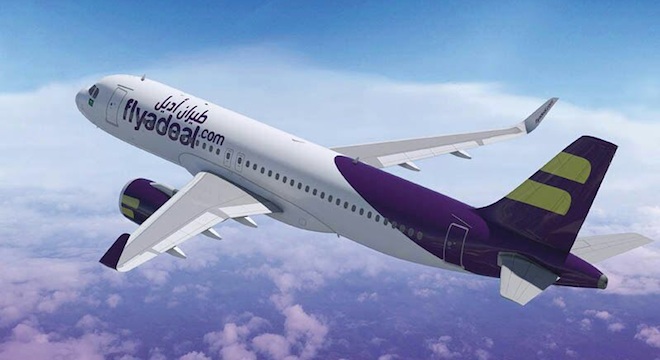
SAUDI ARABIA: Flyadeal Acquires Air Operator Certificate To Operate Domestic And International Flights.

Flyadeal, the newly established low fare airline in Saudi Arabia, is set to commence operations next week, on September 23, marking Saudi National Day.

The General Authority of Civil Aviation (GACA) on Wednesday issued the new carrier its Air Operator Certificate (AOC) at a ceremony held at GACA headquarters in Riyadh.

The ceremony was attended by Eng. Saleh Bin Nasser Al-Jasser, chairman of flyadeal and director general of Saudi Arabian Airlines (Saudia) Corporation, and chairman of the Board of Directors of Saudia Dr. Ghassan bin Abdulrahman Al-Shebl.

By obtaining the Air Operator Certificate, Flyadeal Airlines is now qualified to operate regular domestic and international flights to and from Saudi Arabia's airports.

Flyadeal is a Saudi low-cost airline based at King Abdulaziz International Airport in Jeddah. It is owned by Saudi flag carrier Saudia.

The airline expects to launch operations in the Saudi Arabia's national day which is 23rd September, 2017 with flights to domestic destinations.

Saudia, the flag carrier of Saudi Arabia, announced the creation of Flyadeal on 17 April 2016.

The venture is part of Saudia Group's SV2020 Transformation Strategy, which aims to elevate the group's units into world-class organisations by 2020.

Flyadeal will cater to domestic travellers, Hajj and Umrah pilgrims, and the rising number of tourists to Saudi Arabia, among other groups.

Flyadeal will initially operate flights to major domestic destinations, including Riyadh and Dammam, before expanding to regional markets.

As of September 2017 Flyadeal fleet consist of 2 Airbus A320-200 with a capacity of 180 ecomomy passengers.

Flyadeal has ordered for 6 other aircrafts.


Tourism Observer

Sunday, 7 May 2017

SAUDI ARABIA: Saudi Arabian Airlines (SAUDIA) Sign Codeshare Agreement With China Southern Airlines

Saudi Arabian Airlines (SAUDIA) has announced a codeshare agreement with China Southern Airlines, enabling travellers to conveniently access additional domestic and international routes across both carriers’ portfolios.

Passengers flying to Guangzhou Baiyun International Airport with the Saudi carrier will be able to connect to further Chinese itineraries, such as Beijing, Shanghai and Wuhan.

Meanwhile, the guests of the Chinese airline will benefit from the access to SAUDIA’s network from the Chinese hub with the option of transiting through Dubai International.

The new partnership follows SAUDIA’s network expansion with two new destinations this year, Multan and Port Sudan, and demonstrates the carrier’s commitment to offer improved travel options and flexibility to its passengers.

Saudia Airlines has announced the expansion of its fleet with the addition of a new Boeing 787-9, the first of 15 jets awaiting delivery, bringing the current number of Boeing aircraft to seven.

Purchasing the state-of-the-art aircraft from major global producers is the carrier's strategy to constantly modernise its fleet, according to the requirements for different types and sizes of the aircraft, reflecting its operational strategies for domestic, regional and international flights.

Presently, the Saudi national airline boasts 129 jets, including the market's latest Boeing and Airbus wide-body aircraft.

airBaltic launched its direct route linking Riga and Aberdeen on May 02, offering convenient travel options for travellers from the UK and Baltic states.

The schedule will operate three times weekly on board a Boeing 737 aircraft.

Carol Benzie, managing director, Aberdeen International Airport, commented, "The route will provide Aberdeen holidaymakers with easy access to a number of increasingly popular destinations in the Baltic states, such as Tallinn, Palanga and Vilnius, which was one of the most requested destinations in a leisure survey we undertook with our local community in 2016."

Qatar Airways has been named the official airline partner of the Paris ePrix, an electric street race, as well as sponsor of the 2017 Qatar Airways Paris ePrix, which will take place in the French capital on May 20.

The carrier has also been named the official airline partner of the first-ever New York City ePrix taking place in Brooklyn on July 15 – 16.

Commenting on the partnership with Formula E, H.E. Akbar Al Baker, group chief executive, Qatar Airways, said, "We are very pleased to be able to support this environmentally-friendly sport that promotes the latest technological innovations in producing alternative energy solutions for electric cars.

Qatar Airways is committed to promoting the importance of sports in bringing people together through our many partnerships

On May 01, Oman Air celebrated its inaugural flight from Muscat International Airport to Manchester Airport.

The daily flight to Manchester, operated by an A330-200, represents the carrier’s third daily frequency to the UK and is expected to further boost the already strong political, economic and social links between the two countries.

Additionally, the direct flight will open up easy access to the carrier’s outstanding range of destinations from both Muscat and Manchester with over 27 locations having connectivity within three hours in both directions.

The launch of the new route is in response to significant customer demand and also demonstrates Oman Air’s commitment to continuing its ambitious and dynamic programme of fleet and network expansion.

Celebrating 10 years of services to Kerala, Etihad Airways has launched a fourth daily nonstop schedule from Abu Dhabi International Airport to Calicut International Airport, bringing the total number of weekly schedules to the state to 63.

The extra itinerary makes Kerala one of the carrier’s most frequent Indian destinations, where the airline flies to the gateways of Kochi, Kozhikode and Thiruvananthapuram, representing more than 30 percent of all Indian frequencies.

Neerja Bhatia, vice president, Indian subcontinent, Etihad Airways, commented, “With our multi-frequency scheduled flights to and from Kerala, Etihad Airways has demonstrated a commitment to this vibrant state by offering convenient global access and boosting the domestic tourism industry.”

Friday, 26 August 2016

SAUDI ARABIA: Saudi Arabian Airlines Acquires First A330-300 From Airbus

Saudi Arabian Airlines, the national carrier of Saudi Arabia, has taken delivery of its first A330-300 Regional, making it the launch customer for this new member of the versatile and successful A330 family.

The aircraft is the first of the 20 A330-300 Regional aircraft ordered at the 2015 Paris Airshow, and joins Saudi Arabian Airlines’ existing Airbus fleet of 12 A330-300s and 50 A320 Family aircraft. Specially optimized for regional and domestic operations, the A330-300 Regional will boost capacity on several of Saudi Arabian Airlines’ most in-demand routes, enabling the airline to generate additional efficiencies while offering its passengers an unprecedented comfort level. The A330-300 Regional also represents the lowest-cost alternative and easiest fleet addition due to its high commonality with the A330s already operated by Saudi Arabian Airlines.

Saleh bin Nasser Al-Jasser Director General Saudi Arabian Airlines, said: “We are excited to welcome the first A330-300 Regional to our fast expanding Airbus fleet. It is a step forward in recognising our commitment to a family of aircraft which has contributed immensely to our market growth. The advantage of operating the new regional version of such a popular aircraft with proven operational flexibility and lowest cost per seat means unbeatable economics for our business and our customers.”

Saudi Arabian Airlines will lease the A330-300 Regional fleet from the International Air Finance Corporation (IAFC), a leading lessor in the Middle East.

Moulay Omar Alaoui, President and Chief Executive Officer of IAFC, said: “IAFC has always been a pioneer in introducing innovative Islamic financing solutions to the aviation industry, positioning itself as a strategic partner with unique products and services. We are proud to partner with Saudi Arabian Airlines and Airbus and are confident that this deal will further reinforce the leading position of Saudi’s national airline.”

“We congratulate Saudi Arabian Airlines for becoming the launch customer and operator of the A330-300 Regional. We are convinced our most popular wide-body aircraft will play an instrumental role in supporting the regional network expansion of the airline.” said Fouad Attar, Managing Director of Airbus Middle East.

The A330-300 Regional is optimized for missions up to 2,700 nm (5-hour flight) covering short to medium haul routes and offers significant cost savings through a reduced operational weight of around 200 tons. The reduction in fuel burn per seat and maintenance costs will result in an overall cost reduction of around 20% compared with today’s long-range A330-300.

Thursday, 12 May 2016

SAUDI ARABIA: Saudia To Sell Bonds To Buy Planes

Saudi Arabia’s main airline said it’s planning to sell as much as SAR5 billion (US$1.3 billion) of Islamic bonds in the second quarter to refinance loans and buy planes, becoming the latest issuer in the kingdom to tap debt markets for cash amid an oil slump.

The carrier known as Saudia is in negotiations with local banks to oversee its first-ever bond offering, Saleh Al Jasser, the director general of Saudi Arabian Airlines, said in an interview at the Sakhir airbase during the Bahrain Airshow on Friday. The plans are part of a wider Islamic bond program the company will turn to “as and when needed” for funding, he said.

“We will be initiating a sukuk program for the purpose of refinancing some of our existing loans and also to help finance our growth plans, to finance the acquisition of fleet,” Al Jasser said.

Borrowers in the oil-exporting nation are turning to debt markets in greater numbers amid a slump in crude prices that is worsening the nation’s budget deficit. Saudia’s sale comes as the airline, which bought 50 Airbus Group SE planes at the Paris Airshow last summer, seeks to boost its fleet to 200 by 2020. The carrier is following Dubai-based Emirates airline and FlyDubai in issuing sukuk.

The airline will take delivery next week of three Boeing Co. 787-9 and one 777-300ER, which will be used for flights to Paris, Guangzhou, Casablanca and Dubai, in addition to domestic routes, Al Jasser said. Saudia will add domestic and regional flights this year and in 2017, after announcing the start of services to Algeria, Ankara in Turkey, Munich, Germany and the Maldives, he said.

Saudi Arabia plans to raise as much as 20 billion riyals at a debt auction next week to finance its budget deficit, two people familiar with the plan said this week, asking not to be identified because the information is private. The International Monetary Fund predicts the country’s fiscal shortfall will reach 14 percent of gross domestic product this year.

Wednesday, 27 April 2016

SAUDI ARABIA: Flynas Acquire Boeing vs Airbus By June

Saudi Arabia's Flynas will decide whether to order Boeing 737MAX or Airbus 320NEO planes before the start of the holy month of Ramadan in early June, the airline's chief executive said on Wednesday.

The low-cost carrier is considering an initial order of 60 planes, with the possibility of a further 40, as it seeks to replace its existing fleet and expand.

Flynas currently leases Airbus A320s so choosing Boeing would create complications such as retraining staff to work on the U.S. firm's aircraft, Paul Byrne told reporters on the sidelines of an industry event in Dubai.

"To switch ourselves, they (Boeing) have to do a phenomenal deal for us. That deal will have to cover that pain of transition, as it will be painful," said Byrne.

"We are open to that argument, we see them as a player and what we want is something that will see the long-term future of Flynas. That door is wide open to both."

Ultimately, with Flynas in the process of phasing out its leased Airbus fleet, whichever manufacturer it chooses will over time become the sole supplier.

Byrne was quoted earlier this year as saying the airline was also considering Bombardier for the potential order.

However, on Wednesday, he said it had decided against the Canadian manufacturer as its new CS300 aircraft had not been flown by a Middle Eastern carrier in the region's harsh climate.

Flynas, which turned a profit for the first time in 2015, was expected to do so again this year, Byrne said.

But while he welcomed increased competition in the regional airlines industry, he said the firm was feeling its impact.

"The optimism of 4-5 months ago has dampened down as we're seeing a lot of extra capacity in the market, a lot of state carriers flexing their muscles and dumping capacity with no real plan," said Byrne.

Competition is expected to increase as Saudi Arabian Airlines launches its new low-cost carrier, Flyadeal. Beginning services in mid-2017, it could have up to 50 planes flying by 2020, a senior executive said on Monday.

Flynas, 65-70 per cent of whose flights are domestic, also faces caps on fares imposed by the Saudi government. These would remain in place for at least the next five years, Byrne said, although the limits would be eased on an annual basis.

He argued these charges were unfair on Flynas as, unlike flag-carrier Saudi Arabian Airlines, it was not subsidised by the state.

Monday, 18 April 2016

SAUDI ARABIA; Saudia Unveils New Low Cost Airline

Saudi Arabian Airlines (Saudia), the kingdom's national carrier, has announced the launch of a new low cost service, said a report.

The new airline, which has been named Flyadeal, will serve both domestic and international routes, said an SPA report.

Headquarted in Jeddah, the carrier is expected to begin domestic operations in mid-2017.

Flydeal will operate as an independent entity from Saudia and is part of the kingdom’s plan to boost its air transport infrastructure, a report in Gulf Business. said.

“The airline is focused on delivering value for money to cost-conscious customers. It will be a single-class low fare carrier which means we are focused on getting people from A to B for a fair price, Saudia director-general Saleh bin Nasser Al Jasser confirmed on twitter.

Friday, 12 February 2016

SAUDI ARABIA: Saudia Launches Planes Painted With Tourism Signs

Saudi Arabian Airlines (Saudia) has painted four of its planes with images of the kingdom’s landmarks in a bid to promote tourism.

The images include the Grand Mosque and were commissioned by the Saudi Commission for National Heritage.

The planes were launched on National Day at the King Abdulaziz International Airport on Tuesday and include a Boeing 300ER-777, an Airbus 320, an Embraer 170 and an Airbus 300-330.

SAUDI ARABIA: Saudi Arabian Airlines Takes Delivery Of 50 Aircraft From Airbus

Saudi Arabian Airlines will take delivery of 50 aircraft from Airbus in the largest aviation deal to be secured via Islamic financing, as the European planemaker tries to gain an edge over rival Boeing in the key Gulf aviation market.

Airbus announced the deal at the Paris Airshow, which includes 30 A320neo planes and 20 A330-300 Regional aircraft worth around $8.2 billion based on list prices.

Dubai-based International Airfinance Corporation (IAFC), an Airbus-backed sharia-compliant aircraft leasing fund, will buy the aircraft and lease them to Saudi Arabian Airlines, it said in a statement.

The national carrier of Saudi Arabia is the launch customer for the A330-300 Regional, a version optimized for domestic and short regional flights which is seen as crucial for overcrowded domestic routes in Asian markets.

The A330 Regional is physically identical to the main model but has a specially adapted engine maintenance package and a restricted maximum take-off weight that allows Airbus to offer increased discounts in an effort to boost sales volumes.

The deal dwarfs previous aviation transactions that have relied on Islamic financing, while the format is increasingly popular with carriers ranging from Indonesia to Ethiopia.

IAFC, which exclusively finances Airbus aircraft for clients in the Middle East, Asia and Africa, was launched in June last year with seed capital from Airbus and the Jeddah-based Islamic Development Bank.

The fund appointed Dubai-based Palma Capital and Quantum Investment Bank as arrangers to complete the deal, which consists of both equity and debt financing.

The aircraft will join Saudi Arabian Airlines' existing Airbus fleet of 12 A330-300s and 50 A320-family planes.

SAUDI ARABIA:Aviation Industry Very Competetive

SaudiGulf Airlines was doing more than just showing off its new Airbus A320 aircraft at the Bahrain International Airshow. The new carrier’s presence was the surest sign yet that Saudi Arabia’s domestic aviation market is finally about to take off.

The privately-owned airline and soon-to-be rival Al Maha Airways, a subsidiary of Qatar Airways, have been awaiting final approval and their operating licences from the kingdom’s regulator, General Authority of Civil Aviation (GACA) under a historic decision to open up the domestic market. After several delays, both airlines are expected to launch imminently.

“We’re in the final stages of obtaining our AOC,air operator’s certificate. We provided our main submission of the manuals and all of the systems last year,” SaudiGulf president Samer Majali said, on the sidelines of the airshow at Sakhir Airbase.

“Part of the delay was waiting for the airplane. We got it a month ago. At the beginning of February, we’ll start doing the emergency evacuation simulations and we’ll do the route-proving flights under the supervision of the civil aviation. Hopefully we will finish some time at the end of February-early March, and they will give us the licence.

“We will then commence some soft operations and hopefully we should start commercial operations anywhere between April and June.”

The former head of Bahrain’s state-backed Gulf Air and Royal Jordanian Airlines also blames some of the delay in launching the “boutique airline” — owned by Dammam-based Abdulhadi Al Qahtani Group — on the kingdom’s thorough regulations, which are being implemented for the first time.
“This is the first time that an airline has started up in Saudi Arabia and had to go through the entire certification process. We went through the whole certification and it’s a learning process for all of us,” Majali says.

Saudi Arabia has had one of the most highly regulated aviation markets in the world and limited foreign involvement. But rising population and affluence has led to a demand for more services. GACA expects annual passenger traffic to soar from 65 million in 2012 to 100 million by 2020, including almost a doubling of domestic traffic to 28.5 million.

It agreed in 2013 to allow two foreign airlines to operate domestic services only, while it is also part-way through privatizing state-owned Saudi Arabian Airlines (Saudia).

In another sign of the newcomers’ imminent launch, Al Maha Airways livery also has been added to four planes still being operated by Qatar Airways and staff for the new airline are being trained.

While the regulators have borne much of the blame for delays in the launch of the two new carriers, according to local media, Majali says his Eastern Province-based airline also had been waiting to make an impact by launching with its own aircraft.

“The biggest delay was due to us requiring new airplanes because normally a start-up carrier uses old airplanes by dry leasing and starts up within three to six months, and that’s it. We wanted to make an impression within Saudi with a very high quality carrier, full service, and the whole shebang.

We bought new airplanes from Airbus according to our specifications for the inside, and that normally takes 18 months. That was the major part of the delay,” Majali says.

Curiously, he adds that the carrier has only taken delivery of one of its four aircraft for licensing purposes, with the other three remaining at Airbus’ headquarters in Toulouse, France, “because of the weather”.

“This is the only one required for the AOC process. Once we finish the AOC process, the other three will come,” Majali says.

Initially, the airline plans to launch four routes: Dammam-Riyadh, Dammam-Jeddah, Riyadh-Jeddah, and Dammam-Dubai, with domestic flights offering first class and economy fares, and international flights providing business class and economy class service.

“Then in 2017, which will be our main expansion year, we will increase within Saudi Arabia itself and we will increase within the region,” he says.

The expansion will be fuelled by the 16 Bombardier CS300 jets on order, at a cost of $2bn with an option for a further ten, which Majali says will be delivered in 2017-18.

“It’s an airplane very similar to the A320, slightly smaller — probably ten seats less — but it’s a small, narrow body,” he says.

As a ‘boutique airline’, SaudiGulf will target the luxury market. While there are no plans to explore the business class-only configuration that has previously been unsuccessfully trialled in the kingdom, the model is definitely high specification, and will target the top end of the market.

However, Majali says he will be partly hamstrung by the kingdom’s fare cap.

“With the pricing, we are limited to an extent by the current fare cap and the modifications of the fare cap within Saudi Arabia, but obviously we have flexibility with first class and other things,” Majali says.

“But definitely the market in Saudi Arabia is opening up — you now have three airlines, and another one is coming up. Once you open up the market, there is no reason to have a fare cap any more. Hopefully, in the future, you will pay for the services that you get.”
Majali, who left Gulf Air in 2012, says starting the project from scratch allowed the carrier to order the aircraft to its own specifications and introduce the company ethos from the outset.

“Our advantage is that we’re started from the ground up, and so we can build it right from the start. There’s no excess baggage. Obviously a start-up also has lots of challenges but the upside is that as a start-up carrier we can build systems and procedures, employee attitudes and service right from the start,” he says.

Once the initial 20 aircraft are in operation, Majali says the airline will start thinking about expansion, including looking at a possible large, narrow body aircraft capable of serving longer-range markets.

“The plan in five years is to be a major player within the Saudi Arabian market domestically, and we expect to be a very strong regional player,” he says. “We’ll start thinking of expanding after that. But initially, with the 20 airplanes, we will doing Saudi Arabia domestic, we will be doing regional and a bit more beyond that — India, Pakistan, probably Turkey, Egypt, all destinations within a four or five-hour flying radius from Dammam.”

Al Maha Airways, which had also planned to commence operations in 2015 but was also held up by licensing issues, will initially operate routes to main cities in the kingdom, starting with flights between its hub in Riyadh and the west coast city of Jeddah, before moving to second-tier cities. The airline has already taken delivery of four A320, with plans to add another six by the time it starts operations.

According to reports, the carrier will add a further ten to 15 each year until it reaches a total 50 narrow and widebody aircraft.

When they are up and flying, both of the new airlines will face fierce competition from Saudia and Riyadh-based Flynas, the kingdom’s only low-cost airline, which is owned by National Airline Services Holding (63 percent) and HRH Prince Alwaleed Bin Talal Al Saud’s Kingdom Holding.
Flynas CEO Paul Byrne has helped turn around the airline and is expected to report its first ever profit since launching in 2007 when its latest figures are released within months.

“The advantage for me was that when I came to Flynas I went in as a consultant, so I could see from the outside what was working and what wasn’t. Long haul wasn’t. One of the things we were fantastic at was getting an A320 from point to point on time,” he says.

“You start with a strength like that and build upon it. It’s not rocket science, we know what we do well, we know what people want, and we improved pretty dramatically on what they didn’t want. It was costing us a lot of money in 2014, and we took that particular cost out of the system and we’ve increased our A320 flying.”

The airline has plans to expand from 26 Airbus aircraft and to replace its all-leased fleet with up to 100 new aircraft over the next five years.
Byrne, who entered the aviation industry with Ireland’s Aer Lingus and has worked all over the world, says 70 percent of Flynas’ flights are in the kingdom’s domestic market.

“There’s still plenty of room in there for more flying and that’s where we’re concentrating most of our effort,” he says.
Byrne admits that despite there being only two operators in the country, the Saudi market remains “very tough”.

“Look at how long it has taken for any competition to actually get in there. Before us, you had a low-cost carrier called Sama that didn’t survive the rigours of trying to set themselves up. Nasair the airline’s former name and Flynas as it is, just barely stayed through that whole set-up period, but now we’ve established ourselves it’s still tough to make money,” he says.

Flynas’ potential profitability also has been limited by the kingdom’s fare cap.

“We’re being restricted on what we can charge on a day-to-day basis on our flights. We don’t receive a subsidy on our fuel, the same way as Saudia. If you want to subsidise an airline and then fare-cap them, I’ve no problem with that, but we get fare-capped as well, and don’t receive a subsidy. I don’t know where this equation came from,” he says. “But within ten days of departure, I can increase my prices by up to 80 percent.

“That said, I think GACA are expanding their thinking. They are no longer the political wing of Saudia, so they’re starting to become more and more of a regulator. I think they’re recognising that the kingdom needs to be served better by efficient airlines. We’re one of them. We’re hoping to see more people come in because competition is good; it will be good for us.”

That seems to be the common thinking in Saudi aviation circles — that once more operators come into the market, the regulators will be forced to loosen up and create a more business-friendly attitude.

“There was a heavy hand in the past. It was there for protectionist reasons,” Byrne says. “That is changing, but these attitudes never change overnight, so even though the senior people are changing their thinking, and are focussing on the industry by breaking things up, it’s a big organisation and that has to filter down. It has had 70 years of doing something one way.”

So when SaudiGulf Airlines and Al Maha Airways eventually launch, it will represent the start of not only new services, but a new era in Saudi aviation.

Regeneration of Bahrain’s aviation sector
A generation ago, Bahrain was a key hub in the Middle East, attracting the likes of global logistics company DHL to open its regional base there. For various reasons, the island kingdom’s infrastructure and airline service fell behind its GCC neighbours. But both are being addressed, according to the kingdom’s Ministry of Transport and Telecommunications.

The country’s recent airshow was used to relaunch what has been described by many as a new era for aviation in Bahrain.

The modernisation of the airport, described by the minister as “one of the most important strategic projects for the Kingdom of Bahrain”, will see a $1.1bn new terminal built over the next three years, by which stage national carrier Gulf Air will have taken delivery of the first of its new Airbus A320/A321s and Boeing Dreamliner 787-9s.

While the airline has not yet decided how to deploy the 29 aircraft that make up a $7.6bn order, Acting CEO Maher Salman Al Musallam says the aircraft will enhance the carrier’s offering and create opportunities to expand through the acquisition of longer range aircraft.

Reclaiming home ground
Kuwait Airways is looking to reenergise its operations, with significant additions to its fleet expected in the coming years, including ten Boeing 777-300ERs and 25 Airbus aircraft.

The national carrier’s appearance at the recent Bahrain International Airshow was its first representation at such an event in a generation. Arriving with its new A330, it was a sign the carrier is finally getting its act together.

“In Kuwait, the opportunity that we clearly have and not fully exploited is the fact that we have one of the largest home markets in the area,” says Kuwait Airways chief commercial officer Philip Saunders, speaking at the Bahrain Airshow.

“The truth is that many of our natural customers have preferred to travel with Qatar Airways, or Air Arabia, or many other carriers in the region, but that’s already beginning to change, because we’re putting the right schedules in place; we’re putting our market first.

“We have announced major investments in our fleet and also in our products. From this November, when we receive our Boeing 777, our customers will be in for a surprise, because we will have suites in first class and lie-flat beds in business class, and wonderful product in economy. We’re excited and confident about the future.”

Saunders says Kuwait Airways aims to recover its position as the carrier of first choice in its home market, supported by sixth freedom traffic.

Wednesday, 23 December 2015

MALAYSIA: Sharia Airline, Rayani Air Takes Off With A Prayer

Rayani Air flight crew checks the luggage compartment before departure at the Sultan Ismail Petra Airport in Kelantan, Malaysia. Malaysia’s Rayani Air took to the skies over the weekend with a clear bailiwick. It is the country’s first Islamic airline, offering flights that adhere to Islamic rules including prayers, no-alcohol, no-pork meals, and a strict dress code for Muslim female flight attendants.

The short domestic flight from Kuala Lumpur, Malaysia’s biggest city, begins with a recital of Prophet Muhammad’s supplication before his travel. The passengers — most of them Muslims — cup their hands, as a crew member murmurs a short prayer over the loudspeaker just before takeoff.

Malaysia’s Rayani Air took to the skies over the weekend with a clear bailiwick. It is the country’s first Islamic airline, offering flights that adhere to Islamic rules, including prayers, no serving of alcohol or meals with pork, and a strict dress code for Muslim female flight attendants.

The idea for Rayani Air grew out of much-publicized complaints by conservative Muslims who believed that two major air disasters for the national Malaysia Airlines — Flight 370 that went missing in March 2014 and Flight 17 downed a few months later over Ukraine — were caused by Allah’s wrath. Their solution: Airlines must adopt strict Islamic customs to avoid divine retribution.

The reaction to the disasters, and the creation of the airline that operated its inaugural flight on Sunday, is an example of rising hard-line Islamic values in Malaysia, where Muslims account for about 60 percent of the country’s 30 million people.

“We are answering the call of many Malaysians who wanted an Islamic airline,” Rayani’s managing director, Jaafar Zamhari, said. “We are not talking about being a holy airline or flying to holy destinations. We just want to provide an alternative to travelers, but we are open to all races and religions.”

Ironically, the people who answered the call of conservative Islam and started Rayani Air are Hindus, perhaps an indication that a business opportunity knows no religious boundary. The founders of the airline, which currently flies to three domestic destinations using two Boeing 737s, are Ravi Alagendrran and his wife, Karthiyani Govindan. They used parts of their first names for the airline’s name.

Alagendrran or his wife couldn’t be immediately reached for comments, but in remarks to local media, he had said that “anyone wishing to travel in a modest and alcohol-free environment will feel right at home.”

On a 55-minute flight Tuesday (delayed by two hours) from Kuala Lumpur to the northeastern city of Kota Baru, more than 100 passengers were greeted by Muslim female flight attendants wearing black headscarves, long pants and lime-green jackets. A prayer was recited before takeoff and passengers were served halal food, where animals are slaughtered according to Islamic procedures.

At least one passenger said she chose the airline because of its Islamic credentials.

“It’s quite important for me because first of all, I am a Muslim, and second, Malaysia is an Islamic country,” said Che Masnita Atikah, a 23-year-old student. “It’s quite important to have this kind of airline to represent Malaysia and its image as an Islamic country.”

Rayani Air is the fourth Islamic airline in the world after Royal Brunei Airlines, Saudi Arabian Airlines and Iran Air.

Jaafar said that male and female passengers are not segregated, and that there is no dress code for travelers.

“Even if they come in shorts, they are most welcome,” he said. “We respect the differences among us.”

MALAYSIA: Malaysian Airline Imposes Islamic Law


Strict adherence to the tenets of Islamic law guide newly launched Asian airline.

A new strictly-Shari'a enforcing airline coined Rayani Air launched operations Sunday in Malaysia, with an inaugural domestic flight from capital Kuala Lampur to popular holiday destination Langkawi.

In accordance with Shari'a law, the airline imposes a strict adherence to the tenets of Islamic law. Management prohibits alcohol consumption on board, serves food which is strictly halal, sounds Muslim prayers before take-off, and imposes a modest dress-code where Muslim-women employees must wear a hijab.

Rayani Air's Managing Director, Jaafar Zamhari, told Malaysian news-station Astro Awani on Friday, "It is compulsory for our Muslim women cabin crew to wear hijab and for non-Muslim's to wear a decent uniform."

"We also recite doa (prayers) before the departure of each flight, we have a 'no-alcohol' policy, and we provide food and beverages that are halal," he confirmed.

The airline's routes are currently domestic, with an eye geared towards international expansion - particularly into the Middle East, where it aims to service pilgrims of the Umrah and Hajj.

With a fleet of two Boeing aircraft currently in its rotation, Rayani Air is the latest - yet not the first - airline to operate under the influence of the Shari'a.

It joins the ranks of Royal Brunei Airlines, Saudi Arabian Airlines, and Iran Air. And more are aspiring to join the newly-created "Shari'a airline" niche in the not-yet inundated international market.

The impending rise of Firnas Airlines, a UK startup airline which was raising a capital of $50 million "through sharia-compliant means to fund its plans, with possible financiers in Iran, the United Arab Emirates and U.K."

The airline would target London-based Muslims through its Shari'a-based offerings; It would be free of alcohol, serve strictly halal meat, use interest-free finance and offer a "a more upscale cabin product than available to many Islamic destinations" at a budget-friendly price.

Set to launch in 2016, Firnas will service South Asia initially, before expanding into the Middle East.

Friday, 4 December 2015

SAUDI ARABIA: Saudi Arabian Airlines To Continue Running Flights To Egypt

Saudi King Salman bin Abdulaziz al-Saud has directed Saudi Arabian Airlines to continue running flights to Sharm el-Sheikh from Riyadh and Jeddah, in support of Egyptian tourism.

King Salman also stressed “full confidence” in Egyptian security, the army and the government to protect the security and stability of their country under the leadership of President Abdel Fattah el-Sisi.

Sisi on Wednesday promised a transparent probe and cautioned against hasty conclusions over what brought down the Metrojet Airbus A321 over Egypt's Sinai peninsula on October 31, killing all 224 people on board.

ISIS’ Sinai branch claimed responsibility, but has not explained how it carried out the attack.

Britain suspended flights to Sharm el-Sheikh after saying it feared a bomb caused the disaster and voicing concerns over airport security at the Red Sea resort.

Russia also halted all fights to Egypt.

Egypt's tourism industry, vital to its economy, has already suffered from years of political instability and attacks claimed by militants.

Saturday, 5 September 2015

MOROCCO: Casablanca Airport To Break 8m For The First Time In 2015

On 26 July last year, Royal Air Maroc started a new route from Casablanca to Montpellier in France. Unsurprisingly, the Moroccan flag carrier is largest airline at the nation’s biggest airport, commanding two in every three seats.

Casablanca Mohammed V International Airport is Morocco’s largest airport, serving the largest city (the political capital is Rabat) located in west of the country on the Atlantic Ocean coast. Looking at OAG Schedules Analyser data for week commencing 6 April, the airport has a network of 97 destinations served by 23 airlines. These destinations are spread across Africa (47), Europe (41), Middle East (6), North America (2) and South America (1).

The airport is nearly twice as big as the number two airport – Marrakech, which handled just over four million passengers in 2014. Indeed, at a combined annual traffic of 8.99m passengers in 2014, the eight next biggest airports in Morocco are only just able to mass together enough throughput to beat the eight million annual passengers using Casablanca. Although too early to dictate a trend for 2015, the airport’s traffic was down 1.4% in January and 0.2% in February, against a national average (the biggest eight airports again) of a marginal 1.1% growth.
SVID says ‘Good’ for Casablanca

Entering Casablanca’s monthly passenger data for 2014 into anna.aero’s Seasonal Variation in Demand (SVID) calculator, the airport performs well, generating a score of 2.46 ‒ a ‘good’ rating. The airport’s seasonality performance has improved marginally when compared to the result achieved in 2013, when it attained a score of 2.54, however both years are down on the 2012 result of 1.60 – which was an ‘excellent’ score. That said, in that year, the airport was almost one million annual passengers smaller (7.19 million) than it was at the end of 2014.

Evaluating Casablanca alongside the most significant competing Moroccan airports, our data elves also ran SVID calculations on Marrakech (1.63 – ‘excellent’) and Agadir, which also generated an ‘excellent’ result (1.31). While Casablanca’s busiest month is August and its lowest is February, and Agadir is not dissimilar (August and December), Marrakech has very different traffic profile, with April being its busiest month and July was its quietest in 2014. The seasonal lows for the three airports represent 58% (CMN), 67% (RAK) and 67% (AGA) of their respective seasonal highs.

Paris links are paramount
When comparing total seats being offered across all 97 city pairs in the week commencing 6 April to the same seven days in April 2014, there is a 6.1% increase year-on-year. The top two airports have gone unchanged, however with a 1.4% reduction since last April, Paris Orly’s dominance over the other airport across town has been reduced, a position also compounded by Paris CDG’s 17% annual increase. The biggest growth has been reserved for Dubai however, on which Emirates has added 75% more seats in April 2015. The top 12 offers just two domestic routes (highlighted in bright green) to Agadir and Marrakech.

The airport’s top 12 routes have marginally increased their share of total weekly seat capacity since last April, rising from 41.4% to 42.3%. Rome Fiumicino has fallen out of the top dozen airports ranking, replaced by Dakar. Over the last 12 months, Casablanca has gained a net of three new non-stop routes, having added eight destinations (Lagos, Accra, N’Djamena, Beni Mellal, Naples, Abuja, Errachidia and Zagora), but with five airport pairs being terminated (Turin, Benghazi, Tetouan, Paris Beauvais and Tan Tan).

RAM ramps up weekly capacity
While far from being a dominant position, the top 12 offers five European airlines (highlighted in bright green), with the remaining airlines being made up from Morocco (two), Middle East (three) and Africa (two). Royal Air Maroc currently controls 65% of weekly seats in Casablanca, a figure that has gone unchanged in the last 12 months, despite it increasing by 7%. While Iberia and Tunisair are new to the top 12 in April 2015, this is to the detriment of Alitalia and Etihad Airways, both of which have been ousted. These airlines have not posted the biggest annual growth however, as this was again achieved by Emirates (+75%), seeing the MEB3 carrier jump from sixth to third in the past 12 months. Air France has reduced its capacity by the most, dropping its weekly seats by 778, or 19%, just beating easyJet, which was down by 18% year-on-year. Conspicuous by its absence at Casablanca is Ryanair, which flies to plenty of other Moroccan airports ‒ Rabat, Nador, Essaouira, Oujda, Fez, Marrakech, Agadir and Tangier. Clearly the gates to Casablanca have remained firmly bolted against the Irish ULCC’s entry.

Over the last 12 months, the airport has not lost any serving carriers. That said, it has not added any either, as the same 23 airlines continue to operate from Casablanca. However, this number will be expanded by at least one during 2015, as transavia.com France plans to start operations from Paris Orly in July, according to anna.aero’s New Route Database. In addition to this new route, Air Arabia Maroc plans to launch services to Naples, with Royal Air Maroc to start operations to Abuja, both on 29 March. The Moroccan flag carrier also intends to commence thrice-weekly flights to Beijing in June.

INDIA: AirAsia, Gulf Air, TruJet and Vistara Are Newest Carriers At Rajiv Gandhi Airport


According to AAI figures, in January of this year Hyderabad Rajiv Gandhi International Airport achieved a rolling 12-month passenger throughput of more than 10 million passengers for the first time in its history. This was followed in May by handling over one million passengers in a month for the first time. The airport ranks as India’s sixth busiest and serves the capital of the southern Indian state of Telangana.

The current facility was opened on a former greenfield site in March 2008, when passenger numbers were around the seven million mark. Initially passenger numbers fell as a result of the global economic crisis, but since then demand has rebounded well, and in the year ending 31 March 2015 the airline processed 10.4 million passengers, a 20% increase on the previous 12-month period. Latest AAI figures for June 2015 show that the airport has handled close to 11 million passengers in the last 12 months.

IndiGo is #1 carrier

The leading airline at the airport is IndiGo, with an estimated 40% of scheduled seat capacity spread across a network of 15 domestic destinations and one international (Dubai). This makes the carrier more than twice as big as its nearest rival, Air India. SpiceJet has fallen from second to third at the airport as a result of its network restructuring, while Jet Airways is fourth.

The leading foreign carrier at the airport is Emirates, followed by Etihad Airways, Saudi Arabian Airlines, Thai Airways and British Airways (shown in bright green). Four airlines have begun service from the airport in the last 12 months; AirAsia, Gulf Air (technically a resumption of services), TruJet and Vistara.


Delhi and Mumbai jostle for leading route status

Delhi and Mumbai are evenly matched as the airport’s two busiest routes, well ahead of third-ranked Bengaluru. There are only two international routes in the airport’s top 12, but one of them, Dubai, ranks as the airport’s fourth busiest route, served by Air India, Emirates, flydubai and IndiGo. Abu Dhabi in eighth place is served by Etihad Airways and Jet Airways. Other destinations served in the Middle East include Bahrain, Dammam, Doha, Jeddah, Kuwait, Muscat and Riyadh. Asian destinations with direct service include Bangkok (with Thai Airways), Hong Kong (with Cathay Pacific Airways), Kuala Lumpur (with AirAsia and Malaysia Airlines) and Singapore (with both SilkAir and Singapore Airlines). The only non-stop service to Europe is to London Heathrow with British Airways. There are currently no direct services to anywhere in China or the US.

TruJet is newest airline

On 12 July, Hyderabad welcomed its newest carrier, TruJet. The new, domestic carrier currently has a fleet of two ATR 72-500s and operates from Hyderabad to Aurangabad, Chennai, Tirupati and Rahajmundry, with services to Bengaluru expected to launch in mid-September.